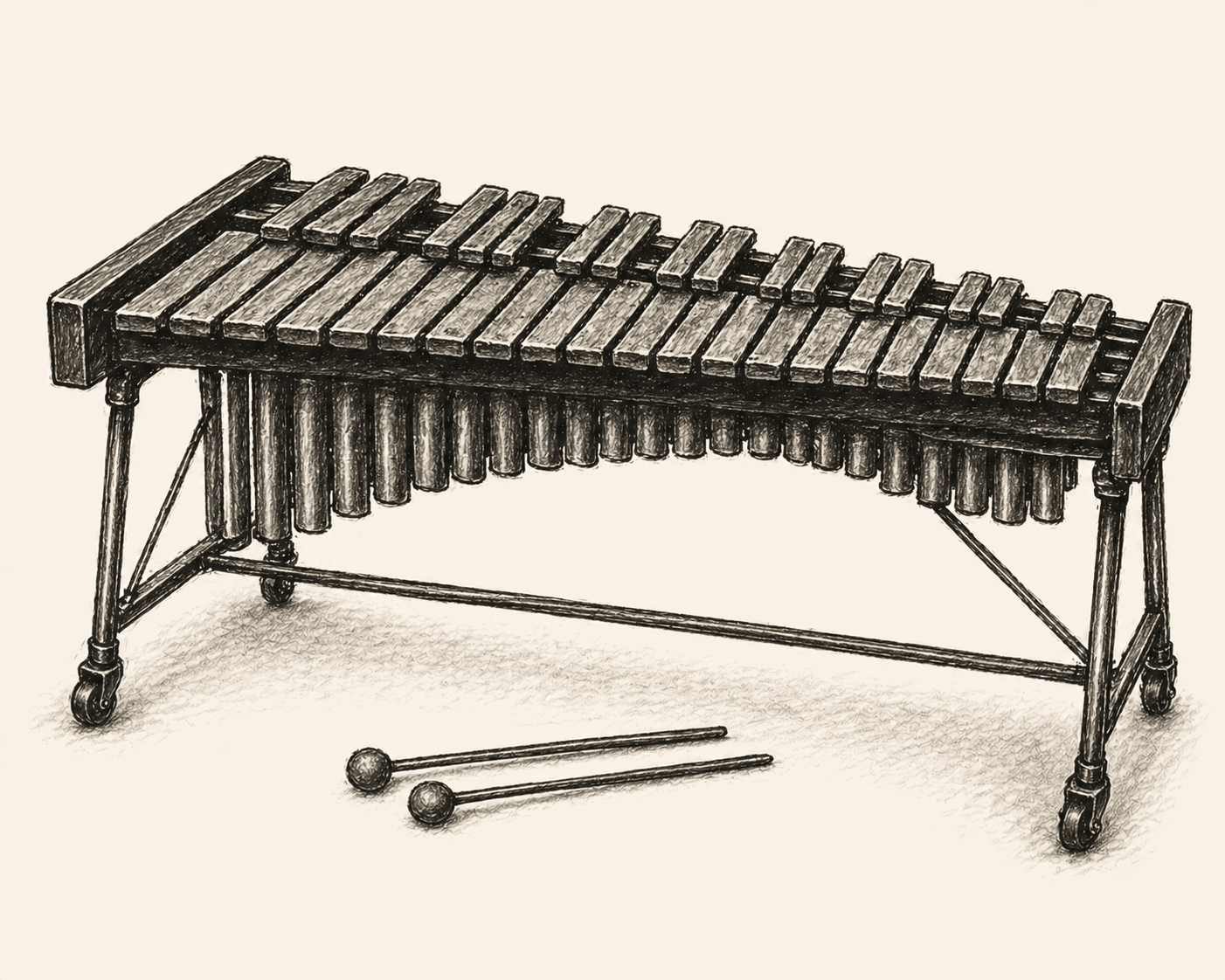
A keyboard of rosewood — each bar tuned, each resonator a length of air calculated to its pitch.
The xylophone is the simplest of the orchestra’s tuned percussion and, by some accounts, the oldest of all its instruments. A row of hardwood bars, graduated in length; a mallet of rubber or rosewood; below each bar a tuned tube of air. Strike, and the wood rings briefly, brightly, and is gone — the briefest articulation of pitch the ear can be given.
Its voice is dry. It does not sing; it does not sustain. What it offers instead is clarity and edge — the perfect consonant to the strings’ vowels. A line of xylophone over a string tutti will cut through, even played softly; doubled at speed it lends a glittering, almost metallic rim to the orchestra’s upper light.
Mechanism
The instrument is built as two ranks of tuned bars, set out in the manner of a piano keyboard — naturals nearer the player, sharps and flats slightly raised behind. Each bar is suspended at its two nodal points by cord, free to vibrate; beneath each hangs a metal resonator, a tube tuned to the bar above. The bars themselves are most often Honduran rosewood, ageing to a deep amber and prized for the woody warmth they retain even at the highest pitches.
Mallets of varying hardness change the instrument’s character completely. Hard rubber and plastic give the bright, glassy tone that most listeners recognise; medium rubber softens the attack; rosewood mallets, harder still, bring out a percussive knock — closer to the instrument’s African ancestors than to its concert form.
Voice and Character
Saint-Saëns, who first put the xylophone in an orchestral score, understood at once what it was for: bones. In Danse macabre the instrument rattles above the strings like a skeleton at midnight, and for a generation afterwards composers reached for it whenever the macabre, the mechanical, or the merely brittle was required.
That association has loosened in our time. Bartók wrote for it as a nocturnal, half-tonal instrument; Stravinsky used it for the puppet’s tantrum and the marketplace’s clatter; Shostakovich, for the brittle irony at the end of the symphonic argument. The xylophone is, in short, what a good composer asks of it. Its limits are real but its possibilities are wider than the literature first suggests.
“Wood that has learned to laugh — and, on the right night, to rattle the bones beneath the laughter.”
— a paraphrase, after the manner of Berlioz on the percussion
Used sparingly the xylophone is a punctuation mark. Used freely it becomes a voice. The line between the two is short, and it is yours alone to draw.
A keyboard of rosewood — each bar tuned, each resonator a length of air calculated to its pitch.
The xylophone is unsentimental. It rewards precision — of rhythm, of articulation, of register — and punishes the line that asks of it what it cannot give.
- i.Write at the sounding octave below. The instrument transposes up an octave. Notate as the player will read — treble clef, one octave below the pitch you wish to hear.
- ii.Do not ask for sustain. The bar rings briefly and dies. A long note is a roll — say so, with tr or trem, and accept the slight blur it brings.
- iii.Trust the rapid figure. Sixteenths and faster sit naturally under the mallets; a brilliant scalar passage will speak where the same line on flute would tire.
- iv.Choose the mallet, in the part. Hard for glassy brightness, medium for the working tone, soft for warmth at the foot of the compass. Mark it; the player will not guess.
- v.Mind the doubling. A xylophone alone is a bright knock; an octave below the piccolo it becomes a chime; doubled with strings at speed it is the rim of the entire texture.
Beyond these few rules the instrument repays imagination. Listen to Bartók, then listen to Saint-Saëns, and notice that the same row of bars sustains them both.
The full compass
F₄ to C₈ as written — three and a half octaves, sounding an octave higher.
The compass is short by the standards of keyboards but generous by the standards of percussion. Three regions of character repay study; a fourth, brief, lies above them.
Basso
The instrument’s warmest octave. Woody, faintly hollow, slow to project. Best as a single voice or in unison with low winds; rapid passagework here will be lost in any but the lightest accompaniment.
Medio
The working register. Direct, articulate, perfectly even from one bar to the next. Almost any orchestral doubling lives here, and almost any solo of consequence begins or ends in it.
Acuto
Glassy, brilliant, faintly metallic. The register of the great Saint-Saëns rattle and of much that has followed it. Cuts through any tutti; use sparingly, lest its sparkle become merely glare.
Sopracuto
The extreme upper bars. Thin, ledger-bound, and almost without body — but in an exposed line they pierce the orchestra cleanly. Reserve them for moments the piece has earned.
A keyboard of rosewood — each bar tuned, each resonator a length of air calculated to its pitch.
The xylophone is, at heart, an instrument of articulation. Its rosewood bars do not sustain, and the player who chooses it must accept — and exploit — the fact that every note is a brief, dry syllable. Within that restriction lies a vocabulary as varied as the mallets themselves, and a small body of extended effects that the modern repertoire has begun to claim.
Standard techniques
Hard rubber and hard plastic mallets are the orchestral default; wooden-headed mallets, harder still, give the brittle, almost skeletal sound that Saint-Saëns asked for in the Danse macabre and Shostakovich in his symphonies. Single strokes, alternated between the hands, are the fundamental articulation. The bars are too short to sustain, and so the roll — where one is wanted — is a rapid single-stroke alternation across a bar or between two, producing the shivering effect that is the closest the instrument has to a long note.
Two-mallet writing is the idiomatic core, with double stops in thirds, sixths, and octaves natural to the instrument. Four-mallet technique is current in solo and chamber writing — Stevens and Burton grips imported from the marimba — and a fluent player will manage chords and divided lines without trouble. The xylophone’s true glory, however, is its rapid, chattering articulation: scales, broken chords, and the kind of perpetual-motion writing that has carried it from the cabaret to the concert hall.
Extended techniques
Bowing the bars is possible but rare; the bars are short, and the bow must be drawn carefully across the edge to draw a sustained tone. The result is fragile and not always in tune, but the timbre — when it speaks — is unlike any other in the orchestra. Soft yarn mallets, struck on bars meant for hard plastic, yield a muted, wooden thud, almost without pitch — useful for colour rather than line.
The mallet shaft, struck against the side of a bar, gives a hard wooden click — a percussion effect of indeterminate pitch. Dead strokes, in which the mallet is pressed into the bar immediately after striking, damp the fundamental and leave only the attack: a dry, spoken articulation that has entered the contemporary literature. Each of these is a colour, not a line; write them as such.
The xylophone is at its best when its dryness is the point of the writing. Asked for warmth or sustain, it cannot give them; asked for rapid clarity, it has no equal in the orchestra.
A keyboard of rosewood — each bar tuned, each resonator a length of air calculated to its pitch.
A short, partial list — five places to begin if one wishes to know what the xylophone can do, and what composers from Saint-Saëns onwards have asked of it.
- № 01
Saint-Saëns — Danse macabre
Skeletons rattling
The xylophone’s arrival in the orchestra — a clatter of dry bones above the strings, dated 1874.
Listen on Spotify - № 02
Saint-Saëns — Le Carnaval des animaux
Fossiles
The same dance, repurposed. A self-quotation; the bones rattle on, now between piano and clarinet.
Listen on Spotify - № 03
Stravinsky — Petrushka
The puppet’s tantrum
Brittle, mechanical, and utterly without sentiment — the xylophone as the voice of a thing not quite alive.
Listen on Spotify - № 04
Bartók — Music for Strings, Percussion and Celesta
Third movement, opening
A solitary xylophone tattoo — the night sound that opens the slow movement, Bartók at his most nocturnal.
Listen on Spotify - № 05
Shostakovich — Symphony No. 5
Finale
Glittering doublings of the strings at speed — bright, sardonic, and impossible to overlook.
Listen on Spotify
Further entries will be added as our study deepens.
A keyboard of rosewood — each bar tuned, each resonator a length of air calculated to its pitch.
The xylophone is among the oldest of all the orchestra’s instruments, and very nearly the last to enter it. Its ancestors — rows of tuned wooden bars, sounded over gourd resonators — are documented in Southeast Asia by the ninth century and in West and Central Africa not long after. It is, in this older sense, an instrument of the village rather than the court.
The European arrival
The earliest European mention is in Arnolt Schlick’s Spiegel der Orgelmacher und Organisten of 1511, where it appears under the agreeable name hültze glechter — the wooden clatter. For three centuries thereafter it remained a folk instrument, especially in Poland and eastern Germany, where travelling players sounded its bars laid out across straw on a tabletop.
Saint-Saëns and the orchestra
The xylophone’s entry into the concert orchestra is a single famous event: Danse macabre, of 1874. Saint-Saëns wanted bones, and no other instrument would give them to him. The work made the xylophone briefly a novelty and lastingly a fixture; he reused the idea, and the same theme, in Le Carnaval des animaux nine years later.
The twentieth century
After Saint-Saëns the instrument spread quickly. Mahler reached for it in his later symphonies; Stravinsky placed it among the puppets and peasants of Petrushka and Les Noces; Bartók made it the night-voice of Music for Strings, Percussion and Celesta. By the middle of the century the xylophone had moved from the orchestra’s margins to its working second desk, and the literature for it had widened past the merely macabre.
The modern instrument
The orchestral xylophone of today, perfected in the workshops of Deagan in Chicago and refined since by makers across Europe and Japan, is the design that Bartók and Shostakovich knew: rosewood bars over tuned aluminium tubes, a frame on wheels, and a compass of three and a half to four octaves. Its ancestors in the Buganda court and the Sumatran longhouse would recognise it at a glance. So would its composers.
Specifications
A summary, for the composer’s desk.
- Family
- Percussion, tuned idiophone
- Italian
- Xilofono
- German
- Xylophon
- French
- Xylophone
- Range
- F₄ — C₈ written (sounds an octave higher)
- Transposition
- Sounds 8va above written; treble clef
- Compass
- Three and a half octaves (four on larger models)
- Bars
- Honduran rosewood, padouk, or synthetic kelon
- Resonators
- Tuned aluminium tubes beneath each bar
- Mallets
- Hard rubber, plastic, or rosewood
- Origin
- Africa and Southeast Asia, ancient; Europe by 1511