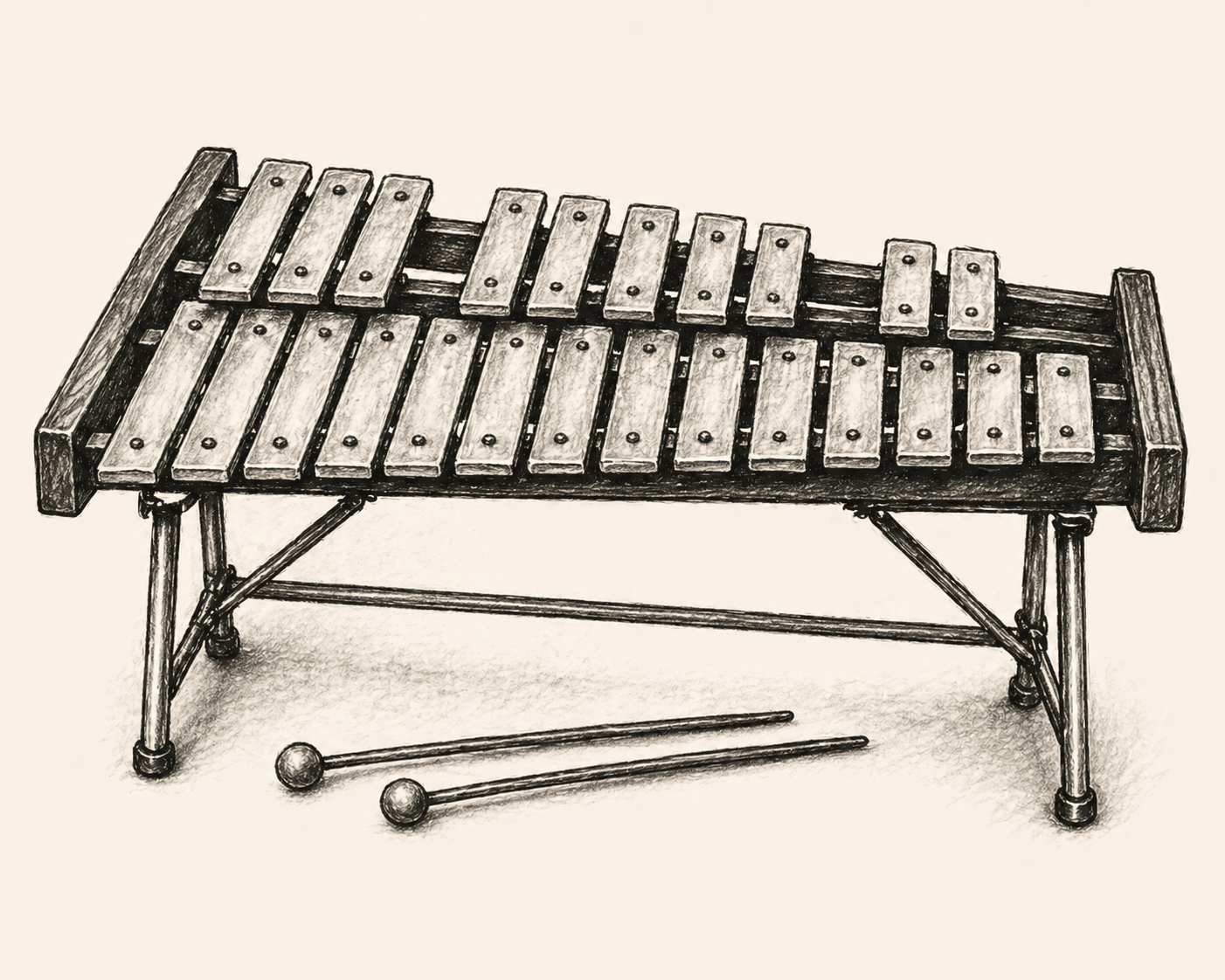
A chromatic ladder of tempered steel — two ranks, the naturals before the player, the accidentals raised behind.
The glockenspiel is the brightest voice the orchestra possesses. Its bars — small, narrow, of tempered steel — are arranged in two ranks like the keys of a piano, and struck with hard mallets of brass, plastic, or rubber. The result is a pure, untempered ring, two octaves higher than written, with a long, glassy decay that no other instrument can quite match.
It is a small instrument, in compass and in repertoire alike. Two and a half octaves are the working range; a single line, judiciously placed, the working idiom. To know the glockenspiel is to know not what it can play, but where it should be heard — the glint of light upon a wave, the chime above the chorus, the high bell at the moment a spell takes hold.
Mechanism
Each bar is a flat rectangle of tempered steel, suspended at its nodal points so that struck it can ring without dampening. The bars sit upon a frame — most often a small portable case for the orchestral instrument — with felt or cord beneath each, and a resonator may or may not lie below. The bars, unlike those of the xylophone or marimba, are not tuned to overtones; the result is a clear, almost unambiguous fundamental.
A second, older form survives — the keyboard glockenspiel, struck from below by hammers and laid out as a small piano. It is the instrument Mozart specified in Die Zauberflöte, and it is what most modern orchestras still use for that opera. Elsewhere, the mallet form has long since prevailed.
Voice and Character
The voice is bell-like, but a small bell — bright, untroubled by formant, with a long ringing decay. Hard mallets make it metallic and pointed; softer mallets, much rarer, soften it toward the celesta. The lowest octave is warmer and a little woollen; the topmost notes are pure glass, and will pierce any orchestration you place them in.
Because the decay is long, the instrument is forgiving of melodic writing but punishing of dense chords — successive strokes will smear into one another unless damped, and the glockenspiel has no damper pedal. Single lines, short ostinati, doublings of flute or celesta at the upper octave: these are the figures the instrument was made to play.
“A small handful of stars, scattered above the orchestra.”
— paraphrase of a familiar orchestration adage
Used too often, the glockenspiel cheapens; used at the right moment, it transforms. The composer’s task is, almost entirely, the second of these.
A chromatic ladder of tempered steel — two ranks, the naturals before the player, the accidentals raised behind.
The glockenspiel asks little of the player and much of the writer. A few habits, kept in mind, are nearly the whole of its craft.
- i.Notate two octaves below sounding. By long convention, the part is written in treble clef, two octaves lower than it sounds — partly to spare ledger lines, partly to spare the eye.
- ii.One line at a time. The long decay turns chords into haze. Reserve the instrument for melody, ostinato, or a single colouring stroke; let other voices carry harmony.
- iii.Mind the player’s reach. Two mallets only, in the orchestral idiom — four-mallet writing belongs to the soloist. Avoid leaps wider than a tenth in quick passages.
- iv.Choose the mallet. Brass for ceremonial brilliance; plastic or hard rubber for general use. Soft mallets are possible but unusual — and worth marking explicitly.
- v.Use sparingly. Few orchestral colours go stale faster. A single phrase, well placed, will outlast a whole movement of indiscriminate chiming.
Beyond these, listen to where the instrument has lived in the great scores — Mozart, Dukas, Respighi, Debussy — and learn its silences as carefully as its notes.
The full compass
G₃ to C₆ as written — sounding two octaves higher.
The compass extends from a written G₃ at the foot of the treble staff to a written C₆ at its summit — sounding, in each case, two octaves higher. Three regions repay study.
Grave
The lowest octave is warmer and slightly woollen — closer in spirit to a tubular bell than to the high glassy ring above. Less brilliant, but expressive when doubled with low celesta or harp.
Medio
The heart of the instrument. Clear, bell-like, of unmistakable focus. Most of the great solos and chimes live here — Mozart’s magic bells, Wagner’s apprentices, Respighi’s afternoon light.
Acuto
Pure glass. The notes will cut through any orchestration; use them at points of arrival, glints, or single doubling lines above the flute. Sustained passagework here grows wearying very quickly.
A chromatic ladder of tempered steel — two ranks, the naturals before the player, the accidentals raised behind.
The glockenspiel speaks in a single, silvery voice. It has neither the resonator system of the vibraphone nor the wooden warmth of the marimba; what it has is its bell-like attack — bright, piercing, and quick to die — and a small set of means by which the player shapes that attack. Its expressive vocabulary is narrower than its cousins’, but it is unmistakable, and a few touches of subtlety reward the careful writer.
Standard techniques
Almost everything written for the glockenspiel is played with two brass mallets, struck single — the sharp, ringing strokes that give the instrument its name. The bars are too short to sustain on their own, and so the roll, when it appears, is a single-stroke roll: a rapid alternation of hands across one bar or between two, producing a shimmering tremolo of pitch. Hard plastic or rubber mallets are sometimes used in the modern repertoire for a slightly less brilliant attack, though the brass head remains the orchestral default.
Two-mallet writing is the idiomatic norm; double stops in thirds, sixths, and octaves are entirely natural, and rapid scalar passages — Mozart’s magic bells, Dukas’s flickering halo — are among the instrument’s glories. Four-mallet passages do appear, but rarely, and require a player who has cultivated the skill. Light staccato, marked secco, will give the cleanest, bell-like ping. Dynamics are limited at the soft end — the bars do not whisper — but the upper end is always more present than the score suggests; mark cautiously.
Extended techniques
Bowing the bars with a contrabass bow, drawn slowly across the edge, draws from the glockenspiel a sustained tone of remarkable purity — a sound used to magical effect by Boulez and others, and unattainable by any conventional stroke. The bars must be bowed one at a time, and the line that results is necessarily slow; but the timbre is strange and lovely.
Soft yarn or cord mallets, struck on bars meant for brass, will produce a curiously muted, hollow tone — the bar still rings, but without the bright fundamental of a struck bell. Dampening with the fingers, immediately after the stroke, gives a dry secco of almost pizzicato character. A coin or a triangle beater drawn along the edge of a bar produces a faint metallic scrape, used sparingly in modernist scores. These effects, gathered, give the composer a quiet repertoire of alternatives to the bell-like default.
For so plain an instrument, the glockenspiel rewards restraint. Used sparingly, its single sound is unforgettable; used too often, it becomes a glitter without weight.
A chromatic ladder of tempered steel — two ranks, the naturals before the player, the accidentals raised behind.
A short, partial list — five places to begin if one wishes to know what the glockenspiel can do, and what it has been asked to do by composers who used it well.
- № 01
Mozart — Die Zauberflöte
Papageno’s magic bells, Act II
The first famous use of the instrument in opera — Papageno’s little carillon, set against pizzicato strings, conjuring its enchanted dance.
Listen on Spotify - № 02
Dukas — L’apprenti sorcier
Climax of the broom’s rebellion
A handful of bright bell-strokes seated above the orchestra — the broom is alive, and grinning.
Listen on Spotify - № 03
Wagner — Die Meistersinger
Dance of the Apprentices
Wagner asks for the glockenspiel’s clearest pealing — a faint chime above the bustle, like a steeple half a mile away.
Listen on Spotify - № 04
Respighi — Pini di Roma
I pini del Gianicolo
Glints of metal placed against muted strings and the recorded nightingale — the pine trees catching the last of the light.
Listen on Spotify - № 05
Debussy — La Mer
Jeux de vagues
Used as Debussy used colour itself — a flicker, then gone. The sea picking up sun.
Listen on Spotify
Further entries will be added as our study deepens.
A chromatic ladder of tempered steel — two ranks, the naturals before the player, the accidentals raised behind.
The glockenspiel descends, as its German name plainly says, from actual bells. Sets of small tuned bells — carillons in miniature — had been used in churches and at court since the late Middle Ages; by the seventeenth century these had begun to migrate into the orchestra, first as small fixed sets struck by hand, then as keyboard mechanisms.
The keyboard form
Mozart’s Die Zauberflöte, in 1791, asks for a Stahlspiel — a small keyboard instrument whose hammers struck steel bars from beneath. Papageno’s magic bells are its most famous use, and modern productions still favour the keyboard form for that single purpose. Outside opera, the keyboard glockenspiel saw limited orchestral use; the future lay with the bars themselves.
The mallet form
By the middle of the nineteenth century the bars had been liberated. A flat, portable instrument — bars laid out chromatically, struck by hand with mallets — became the standard of the orchestral percussion section, and remains so. Wagner used it for the dance of the apprentices in Meistersinger; French composers, from Dukas to Debussy, found in it a colour they used with characteristic restraint.
Cousins and confusions
The glockenspiel is cousin to the celesta, the xylophone, the marimba, and the vibraphone — all of them mallet instruments arranged as a keyboard. It differs from each in material and in decay: steel bars and no resonators, where the celesta has felt hammers and a soundboard, the xylophone wooden bars, the marimba wood with resonators, the vibraphone aluminium with motors. Composers who confuse the four will be politely corrected by their percussionists.
The modern instrument
The modern orchestral glockenspiel has changed little since the late nineteenth century. The bars are tempered steel, chromatic, usually two and a half octaves; the case is portable; the mallets are hard. It is, by any measure, a quietly settled craft — and one of the few percussion instruments whose part the audience nearly always remembers.
Specifications
A summary, for the composer’s desk.
- Family
- Percussion, tuned (idiophone)
- Italian
- Campanelli
- German
- Glockenspiel
- French
- Jeu de timbres / Carillon
- Range
- Written G₃ — C₆; sounds two octaves higher
- Transposition
- Sounds 2 octaves above written; treble clef
- Bars
- Tempered steel, chromatic, in two ranks
- Compass
- Two and a half to three octaves
- Mallets
- Brass, plastic, or hard rubber
- Origin
- Germany, 17th century — “the play of bells”