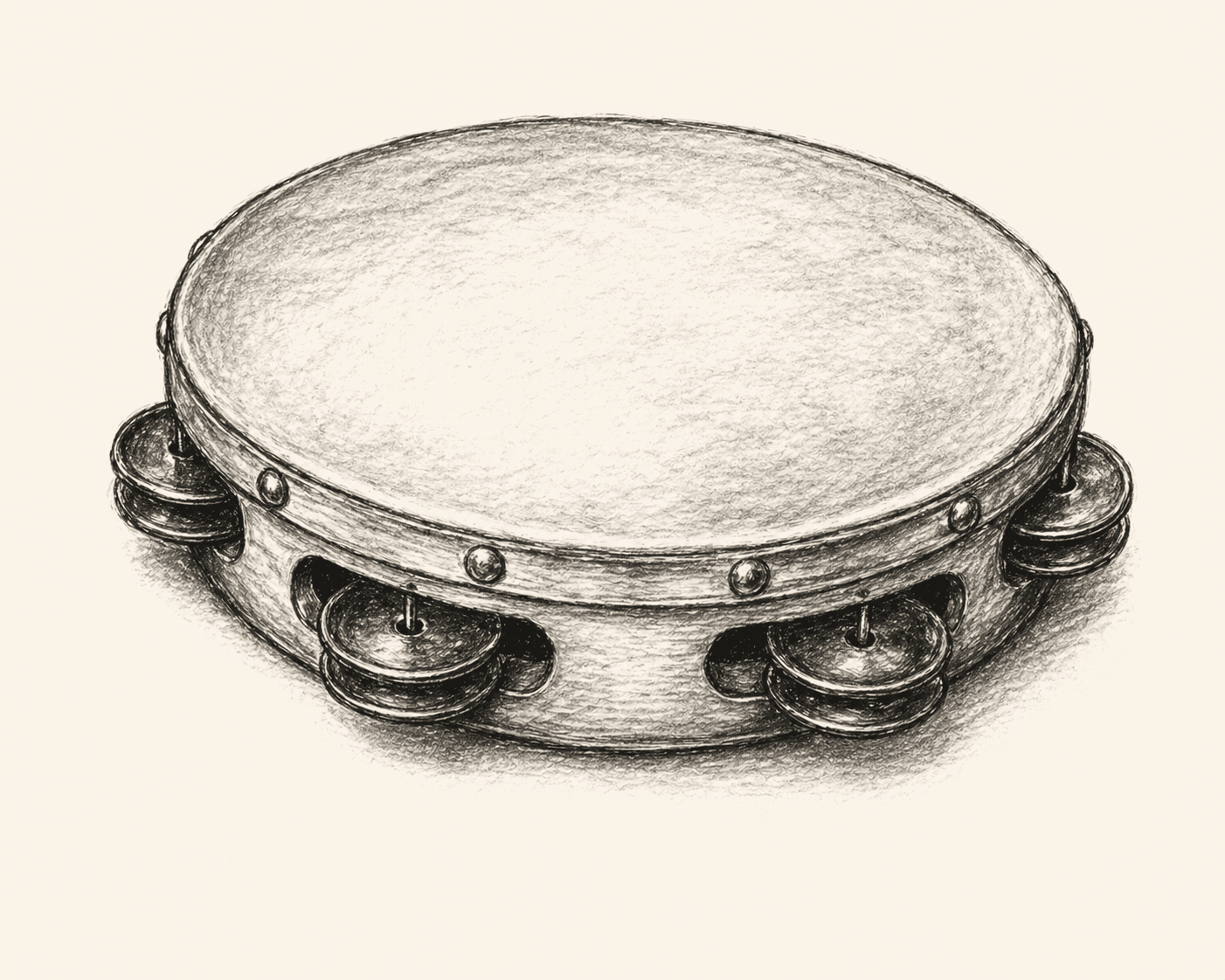
A shallow wooden hoop, a single head, and pairs of jingles — sonagli — set in slots around the rim.
The tambourine is the simplest of the orchestra’s drums and, by some distance, the noisiest. A shallow hoop of wood, a single skin stretched across one face, and pairs of small metal discs — the sonagli, or jingles — set in slots around the rim, free to rattle against each other at the slightest disturbance: that is the whole instrument. From it comes a sound at once dry and silvery, half drum and half jingled metal, unmistakable in any orchestra.
It is, like the triangle, an instrument of association. The tambourine never quite leaves behind the street, the procession, the festa. Berlioz brings it on for a Roman saltarello; Bizet for the bullring; Rimsky-Korsakov and Tchaikovsky for the dances of Spain and Italy. To write the tambourine is, almost always, to write a place — and the listener is, almost always, told where.
Mechanism
The frame is a low circular hoop, traditionally of beech or maple, some ten inches across and an inch or two deep. Slots are cut into the hoop in pairs, and through each slot a small wire pin carries two thin metal discs — the jingles — left loose enough to rattle when the instrument is moved. A single head of skin or plastic is stretched across one face; the other is open. The whole assembly weighs little more than a paperback.
Almost everything the player needs is gathered in a single hand. Held aloft, the tambourine is shaken; struck on the head with the free hand, knee, or fist, it sounds the drum and the jingles at once; touched at the rim with a dampened thumb, it produces the celebrated thumb roll — a long, sustained jingled tremolo of considerable difficulty. Each of these techniques is, in practice, a different instrument.
Voice and Character
The tambourine’s sound is bright and metallic, sustained where most drums are not. The jingles ring on after the head has spoken, and that decay — short but clearly there — gives the instrument its character. It cuts through any tutti without effort, and it struggles to be quiet. Mark it pianissimo at one’s peril; the jingles will speak whether one wishes them to or not.
Its inheritance is southern, and old. The instrument has been with Mediterranean dance for, by some accounts, three thousand years; the orchestra has had it for two hundred. The shorter time has not outweighed the longer. A tambourine in an orchestral score still carries, however lightly, the smell of summer dust and the sound of a tarantella heard from a distance.
“An instrument of southern origin, useful chiefly to colour those dances which take their name and their gait from the south.”
— paraphrased from Berlioz, Treatise on Instrumentation
Write the tambourine sparingly, and write it for what it is: a small, vivid, faintly disreputable thing, with a longer memory than the orchestra around it. Used well, no other instrument can do what it does in so few bars.
A shallow wooden hoop, a single head, and pairs of jingles — sonagli — set in slots around the rim.
The tambourine is a small instrument of very particular habits. A few rules, kept in mind at the desk, will spare the player a great deal at the first reading.
- i.Specify the technique. Shake, struck head, thumb roll, knee strike, fist — each is a different sound. Mark scosso, colpo, pollice, or the equivalent at every change, and let nothing be left to the player’s guess.
- ii.Mind the thumb roll. The thumb roll is a feat of friction, not of speed. It works only on a slightly damp head, and only for a few seconds. Long sustained rolls should be written as shakes — scosso — instead.
- iii.Articulate the rhythm. The instrument has a short, bright decay; rapid figures are heard with great clarity, and slovenly ones equally so. Notate exactly what is wanted, especially in dance music where the tambourine is the rhythm.
- iv.Honour the silences. The jingles speak the moment the player breathes. A rest in the part is a real rest, in which the instrument must be held perfectly still. Build that stillness into the phrase.
- v.Trust the ear, not the dynamic mark. A tambourine at piano will be heard above most of the orchestra; at fortissimo it is almost the only thing audible. Place the instrument with care, and adjust the marking to the orchestration around it.
Beyond these few rules, talk to the percussionist. They will know what is possible — and, more usefully, what is musical.
The notation
Indefinite pitch — written conventionally on the third space, with technique markings above.
The tambourine has no compass in the sense the strings do — its pitch is indefinite, and its part is most often laid on a single line or in the third space of the treble staff. What it has instead is a register of sonorities: a handful of distinct voices the player can summon, each notated by instruction rather than by pitch.
Colpo
The everyday voice — the head struck with the free hand, fist, or knuckle while the instrument is held aloft. Drum and jingles speak together, dry and bright. The default of the orchestral part, and the sound the listener has in mind when the part is marked simply tamburello.
Scosso
A continuous shake, with the head silent — only the jingles speaking. Dynamics from the faintest shimmer to a metallic roar; sustained as long as the music asks. The instrument’s closest equivalent to a roll, and a sound the orchestra has nothing else like.
Pollice
A wetted thumb dragged around the rim sets the head into a continuous tremolo, the jingles ringing after. A celebrated effect, of considerable virtuosity; brief by nature — three or four seconds at most — and not to be confused with the shake.
Sul ginocchio
The instrument struck against the knee, or — in the most extrovert passages — against the elbow or hip. The loudest single note the tambourine can produce, used for accents in dance music and for the punctuation of a tarantella or saltarello at full speed.
A shallow wooden hoop, a single head, and pairs of jingles — sonagli — set in slots around the rim.
The tambourine is held in a single hand, and almost everything the player needs is contained within reach of the other. Knuckle, fist, fingertip, thumb, knee — each is a separate colour, and the instrument moves between them at the speed of a phrase. Three thousand years of Mediterranean dance have left it the most complete vocabulary of any small percussion the orchestra possesses.
Standard techniques
The everyday voice is the head struck with the free hand — the knuckles for a clear bright stroke, the fingertips for a softer and more delicate one, the closed fist for the heaviest accent. Different beating spots give different colours: the centre of the head gives a dry thud, the edge a brighter ring, the rim alone a click of the jingles without the drum. The shake — scosso — holds the instrument aloft and rattles only the jingles, sustained as long as the music asks; it is the tambourine’s closest equivalent to a roll, and there is nothing else like it in the orchestra.
The most celebrated effect is the thumb roll — a wetted thumb dragged with light pressure around the head near the rim, the friction setting up a continuous tremolo of head and jingles together. It is a feat of friction rather than of speed, works only on a slightly damp head, and lasts at most three or four seconds; for longer sustained tremolos the part should be marked as a shake. Loud accents and fast figures in dance music are often produced by striking the head against the player’s thigh, knee, or — in the most extrovert passages — the elbow or hip: sul ginocchio, the punctuation of every well-played tarantella. A single stroke followed by an immediate damp gives the tambourine its secco, useful where the jingles would otherwise smear the rhythm.
Extended techniques
Laid flat upon a table or a padded stand, the tambourine becomes a small frame drum, played with both hands and capable of finger figures of considerable rapidity — a technique borrowed from the Italian tamburello and the Basque pandero, and increasingly common in contemporary scoring. Sticks or mallets in place of the hand give a harder, more aggressive attack, useful in loud rhythmic passages where the bare hand would tire. The instrument can be turned upside-down and struck on the open back for a hollower, less jingled colour.
A bow drawn across the rim, between the jingle slots, yields a thin sustained pitch with the metal singing in sympathy; a shaken roll — the instrument held aloft and rattled while the head is simultaneously struck or thumb-rolled — combines two sounds into a single sustained shimmer. Each of these belongs to the modern repertoire rather than the traditional one, and each rewards a conversation with the player before the part is fixed.
The tambourine is small, vivid, faintly disreputable, and not at all easy to write well. Choose the technique, choose the moment, and the instrument will carry a place and a weather no other can.
A shallow wooden hoop, a single head, and pairs of jingles — sonagli — set in slots around the rim.
A short, partial list — five places to begin if one wishes to know what the tambourine can do, and what it has been asked to do by composers who understood it.
- № 01
Berlioz — Le Carnaval romain
Saltarello
A Roman street dance, headlong and unstoppable. The tambourine drives the whole overture from underneath, as it would have driven the dance itself.
Listen on Spotify - № 02
Bizet — Carmen
Aragonaise, entr’acte to Act IV
Castanets and tambourine, side by side, set the bullring before the curtain rises. A few bars and the place is built.
Listen on Spotify - № 03
Rimsky-Korsakov — Capriccio espagnol
Fandango asturiano
A solo of considerable virtuosity — thumb roll, shake, knee strike, all at speed. The instrument is asked to carry the dance and very nearly does.
Listen on Spotify - № 04
Tchaikovsky — Capriccio italien
Tarantella
The tarantella spins on top of a tambourine that does not stop. Tchaikovsky had heard one in the streets of Rome and remembered it precisely.
Listen on Spotify - № 05
Stravinsky — Petrushka
Shrovetide Fair
A jingled clatter against the carnival crowd — the tambourine here is less a drum than the noise of the fair itself.
Listen on Spotify
Further entries will be added as our study deepens.
A shallow wooden hoop, a single head, and pairs of jingles — sonagli — set in slots around the rim.
The tambourine is one of the oldest instruments still in use. Frame drums with jingles or shells set into the rim are depicted in Mesopotamian reliefs, on Egyptian tomb paintings, on Greek vases — the tympanon of the cult of Dionysos was a tambourine in all but name. The Romans took it as the tympanum; the instrument moved with them across the Mediterranean and never afterwards left it.
The Mediterranean inheritance
Through the medieval and Renaissance centuries the tambourine — by whatever local name — was a familiar instrument of dance and procession across southern Europe and the Levant. Provence had its tambourin; the Basque country its pandero; Italy its tamburello; Spain its pandereta. Each was a small frame drum with jingles, played by hand, and each kept time for the dances of its region.
Entry to the orchestra
The orchestra knew the tambourine first as a curiosity. Gluck and Mozart used it for local colour — Turkish, Spanish, exotic — and Weber kept the practice. With Berlioz the instrument settled. The overture Le Carnaval romain, of 1844, gives the tambourine a part that is both characteristic and indispensable; the saltarello cannot exist without it. Berlioz, who had spent a year in Italy and heard the instrument played in earnest, wrote it into the orchestra with full knowledge of what it could do.
The nineteenth-century south
After Berlioz, the tambourine became almost obligatory wherever the nineteenth century looked south. Bizet wrote it into Carmen; Tchaikovsky into Capriccio italien; Rimsky-Korsakov gave it a cadenza in Capriccio espagnol. Each of these is, in some sense, a tourist’s music; the tambourine is what gives the postcard its postmark. The composers knew this perfectly well, and used the association without apology.
The modern instrument
Today’s orchestral tambourine differs little from the instrument Berlioz heard in Rome. The hoop is wood, the jingles are bronze, nickel silver, or steel; the head is goatskin or, increasingly, plastic. Concert players keep two or three instruments of differing diameters and jingle metals, choosing one to suit the writing. The craft has changed almost nothing in two hundred years — the instrument, in this as in much else, was already finished when the orchestra found it.
Specifications
A summary, for the composer’s desk.
- Family
- Percussion, indefinite pitch
- Italian
- Tamburello
- German
- Schellentrommel
- French
- Tambour de basque
- Range
- Indefinite — notated on a single line or third space
- Transposition
- Non-transposing; percussion or treble clef
- Frame
- Wooden hoop, typically beech or maple
- Standard size
- Approx. 10″ diameter × 2″ deep
- Jingles
- Pairs of small metal discs — sonagli — set in slots around the hoop
- Head
- Single, of goat or calfskin; sometimes plastic
- Origin
- Ancient Near East and Mediterranean; orchestra by the early 19th century