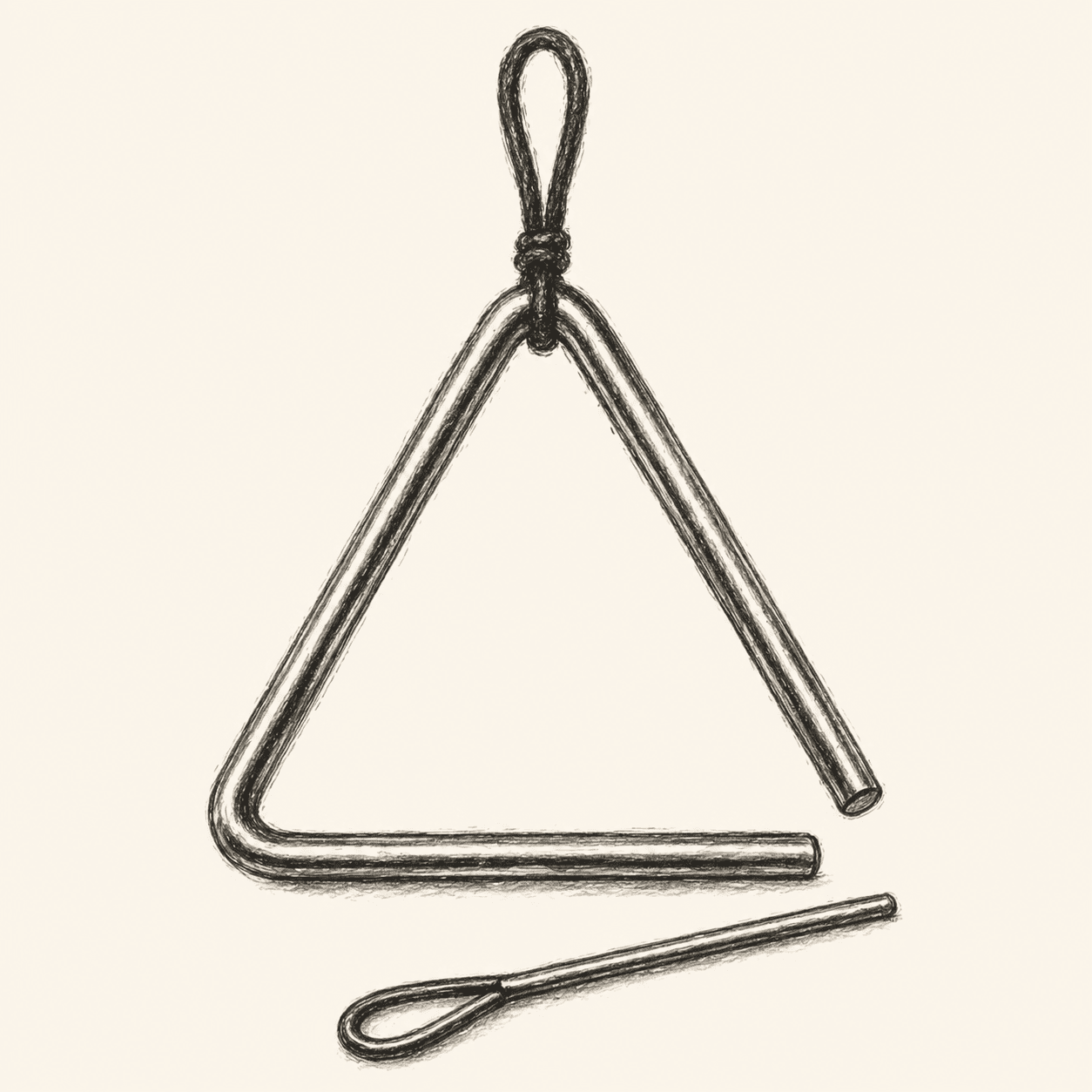
A bent rod of steel, hung at one corner by a slender cord — the open angle is what allows it to ring.
The triangle is, in form, the simplest instrument in the orchestra: a steel rod, bent into three sides, with one corner deliberately left unjoined. It is that gap — the breath of air between two pieces of metal — that allows the instrument to ring at all. Close the corner and the rod is dead; leave it open and the entire frame becomes a small brilliant chord of inharmonic partials, sustaining far beyond what its size would suggest.
Of all percussion, none is more easily misused. A triangle struck at random, ill placed in the texture, becomes the whole evening’s embarrassment — a sound everyone hears and no one quite forgives. A triangle struck with knowledge, on the other hand, can be the most magical six inches of the orchestra: half ornament, half spell.
Mechanism
The instrument is a length of high-carbon steel rod, traditionally between four and ten inches on a side, bent at two corners and left open at the third. It hangs by a thin loop of gut or nylon, held in the player’s left hand or fixed to a stand — the suspension must not damp the metal, which is why the cord is always slender and never wool or leather.
The beater — battente — is most often a thinner steel rod, struck against the lower side or, for a roll, swept rapidly between the inner faces of the closed angle. Wooden or felt-tipped beaters are called for occasionally where a softer, less metallic colour is wanted; a heavier steel beater will produce a louder and more iron tone. The choice belongs to the composer, and should be marked.
Voice and Character
Berlioz, who in his Treatise gave the triangle two pages of careful attention, warned against its use in any context that did not actively require it. He thought its sound “brilliant, especially in the loud passages of the orchestra” — but he meant the warning as much as the praise. The triangle has no fundamental: its pitch is indefinite, but the cluster of high partials it produces will sit above any chord without belonging to it, which is at once its great virtue and its great danger.
Heard alone, it is bright, ringing, almost bell-like. Heard in a tutti it adds a kind of varnish — a high gloss that reads, to the ear, as light rather than as sound. The decay is long, and at low dynamics almost endless; the player who knows how to damp at the right instant is, in some sense, playing two instruments.
“The sound is brilliant, especially in the loud passages of the orchestra; but if used too often it loses its effect.”
— Hector Berlioz, Treatise on Instrumentation
Use it sparingly, and the triangle will earn every note it plays. Use it constantly, and the orchestra will never forgive you — nor, eventually, will the listener.
A bent rod of steel, hung at one corner by a slender cord — the open angle is what allows it to ring.
The triangle is unforgiving of inattention and generous to almost nothing else. A few habits, kept in mind, will save the part — and the composer’s reputation — from much later regret.
- i.Place each stroke deliberately. A triangle note carries unusual weight precisely because it is rare. Strike at the moments the music will accept; everywhere else, write a rest.
- ii.Mark the damping. The decay is long. Indicate where the ring is to be cut — l.v. (laissez vibrer) where the sound should bloom, secco where it must stop.
- iii.Specify the beater. Battente di metallo for the standard ringing tone; di legno for a duller, woodier strike; di feltro for a softer, almost veiled effect.
- iv.Trust the roll. A triangle roll, swept inside the closed angle, will sustain at any dynamic — and crescendo from imperceptible to brilliant in the space of a bar.
- v.Beware doublings. The triangle adds a halo, not a line. Doubled with cymbals it becomes Turkish band; doubled with celesta or harp harmonics it becomes magic. Choose with care.
Beyond these few rules, listen. The triangle is one of the few instruments in the orchestra whose effect a composer can hear, in the mind, very nearly as it will sound — provided the composer hears, also, the silence around it.
The notation
Indefinite pitch — written conventionally on the third space, with technique markings above.
The triangle has no compass in the woodwind sense — its sound is an inharmonic cluster of high partials, conventionally notated on a single line or in the third space of the treble staff. What it offers instead is a register of sonorities: a small set of voices the player can call up by choice of beater, of damping, and of stroke.
Suono aperto
The default voice — the steel beater on the lower side, the instrument left to ring out. Bright, sustaining, faintly bell-like; the cluster of high partials sits above the orchestra without binding to its harmony. The sound the listener has in mind when the part says simply triangolo.
Secco
The free hand grasps the frame the moment after the strike, killing the ring. A small, hard, almost dry note — useful in rapid figures, where an open stroke would smear into the next. Brahms knew the trick.
Battente di legno
A wooden or felt-tipped beater in place of the steel one. The sound is thicker, less brilliant, more shadow than light — useful where the orchestral colour wants the suggestion of a triangle without its glare.
Rullo
The beater swept rapidly between the two inner sides of the closed corner. A steady glittering tremolo, capable of any dynamic from the merest whisper to a small bell-storm. The crescendo roll is one of the orchestra’s purest theatrical effects.
A bent rod of steel, hung at one corner by a slender cord — the open angle is what allows it to ring.
For so plain a piece of metal, the triangle answers to a surprising range of touches. The variables are few — beater, beating spot, damping, and duration — but the gradations between them are wide, and the player who knows the instrument can summon from it anything from a barely audible spark to a small, brilliant bell-storm.
Standard techniques
The default is a single stroke with a slim steel beater on the lower side of the frame, the instrument suspended freely from a short loop of cord. The size and weight of that beater alters the tone: a thinner rod gives a brighter, more delicate ping, a heavier one a fuller, more iron sound. The triangle is most often left to ring — laissez vibrer, the long cluster of high partials sustaining well beyond the stroke; the player damps the frame with the free hand at the moment the music asks for silence. Marked secco, the same stroke ends almost at once.
The roll is made within the closed angle, the beater swept rapidly between the two inner sides — a steady, glittering tremolo, capable of any dynamic and of a long crescendo from niente to fortissimo. The roll is one of the orchestra’s purest theatrical effects, and one of its most easily abused. Mounted on a clip rather than held in the hand, the triangle can be played with two beaters for figures of considerable speed; this is Liszt’s territory, and the closing pages of countless scherzos since.
Extended techniques
A wooden beater in place of the steel one yields a softer, more veiled tone — less brilliant, more shadow than light, useful where the orchestral colour wants the suggestion of the instrument without its glare. A felt-tipped beater goes further still, almost muffling the ring. Striking with the thicker body of the beater, rather than its tip, gives a duller, more iron clang — closer to an anvil than to a bell.
More remarkable is the bowed triangle — a contrabass or cello bow drawn slowly across one of the outer sides, producing a sustained, otherworldly pitch of considerable resonance. The instrument can also be lowered partway into a basin of water during a roll, the pitch bending downward as the metal is submerged; or hand-dampened at one corner while struck at another, for a pitch quite different from the open ring. None of these belongs in every score; each, asked for once with knowledge, can be unforgettable.
The triangle is, in the end, an instrument of one note placed deliberately. The composer who hears the silence around the stroke as clearly as the stroke itself will find it the most generous of small things.
A bent rod of steel, hung at one corner by a slender cord — the open angle is what allows it to ring.
A short, partial list — five places to begin if one wishes to know what the triangle can do, and what it has been asked to do by composers who knew exactly when not to use it.
- № 01
Liszt — Piano Concerto No. 1 in E♭
Scherzo — Allegretto vivace
A solo so prominent that critics nicknamed the work the “Triangle Concerto.” Liszt knew the joke and refused to take it back.
Listen on Spotify - № 02
Brahms — Symphony No. 4
Third movement, Allegro giocoso
The only movement in which Brahms admitted the triangle to his symphonies — and he made it count, glittering above the strings like sunlight off water.
Listen on Spotify - № 03
Beethoven — Symphony No. 9
Finale, Turkish march
A handful of strokes, paired with cymbals and bass drum, that summon the alla turca tradition into the most serious symphony ever written. The effect is almost shocking.
Listen on Spotify - № 04
Wagner — Die Walküre
Magic Fire Music
Among the flickering strings and the chromatic harp, a triangle roll — the spark itself, audible and indispensable.
Listen on Spotify - № 05
Dukas — L’apprenti sorcier
The brooms multiply
A triangle adds the final inch of mischief to a passage already overflowing with it. Without it the joke would be smaller by half.
Listen on Spotify
Further entries will be added as our study deepens.
A bent rod of steel, hung at one corner by a slender cord — the open angle is what allows it to ring.
The triangle in its modern form — a bent steel rod, open at one corner — was already known in medieval Europe, where it appears in manuscripts from the tenth century onward. The earliest examples were sometimes hung with small jingling rings along the lower side, the ancestors of those a tambourine still carries today. Those rings were eventually abandoned; the open frame, and its long ringing decay, proved more useful on its own.
The Janissary band
The triangle entered European art music through the eighteenth-century fashion for alla turca: the imitation, in court orchestras, of the Ottoman Janissary bands whose music had reached Vienna and Paris by way of war and embassy alike. Cymbals, bass drum, and triangle — the so-called Turkish percussion — appeared together, and for several decades the triangle could scarcely be heard without them.
Mozart and Beethoven
Mozart used the triangle in his Entführung aus dem Serail (1782), where the Turkish flavour was the whole point of its presence. Beethoven took the same colour into the symphony itself — the Turkish march of the Ninth’s finale — and for the first time the triangle was treated as a serious orchestral instrument rather than an exotic guest. The barrier had been crossed; it would not be recrossed.
The Romantic orchestra
The nineteenth century gave the triangle its independence. Liszt, in the E♭ Piano Concerto, wrote a part so prominent that the instrument acquired the reputation of a soloist; Brahms, almost ascetic in his percussion writing, allowed it into a single movement of the Fourth Symphony, and made it unforgettable. Wagner used it for fire and for magic; Berlioz, of course, used it for everything.
The modern instrument
The triangle of the modern percussion section is little changed from the one Beethoven knew. Players keep a set of several sizes, each with its own colour of ring, and a small shelf of beaters from delicate steel knitting needles to wooden mallets. The instrument has resisted improvement because it requires none — a piece of bent metal, a length of cord, and a careful hand are still, after eight centuries, the whole apparatus.
Specifications
A summary, for the composer’s desk.
- Family
- Percussion, indefinite pitch
- Italian
- Triangolo
- German
- Triangel
- French
- Triangle
- Range
- Indefinite — high, with a shimmer of overtones
- Transposition
- Non-transposing; treble or percussion clef
- Material
- Steel rod, bent into a near-equilateral triangle, one corner left open
- Standard size
- Approx. 4″ to 10″ on each side
- Beater
- Steel rod, occasionally wood or felt for muted strokes
- Origin
- Medieval Europe; into the orchestra by the late 18th century