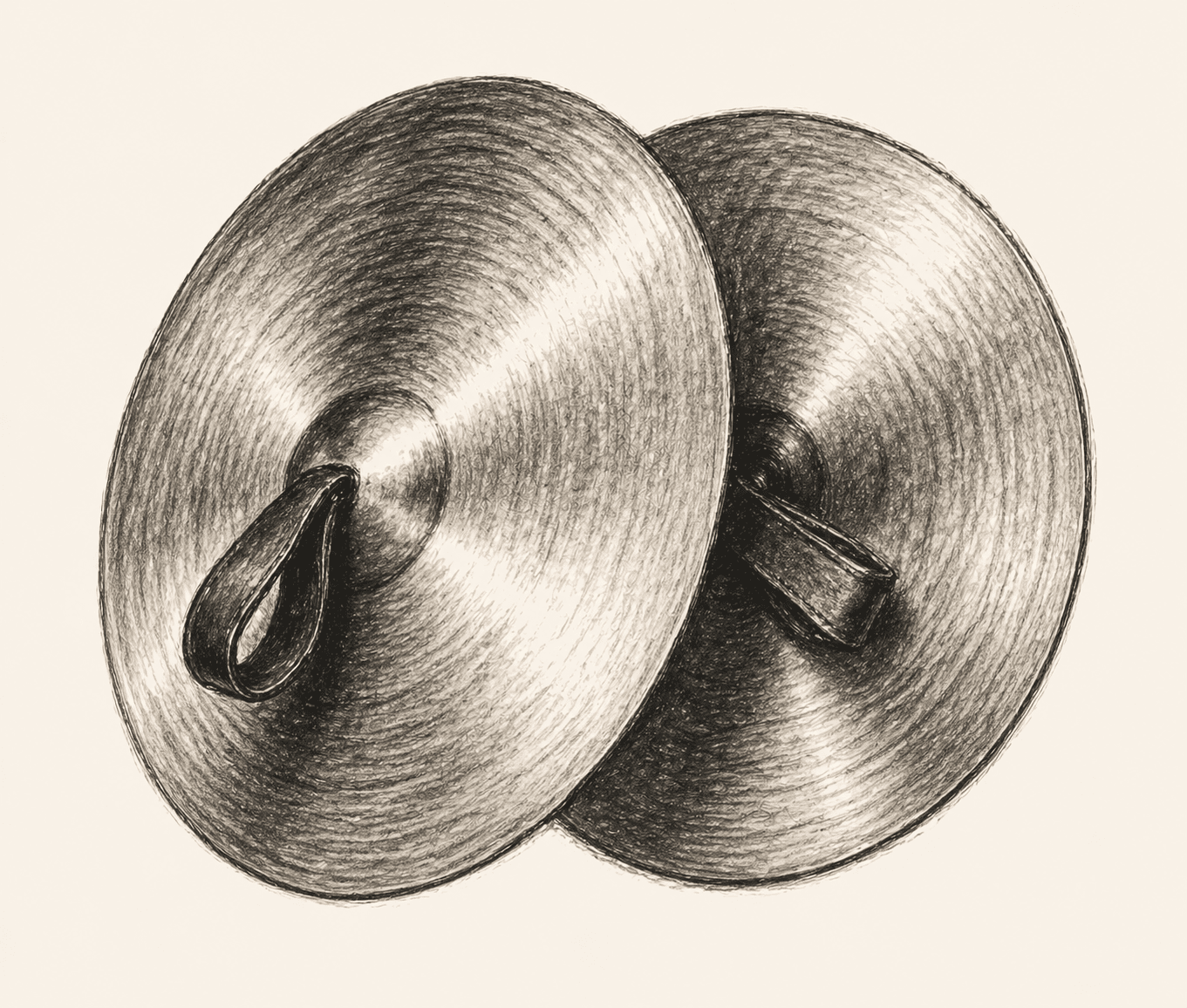
Two hammered discs of bronze, each held by a leather strap passed through a small dome at the centre.
The cymbals are the orchestra’s brightest metal — two hammered discs of bronze, broad as dinner plates, struck together by their leather straps or singly with a stick. They give no pitch and yet they give light: a single full crash will halo a tutti, and a long suspended roll will fill a soft passage with what feels almost like weather.
Like the bass drum, they came late and from elsewhere. The instrument of the modern orchestra is essentially the cymbal of the Ottoman Janissary band, recast in larger bronze and given over to symphonic purposes. Berlioz was the first to take it seriously; Tchaikovsky and Rimsky-Korsakov, the first to take it for granted. Every composer since has had to negotiate with that inheritance.
Mechanism
Each cymbal is forged from a single disc of bell bronze — most often the alloy known as B20, four parts copper to one of tin. The disc is hammered, heated, lathed, and finally pierced at its centre for a small dome — the cup — through which a leather strap is fed. The pair is held by these straps, never by the cup itself, and never with rigid handles: the cymbal must be free to vibrate.
Two principal voices coexist in every part. The piatti a 2 — the pair, struck together — gives a clashed sound of brief attack and long shimmer. The piatto sospeso — a single cymbal hung on a stand and taken with mallet, stick, or brush — gives almost any sound the player wishes, from a faint metallic breath to a full crescendo roll. The composer who wishes the second must write it; in silence the player will assume the first.
Voice and Character
The clashed pair is the most articulate fortissimo in the orchestra. Berlioz, who knew the instrument intimately, observed that the cymbals reinforce the orchestra most happily in passages of a brilliant or pompous character — and reproached the composers of his day for clashing them on every available downbeat. The reproach has aged well. A pair of cymbals struck once is an event; struck twice in the same phrase, almost never.
The suspended cymbal is a different instrument altogether — quieter, more atmospheric, susceptible to the smallest gradations of touch. A soft yarn mallet drawn slowly across its edge yields a long crescendo from silence to thunder; two timpani sticks give a delicate rhythmic figure; a wire brush, almost an exhalation. It is the cymbal of Rimsky-Korsakov’s Scheherazade and of every impressionist score since.
“The cymbals reinforce the orchestra most happily in passages of a joyous, brilliant, or pompous character.”
— Hector Berlioz, Treatise on Instrumentation (paraphrased)
The instrument is forgiving of conviction and unforgiving of habit. Write a single crash where the music demands one, a single roll where it asks for weather, and the cymbals will do the rest.
Two hammered discs of bronze, each held by a leather strap passed through a small dome at the centre.
The cymbals reward the patient composer and embarrass the enthusiastic one. A handful of habits, kept in mind, will spare the score most of its later regrets.
- i.Write the crash you mean. Every clashed pair is an event. If a passage reads as routine fortissimo accents, it almost certainly is; the part exists to mark the few moments worth marking.
- ii.Specify pair or suspended. Piatti a 2 for the clashed pair, piatto sospeso for the single hung cymbal. The two are nearly different instruments. Indicate which, and — for the suspended — the implement: bacchette di timpano, mazzuolo morbido, spazzole.
- iii.Allow the metal to ring. A cymbal struck and immediately damped becomes another, lesser instrument. Mark laissez vibrer (l.v.) wherever the music wants the shimmer to carry; mark secco where it does not.
- iv.Use the roll for shape. A suspended-cymbal crescendo from niente to fortissimo is one of the orchestra’s most exact dramatic devices. Use it for the rise of a tutti or the threshold of a key change — never as ornament.
- v.Notate clearly. A single line, or a high note in the bass or treble staff, with the part marked Piatti and the technique above. The player needs no more — and tolerates no less.
Beyond these few rules, talk to the percussionist. They will know what is possible — and, more usefully, what is musical.
The notation
Indefinite pitch — written high on the staff, with technique markings above.
The cymbals have no compass in the sense the woodwinds do — they are unpitched, broadband, and laid on a single line or high on a staff. What they have instead is a register of sonorities: a small set of distinct voices the player can summon by choice of cymbal, of stroke, of damping.
Piatti a 2
The pair struck together, edge against edge, and allowed to ring on. The crash of Berlioz’s Marche, of Tchaikovsky’s climaxes, of Mahler’s chorales — broad, brilliant, and unmistakable. Marked l.v. by default; the metal will continue several seconds beyond the stroke.
Piatti soffocati
The same stroke, the discs immediately stilled against the player’s chest. A short, articulate crash — closer to a metallic snap than a shimmer. The right voice for marches and for any passage that wants the gesture without the halo.
Piatto sospeso · stroke
A single cymbal hung on a stand and taken with a stick or mallet. The stroke at the edge gives a high shimmer; at the bell, a clearer pitch and a faster decay. The everyday voice of twentieth-century scoring — used by every composer from Stravinsky onward.
Piatto sospeso · rullo
Two soft yarn mallets in alternation across the edge of the suspended cymbal. At pianissimo, a faint hiss of metal; at fortissimo, a wash of light over the whole orchestra. The instrument’s most exact dramatic device, and the easiest to overuse.
Two hammered discs of bronze, each held by a leather strap passed through a small dome at the centre.
Two discs of bronze, and an extraordinary catalogue of voices to choose between: the cymbals are, in their way, the most varied of the orchestra’s metals. Pair or single, edge or dome, hard mallet or soft, allowed to ring or stilled at once — each combination is nearly a separate instrument, and the modern repertoire has asked for almost all of them.
Standard techniques
The clashed pair — piatti a 2 — is the historical default, the discs struck edge against edge, glanced rather than smacked, so that the bronze is free to ring on. Marked laissez vibrer or l.v., the metal will continue several seconds beyond the stroke; pressed to the player’s chest, it becomes the dry, articulate piatti soffocati of march and military music. The control of that decay is the heart of pair-cymbal writing: a long ring against a soft chord, a short stroke against a brilliant one, and the listener is told a different thing each time.
The suspended cymbal — piatto sospeso — is a different instrument, hung on a stand and taken with whatever the music wants: hard sticks for a clear ringing attack, soft yarn mallets for the celebrated crescendo roll, wire brushes for an almost spoken whisper, timpani sticks for rhythmic figures of considerable precision. The stroke at the edge gives the high shimmer of Rimsky-Korsakov; the stroke on the dome — the cup — gives a clearer pitch and a faster decay, almost bell-like in character. A choke, the player’s hand catching the metal the instant after the stroke, ends the sound at once. Composers should mark the implement and the spot wherever the music depends on either.
Extended techniques
A contrabass bow drawn slowly across the edge of a suspended cymbal yields one of the strangest sounds in the modern orchestra — a sustained, eerie, almost vocal pitch with a long sustain quite unlike anything the stick can produce. The cymbal can also be scraped — a coin, the shaft of a triangle beater, or the edge of another cymbal drawn across the grooves of the lathing — for a metallic rasping cry. The water cymbal of contemporary scoring lowers a rolled cymbal slowly into a basin of water, the pitch falling as the metal is submerged: a true descending glissando, brief but unmistakable.
Cymbals can be stacked, one inverted on top of another, for a short, splashy attack; placed face-down on a timpano, the cymbal becomes a small metallic gong, the drum’s membrane lending it a new and cavernous resonance. Finger rolls and fingernails on the edge produce delicate, almost inaudible shimmers — the percussion section’s closest equivalent to a string harmonic. None of these belongs in every score; all of them, used once with conviction, will be remembered.
The cymbals reward conviction and punish habit. One crash, one roll, one bowed shimmer — placed where the music has earned them — will do more than a dozen of any of the same.
Two hammered discs of bronze, each held by a leather strap passed through a small dome at the centre.
A short, partial list — five places to begin if one wishes to know what the cymbals can do, and what they have been asked to do by composers who understood them.
- № 01
Berlioz — Symphonie fantastique
Marche au supplice
A single fortissimo crash on the head’s fall — the most theatrical use of the instrument in the early symphonic repertoire, and the moment Berlioz first treated the pair as a dramatic event rather than a mere effect.
Listen on Spotify - № 02
Tchaikovsky — Romeo and Juliet
Climax of the love theme
A single shattering pair, struck at the top of the long crescendo — the closest the orchestra comes to a sob at full volume.
Listen on Spotify - № 03
Rimsky-Korsakov — Scheherazade
The Festival at Baghdad
A long shimmering roll on the suspended cymbal beneath the woodwind festival — the instrument as light scattered on water, scarcely a percussion at all.
Listen on Spotify - № 04
Mahler — Symphony No. 2, Resurrection
Finale
Clashed pairs at the height of the chorale — Mahler asks for the metal to ring on, undamped, against the brass and the offstage band.
Listen on Spotify - № 05
Stravinsky — The Firebird
Infernal Dance of King Kashchei
A suspended cymbal struck with a stick on the offbeats, ringing through Stravinsky’s syncopation — a small cousin to the bass drum’s sacrificial figures, four years later.
Listen on Spotify
Further entries will be added as our study deepens.
Two hammered discs of bronze, each held by a leather strap passed through a small dome at the centre.
The cymbals are among the oldest of all instruments. Bronze discs struck in pairs are recorded in Bronze Age Mesopotamia, in ancient China, in the temples of Egypt, and across the Mediterranean of antiquity. They served, by turns, ritual and military purposes — and they have never quite shed either inheritance.
From Janissary to orchestra
The instrument familiar to the modern orchestra came west by way of the Ottoman Janissary band, where pair-cymbals — the zil — marched alongside the davul and the kettledrums. When eighteenth-century Europe became briefly besotted with all things Turkish, the cymbals came with the fashion. Mozart used them in Die Entführung aus dem Serail, Haydn in his Military Symphony, and Beethoven, two decades later, in the finale of the Ninth.
The Zildjian craft
The cymbals played in nearly every concert hall on earth descend from a single workshop. In 1623 an Armenian alchemist working in Constantinople, Avedis Zildjian, perfected an alloy and a method of hammering that produced a cymbal of unprecedented brilliance. The family kept the formula for four centuries; the firm continues to this day. Most of the great orchestral pairs heard between Berlioz and Mahler were, and are, Zildjians.
Berlioz and the symphonic voice
Berlioz, here as so often, was the first composer to write for the cymbals as a colour rather than as an effect. The Symphonie fantastique, the Requiem, and the Te Deum all treat the pair as a deliberate dramatic stroke and the suspended cymbal — anticipating common practice by half a century — as a sustainable atmosphere. His Treatise of 1844 codified the lesson. Tchaikovsky, Wagner, Mahler, and Strauss all read it.
The modern instrument
The orchestral cymbals settled into their present form in the late nineteenth century — a matched pair of hammered B20 bronze, 16 to 22 inches across, played by leather straps. The suspended cymbal joined them as a regular member of the percussion section in the years around Scheherazade, and has been there ever since. Stravinsky, Debussy, Mahler, and the composers who followed have asked the instrument for almost every conceivable sound — but the basic craft, and the basic warning, remain Berlioz’s.
Specifications
A summary, for the composer’s desk.
- Family
- Percussion, indefinite pitch
- Italian
- Piatti
- German
- Becken
- French
- Cymbales
- Range
- Indefinite pitch — broadband, with a long shimmering decay
- Transposition
- Non-transposing; single-line staff, or written high on the bass or treble staff
- Standard diameter
- Approx. 16–22″ (40–55 cm) for the orchestral pair
- Alloy
- Bronze — typically B20, 80% copper to 20% tin, hammered and lathed
- Mallets
- Held by leather straps for the pair; the suspended cymbal taken with timpani sticks, soft yarn mallets, wire brushes, or rute
- Origin
- Ancient — Bronze Age Mesopotamia, China, and Egypt; entered the European orchestra via Ottoman Janissary bands in the late 18th century