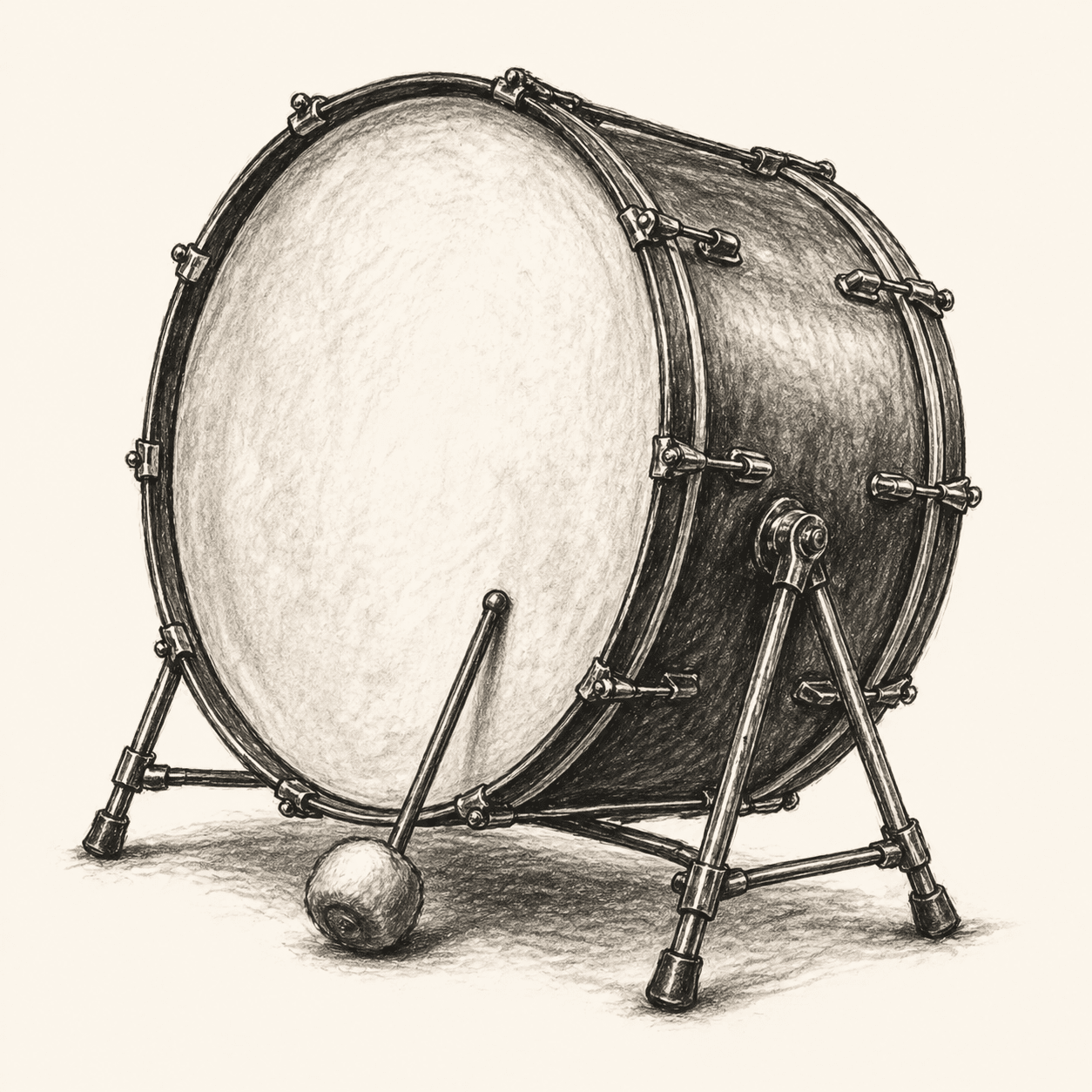
A great cylindrical shell, headed on both faces, set vertically in its frame so the player may strike either side.
The bass drum is the orchestra’s lowest unpitched voice — a great cylindrical shell, headed on both faces, struck with a felt mallet whose weight is part of the sound. It carries no pitch and yet it carries weather: a single soft stroke can darken a whole tutti, and a single loud one can shake the floor of the hall.
It came late to the orchestra and has never quite settled into politeness. Mozart used it in Die Entführung for the colour of Janissary marching music; Beethoven, in the Ninth, for the same effect at a graver scale. From there the instrument has been called upon whenever the music required either the deepest possible whisper or the loudest possible blow — and, very often, both within the same minute.
Mechanism
The shell is most often of laminated maple or birch, three to four feet across and roughly half as deep. Two heads — calfskin in the older practice, plastic in the modern — are tensioned across the open faces by rods around the rim. The instrument is mounted upright in a wooden cradle so the player may strike either head, and tilted as taste prefers; some American orchestras play it nearly horizontal, the Germans almost vertical.
The mallet — the battente — does most of the writing. A heavy felt-headed beater on the centre of the head produces the characteristic deep boom; a softer, lighter one near the edge gives a hollow whisper. Two mallets used together yield a roll, sustaining at any dynamic the player wishes. The composer who specifies battente di feltro or bacchette di timpano — timpani sticks, as in Le Sacre — writes a different instrument altogether.
Voice and Character
Berlioz, who used the bass drum more thoughtfully than any composer before him, complained in his Treatise of its “deplorable abuse” in the theatres of his day — struck on every downbeat, regardless of the music, in pursuit of mere noise. The warning still serves. The bass drum gives an enormous return on a single well-placed stroke, and a vanishing return on the second.
Its character is weight without articulation. It does not sing; it does not phrase; it is felt rather more than it is heard. At pianissimo it is a kind of barometric pressure — the listener senses the room has grown larger. At fortissimo it is closer to physical force than to music. Between these poles lies most of its useful territory: the long roll beneath a developing tutti, the muffled stroke under a funeral march, the quiet thud at the close of a nocturne.
“Nothing is more common, and at the same time more deplorable, than the abuse of the bass drum.”
— Hector Berlioz, Treatise on Instrumentation
Heeded, this is the best advice ever given about the instrument. Write for the bass drum as one writes for any rare and powerful colour: with reluctance, and then with conviction.
A great cylindrical shell, headed on both faces, set vertically in its frame so the player may strike either side.
The bass drum rewards restraint above everything else. A handful of habits, kept in mind, will do most of the work for the careful composer.
- i.Write the strokes you mean. Every stroke is an event. If a passage reads as routine downbeats, it is almost certainly wrong; the part exists to mark the few moments that need marking.
- ii.Specify the mallet. Battente normale, di feltro morbido, bacchette di timpano, rute — each is nearly a different instrument. Indicate the implement wherever the music depends on it.
- iii.Use the roll for weather, not for noise. A bass-drum roll at pianissimo is among the most evocative sounds the orchestra possesses; a bass-drum roll at fortissimo, sustained too long, is among its dullest.
- iv.Notate clearly. A single line, or the bottom space of the bass clef, with the part marked Gran cassa or simply G.C. The player needs no more — and tolerates no less.
- v.Mind the decay. The drum rings on long after the stroke. Mark the damping — secco, sec, smorzato — wherever the music wants the sound to stop. Berlioz and Verdi both did, and for good reason.
Beyond these few rules, talk to the percussionist. They will know what is possible — and, more usefully, what is musical.
The notation
Indefinite pitch — written conventionally low on the bass staff, with technique markings above.
The bass drum has no compass in the sense the woodwinds do — its pitch is indefinite, and its part is usually laid on a single line or low in the bass staff. What it has instead is a register of sonorities: a small set of distinct voices the player can summon by choice of mallet, of stroke, of damping.
Colpo secco
A single stroke, the head damped immediately by hand or knee. Dry, articulate, almost percussive in the small sense of the word — the sound of Verdi’s Dies irae and of Stravinsky’s offbeats. The everyday voice of the drum in the symphonic repertoire.
Colpo aperto
The same stroke, undamped — the head allowed to ring on. A long, decaying boom that can fill a slow phrase entirely on its own. Less articulate than the secco, more atmospheric; the close of a nocturne, the depth of a night march.
Rullo
A two-mallet roll. At pianissimo it reads as distant thunder, the floor of an unsettled tutti; at fortissimo it is among the most overwhelming sounds the orchestra produces, and one of the easiest to misuse. Mahler asks for both within minutes of one another in the Second.
Bacchette di timpano
The drum struck with hard timpani sticks rather than the felt beater. A tighter, more rhythmic attack, capable of articulation the soft mallet cannot manage. Stravinsky’s sacrificial offbeats — and a dozen imitators since — live entirely here.
A great cylindrical shell, headed on both faces, set vertically in its frame so the player may strike either side.
The bass drum’s vocabulary is small, but the gradations within it are immense. A single stretched membrane and a felt-headed mallet give the player every dynamic the orchestra commands, from a barometric murmur at the threshold of audibility to a full detonation; and the difference between any two strokes lies in the choice of beater, of beating spot, and — most of all — of what is done with the head after it has spoken.
Standard techniques
The single stroke, struck near the centre of the head with a felt-headed beater, is the instrument’s default voice — the one a bare gran cassa in the part will summon. Move toward the edge and the resonance opens; move toward the centre and the fundamental gathers and darkens. Soft felt beaters give a deep, rounded boom; harder felt and core-weighted mallets a more articulate attack. Two mallets, used in alternation, sustain the roll: at pp a distant rumour of thunder, at ff one of the most overwhelming sounds the orchestra can produce. The damping — by hand or by knee against the resonant head — converts any of these into a colpo secco, the dry stroke of Verdi’s Dies irae and of Stravinsky’s sacrificial offbeats.
The implement itself is part of the writing. Bacchette di timpano — hard timpani sticks — give a tight, rhythmic attack that the soft mallet cannot match; rute or switches give a light, brushed thud; ordinary beaters paired with a muffling cloth across the head produce the muffled funeral stroke of Berlioz and Mahler. The drum is most often left to ring, undamped, beneath a slow phrase, and stilled secco only where the music demands an articulate end.
Extended techniques
The most celebrated of the modern extensions is the superball friction stroke — a rubber-tipped mallet rubbed slowly across the head, producing a long howling moan that has become the percussion section’s small lion’s roar. A contrabass bow drawn across the rim or the shell yields a sustained metallic pitch, eerie and unmistakable. The drum can also be played with the bare hands, like a great frame drum, for a softer and more intimate attack; brushes draw a hissed whisper from the head; a chain or a length of metal laid across the batter buzzes with every stroke.
Two players, one on each head, give the percussionist of the modern score a kind of stereophonic command of the instrument. Prepared bass drums — coins, chains, a thunder sheet pressed against the head — appear in the contemporary repertoire and reward consultation with the player. What the bass drum cannot do is glissando: the head is too large and too slack for the timpanic change of pitch, and any composer who asks for one will find an empty silence in its place.
The bass drum gives an enormous return on a single well-considered stroke and a vanishing one on the second. Choose the beater, choose the spot, and choose the moment; the rest belongs to the player.
A great cylindrical shell, headed on both faces, set vertically in its frame so the player may strike either side.
A short, partial list — five places to begin if one wishes to know what the bass drum can do, and what it has been asked to do by composers who understood it.
- № 01
Berlioz — Symphonie fantastique
Songe d’une nuit du sabbat
Tolling Dies irae beneath the witches’ chorus — the bass drum, struck softly, becomes a distant funeral bell at the bottom of the orchestra.
Listen on Spotify - № 02
Verdi — Requiem
Dies irae
A single colossal stroke, fortissimo, that cleaves the air. Verdi marked it secco — dry — and demanded a drum tuned slack to a low rumble.
Listen on Spotify - № 03
Mahler — Symphony No. 2, Resurrection
Finale
Long rolls at the threshold of audibility, crossing into the offstage band — the bass drum as the floor of an apocalypse.
Listen on Spotify - № 04
Stravinsky — Le Sacre du printemps
Danse sacrale
A bass drum struck with timpani sticks on the offbeats — the rhythmic engine of the whole sacrificial dance, and one of the most copied effects in twentieth-century scoring.
Listen on Spotify - № 05
Tchaikovsky — 1812 Overture
Coda
Where cannon are unavailable, the bass drum stands in — fortissimo, on the downbeats, beneath the bells. The most theatrical use of the instrument in the standard repertoire.
Listen on Spotify
Further entries will be added as our study deepens.
A great cylindrical shell, headed on both faces, set vertically in its frame so the player may strike either side.
The bass drum entered Western music as a foreigner. Its ancestor is the davul, the great double-headed drum of the Ottoman Janissary bands — slung from the shoulder, struck on one head with a heavy beater and on the other with a thin switch. When eighteenth-century Europe became briefly besotted with all things Turkish, the davul came with the fashion, and the orchestra acquired a new low voice almost by accident.
The Janissary craze
By the 1770s a so-called Turkish percussion section — bass drum, cymbals, triangle, sometimes a small bell-tree — was a fixture of military bands across the German lands and France. Mozart wrote it into the overture and chorus of Die Entführung aus dem Serail, Haydn into his Military Symphony, and Beethoven, two decades later, into the finale of the Ninth. The instrument had not yet shed its associations with the marching field; it would take Berlioz to teach the orchestra what else it could do.
Berlioz and the symphonic voice
Berlioz is the first composer who can be said to have written for the bass drum as a colour rather than as an effect. The Symphonie fantastique, the Requiem, the Te Deum — all treat the drum as a sustained, modulated presence, capable of whisper as readily as of detonation. His Treatise, published in 1844, codified the lesson and scolded his contemporaries for ignoring it. Verdi, Mahler, and Strauss all read it. The repertoire of the next century is, in this respect, Berlioz’s.
The modern instrument
The orchestral bass drum settled into its present form in the late nineteenth century — a large two-headed shell, mounted in a tilting cradle, played upright with a felt-headed beater. Plastic heads have largely supplanted calfskin since the mid-twentieth century, though many players keep a calfskin set for the older repertoire. Stravinsky, Mahler, Shostakovich and the composers who followed them have asked the instrument for almost every conceivable sound — but the basic craft, and the basic warning, remain Berlioz’s.
Specifications
A summary, for the composer’s desk.
- Family
- Percussion, indefinite pitch
- Italian
- Gran cassa
- German
- Große Trommel
- French
- Grosse caisse
- Range
- Indefinite pitch — low, sub-bass register
- Transposition
- Non-transposing; bass clef or single-line staff
- Standard diameter
- Approx. 36–40″ (90–100 cm)
- Heads
- Two — calfskin or plastic, on a wooden or metal shell
- Mallets
- Felt-headed beaters of varying weight; rute, switches, timpani sticks for special effects
- Origin
- Ottoman Janissary bands; entered the European orchestra in the late 18th century