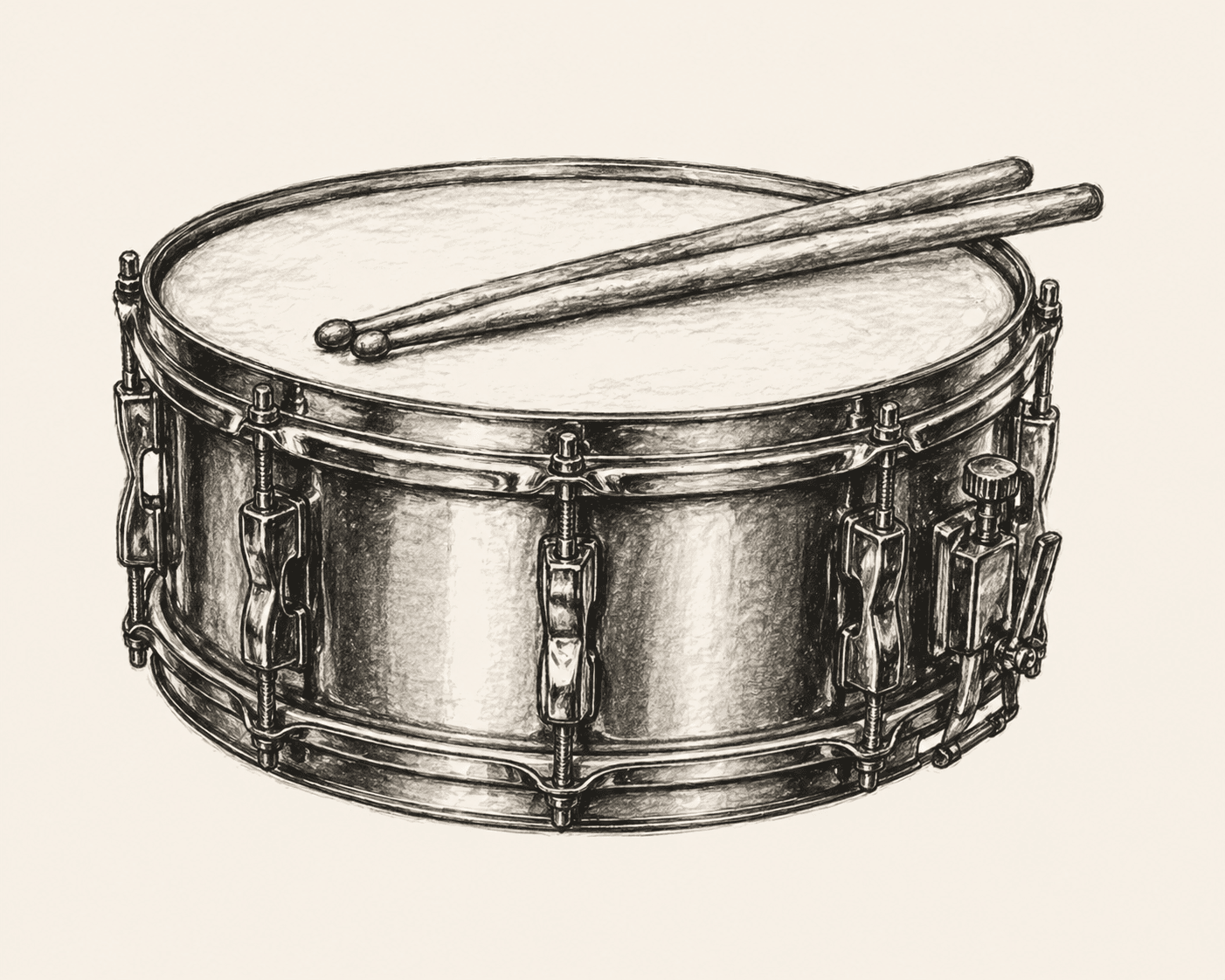
A short cylindrical shell, two heads stretched in opposition — and, beneath, a row of taut snares that give the instrument its name.
The snare drum is, of all the percussion, the most articulate. It cannot sing, and it cannot harmonise; what it does instead is speak. A short cylindrical shell, two stretched heads, and beneath them a row of snares — wires or strands of gut drawn taut across the lower head — is all the instrument is. From those few materials comes a sound at once crisp, dry, and unmistakable, capable of carrying a battlefield or floating barely audible at the back of a hall.
It is, in the orchestra, a relative newcomer. Marin Marais wrote it into a storm scene in 1706; Rossini gave it a famous solo a century later; but only with Berlioz and the Russians of the late nineteenth century did the snare drum take its place as a settled member of the ensemble. The instrument now sits behind the timpani, almost always at the player’s left hand — patient, watchful, and rarely played for long.
Mechanism
The shell is short — five to eight inches deep, fourteen across — and most often of laminated maple, birch, or beaten metal. Two heads are stretched across it: above, the batter, struck with a pair of slender sticks; below, the resonant, against which the snares themselves lie. A throw-off lever lifts those snares clear of the head, converting the instrument, in an instant, from a snare drum into a small unsnared tom.
The sticks — bacchette — are themselves part of the writing. Hickory, of varying weight and tip, is the orchestral standard; wire brushes draw a sustained whisper from the head; multi-rod bundles soften the attack without softening the rhythm. A composer who asks for spazzole or verghe writes a different instrument from one who does not.
Voice and Character
Berlioz, who studied the percussion as carefully as anyone in his century, called the snare drum’s sound strident, mat, et sec — strident, matte, and dry. He used it sparingly, knowing what a single roll could do at the right moment; and the lesson has carried forward. The instrument’s power lies in restraint, and the most memorable snare drum writing in the repertoire — Boléro, the Leningrad — is built on the smallest of figures, repeated and slowly magnified.
Its character is, by long inheritance, military. The drum was, for five centuries, a parade instrument and a battlefield instrument before it was an orchestral one, and the orchestra has never quite forgotten the fact. A snare drum at the back of a slow movement speaks, however quietly, of a regiment in the next street. Composers have used this association — Prokofiev, Shostakovich — and others have worked against it, finding in the same instrument a sound nearly weightless. Both are honest uses.
“Strident, matte, and dry — and, used with discretion, capable of effects of the most singular kind.”
— paraphrased from Berlioz, Treatise on Instrumentation
Write for the snare drum as one writes for the timpani — sparingly, and with the knowledge that every stroke is heard. A snare part well made will cost the player little and gain the orchestra a great deal.
A short cylindrical shell, two heads stretched in opposition — and, beneath, a row of taut snares that give the instrument its name.
The snare drum repays precision. A small cluster of habits, observed at the desk, will save much trouble at the first reading.
- i.Specify the sticks. Indicate hardness or kind — bacchette dure, normali, spazzole, verghe — wherever the music depends on it. A wire brush and a hickory tip are nearly two different instruments.
- ii.Indicate snares on or off. Mark con corde or senza corde at every change. Without snares the drum is a small tom; with them it is the snare drum. The two should never be left to guesswork.
- iii.Distinguish the roll from the rhythm. A buzz roll, a measured tremolo, and a written-out figure are all useful, and not interchangeable. Specify the kind of roll, and its dynamic shape from the first stroke to the last.
- iv.Write the silences. The snare drum vanishes into rest more cleanly than almost any other instrument. Place its entries deliberately, and let the rests carry their own weight.
- v.Trust the dynamics. A snare can play below mezzo-piano without losing its definition, and above forte without losing its pitch. Mark the contour exactly — no instrument is more responsive to it.
Beyond these few rules, talk to the percussionist. They will know what is possible — and, more usefully, what is musical.
The notation
Indefinite pitch — written conventionally on the third space, with technique markings above.
The snare drum has no compass in the sense the woodwinds do — its pitch is indefinite, and its part is most often laid on a single line or in the third space of the treble staff. What it has instead is a register of sonorities: a handful of distinct voices the player can summon, each of them notated by instruction rather than by pitch.
Tamburo aperto
The everyday voice — sticks on the centre of the batter, snares engaged. Bright, dry, articulate at every dynamic. The default of the orchestral part, and the sound the listener has in mind when the part is marked simply tamburo.
Senza corde
The throw-off lever lifts the snares clear of the head, and the instrument turns into a small, dry tom — a softer, hollower sound, useful where the snares would intrude. Mahler and Mussorgsky both knew the trick.
Sui cerchi
Stick on rim, or stick striking head and rim together. The first is a clipped wooden click, useful at low dynamics; the second is the loudest single note the drum can produce, a sound of considerable violence. Specify which.
Rullo
A double-stroke or buzz roll will sustain at any dynamic from imperceptible to ear-splitting. The crescendo roll from pianissimo to fortissimo is among the orchestra’s most reliable theatrical effects, and one of its hardest to misuse.
A short cylindrical shell, two heads stretched in opposition — and, beneath, a row of taut snares that give the instrument its name.
The snare drum’s expressive vocabulary is, almost uniquely among the percussion, codified — the language of stick on head having been worked out across five centuries of military service, drilled into manuals long before it ever reached the conservatory. The rudiments, the rolls, the accents and the silences between them are a discipline as much as a sonority, and the orchestral player inherits the lot.
Standard techniques
At the foundation lie the rudiments — single and double strokes, the paradiddle, the flam, the drag, the ratamacue — the small grammatical units out of which every figure is built. From the doubles comes the open or measured roll; from a faster, more relaxed wrist comes the buzz or press roll, in which each stick is allowed to bounce freely against the head. The orchestral roll, unless otherwise marked, is most often the buzz: a smooth, sustained whisper or roar, capable of beginning below audibility and arriving at full force without a seam.
Accent and absence make the rest of the writing. A snare drum accented at ff against unaccented strokes at p is one of the most articulate gestures the orchestra possesses; the player controls each stroke individually, and the drum responds in kind. The rim shot — stick striking head and rim together — is the loudest single note available, a crack of considerable violence; the cross-stick, played quietly on the rim alone, is its near opposite. Snares engaged or released — con sordina, senza — change the instrument outright; so does a switch from sticks to spazzole (wire brushes), which draw a sustained jazz-tinged whisper from the head and have entered the concert hall by way of Ravel and Copland.
Extended techniques
Beyond the rudimental vocabulary, the modern snare drum has been asked to do a great deal more. Sticks struck on the wooden shell, or against one another above the head, give a dry clicking percussion of indefinite character; mallets — yarn or felt — in place of sticks soften the attack and let the snares speak alone. A coin or a length of light chain laid across the batter head turns every stroke into a buzz of metal on metal; brushes drawn in slow circles across the head produce a sustained breath of sound, more whisper than rhythm.
The drum can also be bowed — a contrabass bow drawn against the rim, or against the snares themselves on the underside, yields an eerie, sustained pitch quite unlike anything the sticks can manage. Playing on the resonant head from below is rarer still, but possible where the instrument is mounted to allow it. None of these are common; all of them work; each should be discussed with the player before the page goes to print.
The snare drum is, in the end, an instrument of articulation. The composer who treats every stroke as an event — and every silence between strokes as part of the line — will find it the most responsive of collaborators.
A short cylindrical shell, two heads stretched in opposition — and, beneath, a row of taut snares that give the instrument its name.
A short, partial list — five places to begin if one wishes to know what the snare drum can do, and what it has been asked to do by composers who understood it.
- № 01
Ravel — Boléro
Throughout
A single ostinato, repeated for fifteen minutes without alteration. The whole work is, in effect, a crescendo built on top of one drum.
Listen on Spotify - № 02
Rimsky-Korsakov — Scheherazade
Fourth movement, festival at Baghdad
Sharp military tattoos drive the sea and the ship together — the snare cuts through the orchestra like a fife and drum corps remembered from afar.
Listen on Spotify - № 03
Nielsen — Symphony No. 5
First movement, cadenza
A renegade snare drummer is asked to improvise as if to halt the orchestra at all costs. It is, very nearly, a battle scene — and one of the most extraordinary moments the instrument has ever been given.
Listen on Spotify - № 04
Prokofiev — Lieutenant Kijé
Birth of Kijé
A piccolo over a distant snare — a regiment heard from the next street. The drum is the whole period and place in a single sound.
Listen on Spotify - № 05
Shostakovich — Symphony No. 7, Leningrad
First movement, invasion theme
A quiet snare ostinato, over and over, beneath a tune that grows from charm to monstrosity. Twelve minutes of mounting horror balanced on one drum.
Listen on Spotify
Further entries will be added as our study deepens.
A short cylindrical shell, two heads stretched in opposition — and, beneath, a row of taut snares that give the instrument its name.
The snare drum descends from the medieval tabor — a small rope-tensioned drum, hung at the player’s arm and struck with a single stick while the same hand of the same player worked a three-holed pipe. The tabor had snares, sometimes one and sometimes several, stretched across the struck head. Out of it, by the fifteenth century, came a larger drum played with two sticks: the ancestor of the side drum and, by inheritance, of every snare drum the orchestra has known since.
The military centuries
For five hundred years the drum was an instrument of war. The Swiss infantry of the fourteenth century paired it with the fife; from them the practice spread across Europe. Drummers passed orders of formation, advance, and retreat; the rudiments of the modern percussionist — the paradiddle, the flam, the drag — were codified first in regulation manuals, not in conservatories. The instrument the orchestra now plays remembers, in every figure, that earlier life.
Entry to the orchestra
Marin Marais wrote a snare drum into the storm of his opera Alcione in 1706 — the first conclusively documented orchestral use. A century later, Rossini gave the instrument a famous solo at the head of La gazza ladra, and the listening public was, by all accounts, scandalised. Even so, the snare drum was slow to settle. Through most of the nineteenth century it remained an instrument of effect — a colour summoned for storms, battles, and marches, and dismissed when the colour was done.
The Russians and after
Rimsky-Korsakov, writing in the closing decades of the century, made the snare drum a settled member of the ensemble. After him, no major orchestrator could ignore it. Ravel built a fifteen-minute work on a single repeated figure of one; Nielsen turned it loose against the whole orchestra; Shostakovich wrote it into the long, slow horror of the Leningrad. By the middle of the twentieth century the instrument had been asked to do nearly everything an indefinite-pitch drum can.
The modern instrument
Today’s orchestral snare drum is, in essence, a refined version of the mid-twentieth-century military side drum: a maple, birch, or metal shell of fourteen inches across, plastic heads above and below, wire snares on a throw-off mechanism. Concert players keep several drums of differing depths, choosing the instrument to suit the writing. The craft has changed slowly, because — like the timpani — it had largely arrived.
Specifications
A summary, for the composer’s desk.
- Family
- Percussion, indefinite pitch
- Italian
- Tamburo militare
- German
- Kleine Trommel
- French
- Caisse claire
- Range
- Indefinite — notated on a single line or third space
- Transposition
- Non-transposing; percussion or treble clef
- Shell
- Wood (maple, birch) or metal (steel, brass)
- Standard size
- Approx. 14″ diameter × 5–8″ deep
- Snares
- Gut, wire, or nylon, stretched across the lower head
- Origin
- Medieval Europe, from the tabor; orchestra by 1706