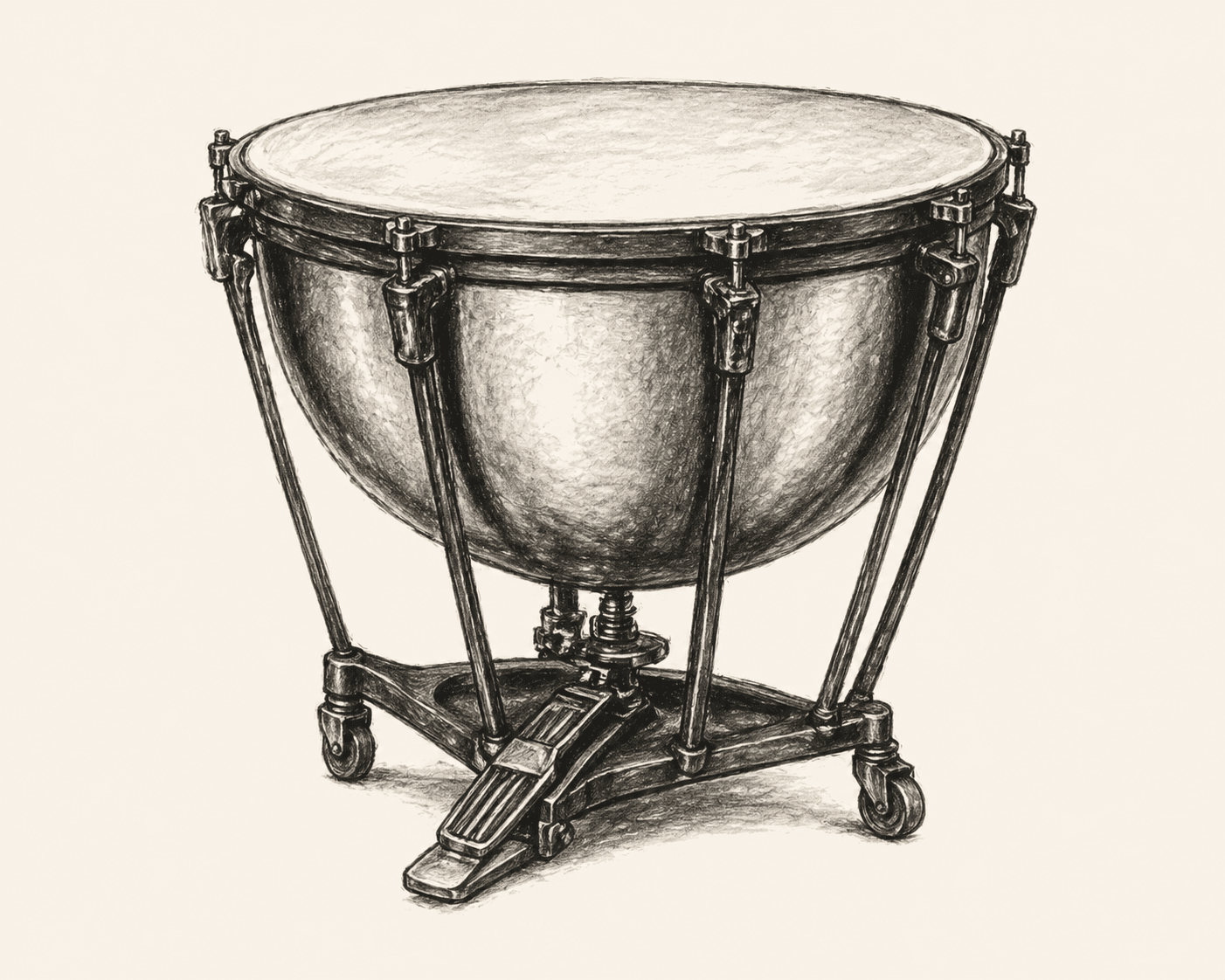
A hammered copper bowl, head tensioned by rods at the rim — its pitch raised or lowered by the foot upon the pedal.
The timpani are the only members of the percussion family whose business is pitch as well as pulse. A hammered copper bowl, a stretched membrane, a felt-headed mallet — and the orchestra has, in a single stroke, a bass note both rhythmic and harmonic. They have stood at the back of the ensemble since the seventeenth century, and the orchestra without them is — in some elemental sense — not yet itself.
A modern set comprises four drums, ranged in size from roughly thirty-two inches in diameter to twenty-three. Each covers a perfect fifth or thereabouts; together they span from a low D₂ to a high A₃. Their pitches are not chosen once and left — the pedals are made for retuning, and the modern repertoire asks for it constantly.
Mechanism
The bowl is hammered from a single sheet of copper, parabolic in profile — the shape governs the timbre as much as the head does. Across the rim is stretched a membrane of calfskin or, on most modern instruments, plastic; tension rods around the rim hold it taut, and a pedal connected by chain or cable to those rods raises or lowers the pitch in a smooth glissando. The Dresden pedal, balanced and clutched, predominates; the Berlin pedal, ratcheted, is its cousin.
The mallets — bacchette — are themselves an instrument of choice. A hard wooden core, wrapped in felt of varying density, will produce anything from a velvet pianissimo to a dry, articulate forte. Wooden sticks, used rarely, give a sound nearly comic in its hardness. The composer who specifies bacchette di legno or di feltro morbido writes far more than a dynamic.
Voice and Character
Berlioz, in his Treatise, wrote that “of all percussion instruments, the most valuable is unquestionably the kettledrum.” He was not being polite. The timpani give the orchestra a foundation no other instrument can provide — a low note both pitched and articulated, capable of pianissimo whisper or detonation, and able to sustain through a roll any duration the music asks.
Their character is gravity. They are most themselves at the threshold of audibility, where the roll seems less a sound than a rumor of one; and most arresting at the other extreme, where a single fortissimo stroke can split a tutti in two. Between the two lies the long, steady pulse of the symphonic tradition — Brahms’s opening, Mahler’s funerals, Sibelius’s slow accumulations. The timpanist, unlike most of the orchestra, plays only when the music needs them. They make every note count.
“Of all percussion instruments, the most valuable is unquestionably the kettledrum.”
— Hector Berlioz, Treatise on Instrumentation
Write for them with intention. A timpani part well written reads, in the score, as something between a drum part and a bass line — and sounds, in the hall, like the floor of the music itself.
A hammered copper bowl, head tensioned by rods at the rim — its pitch raised or lowered by the foot upon the pedal.
The timpani reward the composer who thinks like a player. A few habits will spare both player and conductor much grief at the first reading.
- i.Specify the tuning at the head. Indicate the pitches of each drum at the start of the movement, and again at any change. The timpanist tunes by ear, in silence — a moment’s warning is the whole game.
- ii.Allow time for retuning. A pedal change is fast, but not instantaneous, and is heard if rushed. Build the rests into the part, or write the change into a tutti loud enough to mask it.
- iii.Choose the sticks. Indicate hardness — bacchette dure, normali, morbide — wherever the music depends on it. A felt mallet and a wood mallet are nearly two different instruments.
- iv.Trust the roll. A timpani roll, marked tremolo or trill, will sustain at any dynamic from imperceptible to overwhelming. It is the closest thing the orchestra has to a held bass.
- v.Mind the dynamics — and the silences. The timpani vanish at piano and eclipse the orchestra at fortissimo. Mark the contour exactly, and never forget how much of their power lies in not playing.
Beyond these few rules, talk to the timpanist. They will know what is possible — and, more usefully, what is musical.
The full compass
D₂ to A₃ — two and a half octaves, divided across four drums.
The compass is not, as with the woodwinds, a single continuous range — but the union of four overlapping ones. Each drum covers a perfect fifth or so; the four together climb from a low D₂ to a high A₃, and their territories meet in useful overlap.
Grande
The largest drum, and the orchestra’s foundation. Slow to speak, and slowest to die away — a low D here will hum beneath an entire phrase. Reserve it for the gravest pedal points, and never ask it to articulate quickly.
Grosso
The bass voice. Less ponderous than the great drum, more responsive at speed; the natural home of the tonic in most classical keys. Beethoven’s F, Brahms’s C — all live here.
Medio
The dominant in most keys, paired with the grosso. Clear, articulate, the most often heard. Rolls bloom here without the heaviness of the lower drums.
Piccolo
The smallest of the standard set, and the brightest. Where the modern repertoire has stretched the timpani upward — Bartók, Stravinsky, Carter — it is this drum that has carried the weight of the writing.
A hammered copper bowl, head tensioned by rods at the rim — its pitch raised or lowered by the foot upon the pedal.
For an instrument so often described in terms of weight and force, the timpani possess an expressive vocabulary of remarkable subtlety. A single drum, struck in two different places with two different mallets, will yield two altogether different voices; the same note, rolled at the threshold of audibility and then again at full power, seems hardly to belong to the same family of sound. The composer writes not only the pitch and the rhythm, but the colour.
Standard techniques
The single stroke is the foundation of all timpani writing. The player crosses the hands or alternates them according to the figure; the stick rebounds cleanly from the head, and the bowl is left to ring. Double stops — two drums struck simultaneously — are idiomatic and have been since Beethoven. The roll is, by long habit, a single-stroke roll, its speed adjusted to the dynamic and to the size of the drum: the great drum wants a slower roll than the piccolo, and a roll too fast for its bowl will sound merely flustered.
The beating spot is the timpanist’s first lever of timbre. The normal position is some three or four inches from the rim — the compromise between resonance and articulation. Drawn nearer the edge, the sound grows warmer and more singing; drawn closer to the center, drier, more articulate, and at the very center, almost without pitch. The mallet is the second lever. Felt heads of graded hardness — bacchette dure, normali, morbide — and the rare wooden stick give the writer a palette as wide as that of any string section. Hand muffling, with a finger or palm laid lightly on the head, will damp the ring and leave only the attack.
The pedal is the modern instrument’s great gift. It permits retuning within a piece, even within a phrase; and, when pressed beneath a held roll, draws the pitch upward or downward in a true glissando — a sound first asked for by Bartók, and which only the post-Dresden timpani can produce. A pedal-tuned glissando, marked across a sustained roll, remains one of the instrument’s most arresting effects.
Extended techniques
The contemporary literature has stretched the kettledrum in directions earlier composers would not have imagined. The mallet may be reversed and the wooden butt used to strike the head, producing a hard, tom-like crack; or the rim itself may be struck, for a thin metallic report. The drums may be played by hand, with the fingers or palm against the head, in the manner of thetabla. Two mallets on a single drum permit very rapid figuration unattainable by alternation across two; players have grown adept at it.
A suspended cymbal laid upon the head and rolled — the so-called cymbal-on-timpani — produces a shimmering, indefinite pitch as the cymbal rattles in sympathy; pressing the pedal beneath bends the whole halo of sound. A superball mallet drawn across the head will elicit an unearthly friction tone, low and moaning. Harmonics, drawn very softly with a fingertip lightly touching the head, are real but seldom asked for. Prepared timpani — coins or chains laid upon the head — appear in the work of certain modernists; they are effects of last resort, and should be used as such.
Whatever is asked, ask it of a player who has time to prepare. The timpani will yield as much as the composer is willing to imagine; but they yield it best to the composer who has spoken, in advance, with the timpanist.
A hammered copper bowl, head tensioned by rods at the rim — its pitch raised or lowered by the foot upon the pedal.
A short, partial list — five places to begin if one wishes to know what the timpani can do, and what they have been asked to do by composers who understood them.
- № 01
Beethoven — Symphony No. 9
Scherzo, octave Fs
A solo of single notes — bare, hammered octaves — that for one extraordinary moment makes the timpani the equal of any voice in the orchestra.
Listen on Spotify - № 02
Brahms — Symphony No. 1
First movement, opening
A throbbing pedal C beneath the strings — the whole symphony seems to be lifted out of the earth by it.
Listen on Spotify - № 03
Berlioz — Symphonie fantastique
Scène aux champs
Four players, four drums — a distant thunder rolled from the back of the orchestra. Berlioz, writing his own Treatise, called the timpani indispensable.
Listen on Spotify - № 04
Strauss — Also sprach Zarathustra
Sunrise
C and G, struck in slow alternation against the rising brass — the most famous heartbeat in the literature.
Listen on Spotify - № 05
Bartók — Music for Strings, Percussion and Celesta
Third movement
A study in glissandi: the pedal pressed mid-roll, the pitch drawn upward — a sound only the modern instrument can produce.
Listen on Spotify
Further entries will be added as our study deepens.
A hammered copper bowl, head tensioned by rods at the rim — its pitch raised or lowered by the foot upon the pedal.
The kettledrum is older than the orchestra it now anchors. Its earliest ancestors — the small paired naqqāra of the medieval Arab world — reached Europe by way of the Crusades, and by the fifteenth century larger drums, slung at the saddle, were a fixture of mounted cavalry. They were instruments of war first, of court ceremony second, and of music last.
The Baroque
By the late seventeenth century the timpani had entered the orchestra, almost always in pairs and almost always tuned to tonic and dominant. Lully used them; Purcell used them; Bach and Handel used them — sparingly, ceremonially, and with the brass. Tuning was a slow business of T-handled keys around the rim, performed before the movement and seldom altered within it. The instrument was, in the truest sense, rhythmic — a drum that happened to be in tune.
Beethoven and the soloist
Beethoven changed what the timpani were for. The hammered octave Fs of the Ninth’s scherzo, the held tonic of the violin concerto, the tritone tuning of the Eighth — these are the moments at which the timpani stop being a member of the brass section and become a voice in their own right. After Beethoven, no major symphonist has been able to write for the orchestra without writing seriously for them.
The pedal mechanism
Through most of the nineteenth century, retuning remained slow, and composers who asked for rapid changes — Berlioz above all — paid for the wish in extra players. In 1881 Carl Pittrich, in Dresden, patented the pedal mechanism: a single foot, a coupled set of rods, a glissando of pitch. Within a generation it had transformed the writing. Bartók could ask for a timpani glissando; Carter could ask for solo passages of melodic intricacy. The instrument we know is the Dresden instrument.
The modern instrument
The modern timpano is a pedal-tuned copper bowl with a plastic head — though many players keep a set of calfskins for the older repertoire. Standard practice has settled on four drums, occasionally five for the late-Romantic and twentieth-century repertoire. The instrument Mahler wrote for, the instrument Stravinsky wrote for, and the instrument the player carries on stage today are, in essence, the same — a craft that has changed slowly because it had, by the early twentieth century, very largely arrived.
Specifications
A summary, for the composer’s desk.
- Family
- Percussion, definite pitch
- Italian
- Timpani
- German
- Pauken
- French
- Timbales
- Range
- D₂ — A₃ (across a set of four)
- Transposition
- Non-transposing; bass clef, sounding as written
- Standard set
- Four drums — 32″, 29″, 26″, 23″
- Head
- Calfskin or plastic, tensioned over a copper bowl
- Tuning
- Pedal-operated; each drum a perfect fifth or so
- Origin
- Middle East via medieval Europe; pedal mechanism, Dresden, 1881