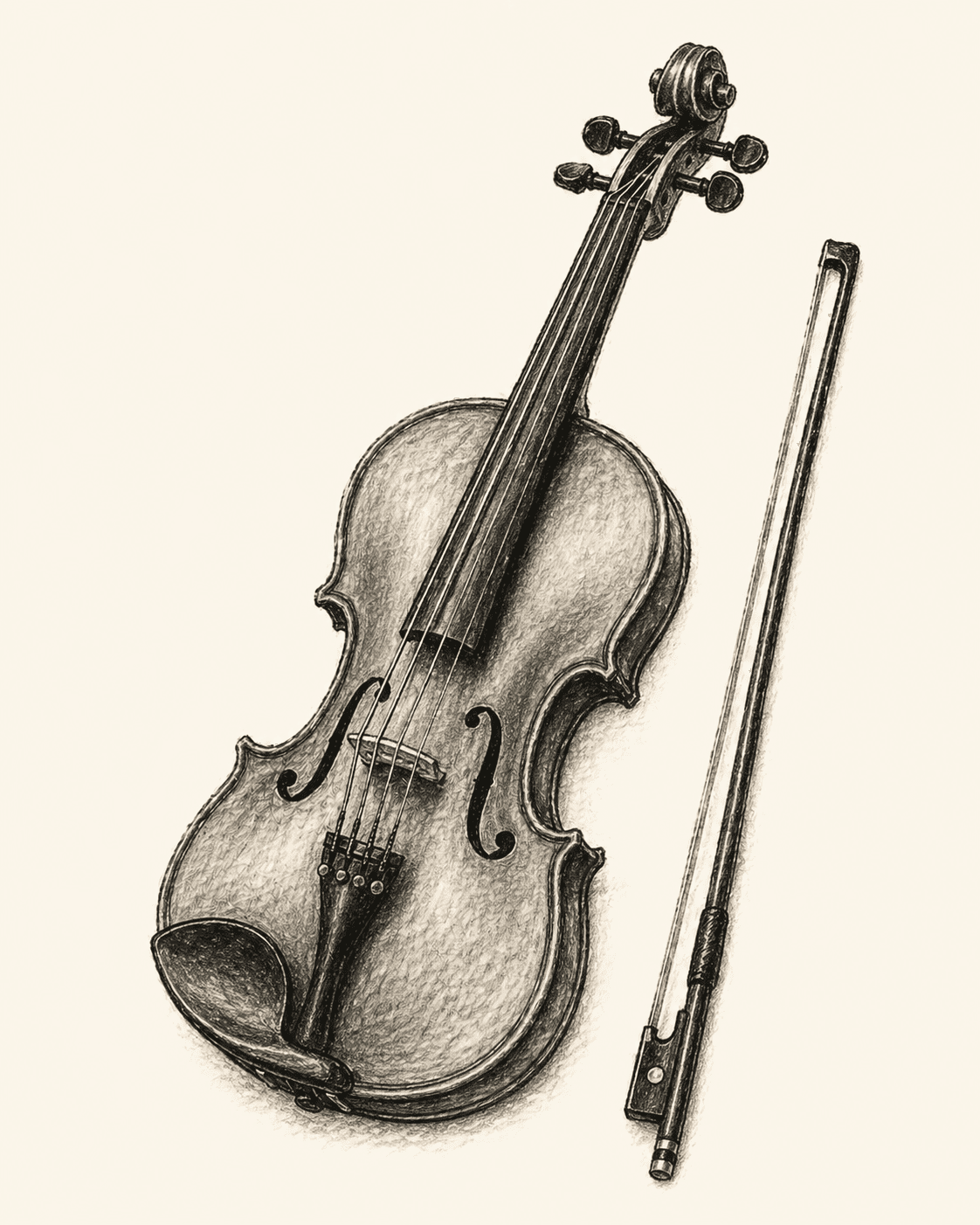
A hollow body of spruce and maple, scarcely thirty-six centimetres long — and yet the carrying voice of every orchestra since Monteverdi.
The violin is the orchestra’s soprano and its conscience. It can sing alone above a hundred players or vanish entirely into a section of sixteen; it can be made to sound, with no change of fingering, like a bird, a sob, a dance, a knife. No other instrument carries so much of the orchestral repertoire on its shoulders, and none has been rebuilt so little — its essential design has stood, almost unchanged, since the workshops of Cremona in the seventeenth century.
It is an instrument of paradoxes. Tiny, yet loud; simple, yet intricate; a soloist’s vehicle and a chorister’s. The bow draws the sound; the left hand shapes it. Between the two there is no key, no valve, no fret — only the player’s ear and the long correction of practice.
Construction
The body is made in two arched plates — spruce above, maple below — joined by ribs of the same maple and held in tension by an inner scaffold of bass-bar and soundpost. The neck and scroll are carved from a single block of maple; the fingerboard, traditionally, of ebony. Four strings — once gut, now most often synthetic-core or steel — run from tailpiece to pegbox over a small maple bridge whose feet transmit the vibration into the soundbox below.
The bow is its own instrument. A stick of pernambuco wood, slightly cambered, strung with horse-hair under tension by a screw at the frog. The right hand’s weight, speed, and point of contact between bridge and fingerboard determine almost everything we hear. Of the violin’s thousand articulations, perhaps nine in ten belong to the bow.
Voice and Character
Berlioz thought the violin “capable of a host of seemingly contradictory shades of expression” — and that it possessed, in itself, the capacity for tenderness, for grace, for fire, for fury. He was not given to overstatement. The instrument can be made to whisper at the threshold of audibility, or to cut through full brass without effort. Few of its rivals manage either; none manages both.
Each of the four strings has its own colour. The G is dark, throaty, almost baritonal; the D, warm and slightly veiled; the A, vocal and easy; the E, brilliant, sometimes piercing. A line that climbs from G to E will pass through four temperaments before it ends — and a good composer thinks in those temperaments, not merely in pitches.
“The violin is the most perfect of all instruments — it has within it everything: voice, line, breath, and silence.”
— paraphrased, after Yehudi Menuhin
To write for the violin is to write for an instrument that has already heard everything. Honour the player; honour the line; the rest will follow.
A hollow body of spruce and maple, scarcely thirty-six centimetres long — and yet the carrying voice of every orchestra since Monteverdi.
The violin is generous, but not infinitely so. A few principles, observed without ceremony, will save the score from rewriting and the player from quiet despair.
- i.Think in strings, not only in pitches. The same note on G and on D will sound like two different instruments. Specify sul G, sul D, when the timbre matters; otherwise let the player choose.
- ii.Mind the bow. A long phrase needs a place to turn the bow as much as a wind needs a place to breathe. Mark slurs deliberately; the player will plan the rest.
- iii.Use double stops with care. Two strings, sounded together, must lie a sixth apart or less in most positions; thirds and tenths are easy, sevenths and elevenths are not. The harder it looks, the harder it is.
- iv.Choose between section and soloist. Sixteen first violins playing pianissimo on the G string is one of the great sounds in music. One first violin playing the same line is another. Decide which you want.
- v.Trust the upper octaves only with reason. Above the seventh position, intonation grows hazardous and tone thinner. Reserve those altitudes for moments the music has earned.
Beyond these few rules, write for the player who will sit in the chair and lift the bow. Their advice, asked early, is worth more than any treatise.
The full compass
G₃ to E₇ — nearly four octaves on four strings.
The compass extends from the open G₃ — the lowest of the four strings — upward through the harmonics of the E string to a practical limit around E₇, with virtuosi reaching beyond. Each of the four strings names a region of its own.
Sol
The lowest of the four strings. Dark, throaty, slightly grainy — the violin at its most masculine. Wagner, Brahms, and Mahler reached for it when they wanted weight without losing the violin’s singing edge.
Re
The middle voice. Warm, slightly veiled, the colour of a baritone humming. Often the most expressive register the violin owns, and the easiest to overlook in writing.
La
The vocal middle of the instrument. Easy to play, easy to listen to, the natural register of song. Most great melodies live here, or pass through here at least once.
Mi
The brilliant top. The E string sings, soars, and at its extreme begins to whistle — a register reserved for climaxes, cadenzas, and the rare moment when the music must rise above everything else.
A hollow body of spruce and maple, scarcely thirty-six centimetres long — and yet the carrying voice of every orchestra since Monteverdi.
The violin’s expressive vocabulary is, in practice, the vocabulary of the bow joined to the small alphabet of the left hand. Almost every articulation in the orchestral score belongs to one of the two; the rare exceptions — pizzicato, scordatura, the knock of wood on string — only prove how much the rest is a matter of horsehair drawn across gut.
Standard techniques
The default stroke is détaché — a separate, sustained bow for each note, neither slurred nor short. From this baseline the player moves outward: legato within a slur, martelé for the hammered, consonantal attack, staccato for crisply separated notes, spiccato for the bow lifted lightly off the string, and sautillé for the same gesture taken so quickly that the bow bounces of its own weight. Ricochet and jeté are controlled rebounds — three, four, six notes from one impulse — beloved of Paganini and the French school. Louré, or portato, is a gentle pulsing within a single bow, and tremolo is the rapid alternation that thickens and shadows whatever lies beneath it.
Pizzicato — the string plucked rather than bowed — has its own grammar: ordinary right-hand pizzicato, the rarer left-hand pizzicato (marked with a cross above the note) that allows simultaneous bowing, and the snapped Bartók pizzicato, the string drawn up and let fall against the fingerboard. The last is more idiomatic on the lower instruments but appears, occasionally, on the violin.
Among the colourings: sul ponticello, bowed close to the bridge, glassy and metallic; sul tasto, over the fingerboard, veiled and flute-like; col legno battuto, struck with the wood of the bow, dry and skeletal — and the rarer col legno tratto, drawn rather than struck, whispery and not always idiomatic. Trills, double-stops, natural and artificial harmonics, glissando and the more discreet portamento, vibrato in all its degrees and the cooler senza vibrato, the mute placed (con sordino) and removed (senza sordino): from these the orchestral palette is assembled.
Extended techniques
Beyond the inherited vocabulary lies a second, younger one — most of it the gift of the twentieth century. Scordatura, the retuning of one or more strings, is in fact older (Biber, Mahler’s scordatura solo in the Fourth Symphony), but modern composers have drawn from it new and stranger resonances. Bowing behind the bridge, between bridge and tailpiece, produces unpitched whistles and groans; extreme sul ponticello, pressed near to white noise, gives the shimmer of breath rather than tone. Quarter-tones and finer microtones are within the violin’s reach in skilled hands; multiple-stop tremolo, prepared techniques (rare, and best worked out with the player), and unusual bow placements all enlarge the instrument’s vocabulary further.
These are tools, not ornaments. Used without occasion they grow tired within a page; used with reason they remind the listener that the violin is, after all, a wooden box still capable of surprising us.
A hollow body of spruce and maple, scarcely thirty-six centimetres long — and yet the carrying voice of every orchestra since Monteverdi.
A short, partial list — five places to begin, drawn from the unaccompanied, the concerted, and the orchestral, for an instrument whose repertoire is too large for any list to be more than suggestive.
- № 01
Bach — Partita No. 2 in D minor, BWV 1004
Chaconne
A single movement, fifteen minutes long, written for four strings and one bow — the summit of what the instrument can be asked to bear alone.
Listen on Spotify - № 02
Beethoven — Violin Concerto in D, Op. 61
First movement, soloist’s entry
Five quiet notes from the timpani, then the violin enters in octaves — serene, unhurried, already at the height of the discourse.
Listen on Spotify - № 03
Mendelssohn — Violin Concerto in E minor, Op. 64
Opening
No orchestral preamble. The soloist begins at once, on the E string, with the most singing line in the literature.
Listen on Spotify - № 04
Rimsky-Korsakov — Scheherazade
Solo throughout
The concertmaster as Scheherazade herself — a single line that returns between each tale, and earns its silence between them.
Listen on Spotify - № 05
R. Strauss — Ein Heldenleben
The Hero’s Companion
A long, capricious solo for the leader — by turns flirtatious, exasperating, tender. A portrait of his wife, Strauss said, and not flattered.
Listen on Spotify
Further entries will be added as our study deepens.
A hollow body of spruce and maple, scarcely thirty-six centimetres long — and yet the carrying voice of every orchestra since Monteverdi.
The violin appears, almost fully formed, in the workshops of Northern Italy in the first half of the sixteenth century. Its ancestors — the medieval vielle, the Renaissance lira da braccio, the rebec — were all bowed, all small, all held variously at the shoulder or against the chest. None had the violin’s precise four-string tuning in fifths, nor its f-shaped soundholes, nor its singular carrying tone. By 1550 the instrument we know was being made, in Brescia and Cremona, by men whose names still hang above the great auction houses.
Cremona
Andrea Amati, working in Cremona around 1560, established the proportions and varnish that would define the instrument for centuries. His grandson Niccolò trained the two makers who would bring the form to its summit: Antonio Stradivari and Giuseppe Guarneri del Gesù. Between them, in the early eighteenth century, they produced the instruments that two hundred and fifty years of soloists have not improved upon — only sought to understand.
The Baroque violin
The instrument of Bach and Vivaldi was not quite the instrument we know. Strings were of pure gut, the bow shorter and convex, the neck mounted at a flatter angle. Tone was lighter, more vocal, less projecting; technique favoured the dance and the sung phrase over the symphonic line. Most of the great Cremonese instruments in modern use have been quietly rebuilt — longer neck, higher bridge, steel-cored E — to meet the demands of the concert hall.
Tourte and the modern bow
The modern bow is largely the work of François Tourte in late eighteenth-century Paris. He gave it its concave curvature, its pernambuco stick, its precise weight and balance, and the screw-and-frog mechanism still used today. Without Tourte’s bow the long, sustained line of the nineteenth-century concerto would not have been possible; the violin, it might be said, became a Romantic instrument the day his bow was finished.
The modern instrument
The violin a player picks up today — whether a Stradivari of 1715 or a fine workshop instrument of 2025 — is recognisably the same object that Vivaldi knew, modified only at its edges. Its design has resisted four centuries of innovation, not from conservatism, but because it works. Few human artefacts have endured so long with so little need of revision.
Specifications
A summary, for the composer’s desk.
- Family
- Strings, bowed
- Italian
- Violino
- German
- Violine (also Geige)
- French
- Violon
- Range
- G₃ — E₇
- Transposition
- Non-transposing; treble clef
- Body length
- Approx. 36 cm (14″)
- Strings
- Four — G₃, D₄, A₄, E₅, tuned in fifths
- Origin
- Northern Italy, early 16th century