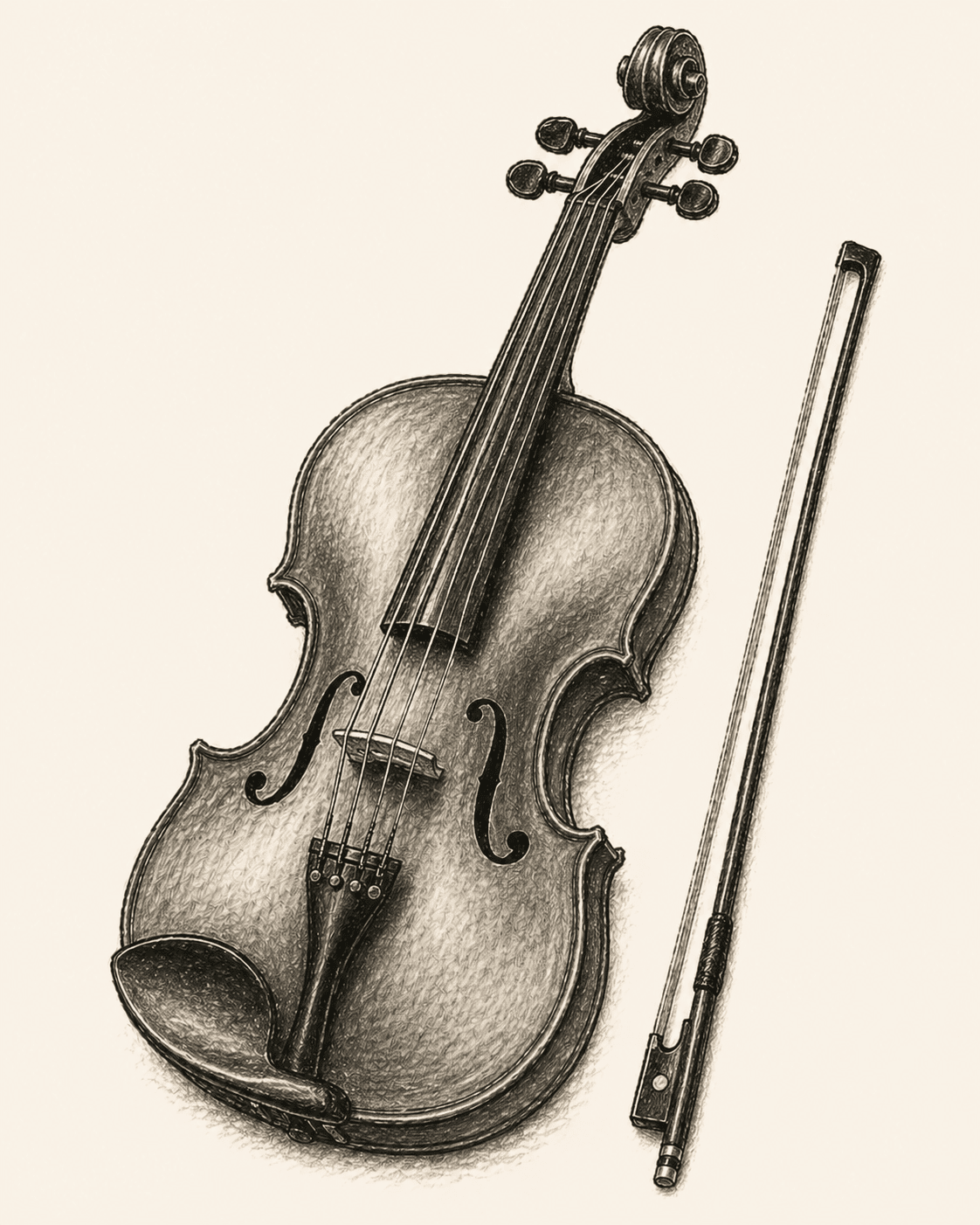
A little larger than the violin — though never quite as large as its acoustics would wish — and tuned a perfect fifth below.
The viola is the string family’s great compromise. Acoustically it ought to be half again the size of the violin; held under the chin, it cannot be. So the player and the maker between them have, for four centuries, conspired in a small fiction — a body slightly too small for its lowest string, slightly too large to be played as a violin — and the result is a voice unlike any other in the orchestra.
It is the inner voice. Beneath the violins, above the cellos, the viola carries the harmonies that bind the strings together — and, on its own, a timbre that is by turns warm, husky, plaintive, even hollow. The nineteenth century thought of it as the alto of the choir. The twentieth gave it concertos and asked it, finally, to sing alone.
Mechanism
In its parts the viola is a violin enlarged: spruce belly, maple back and ribs, ebony fingerboard, a soundpost set just inside the bridge foot. Four strings — C, G, D, A — each tuned a perfect fifth above the last, and a perfect fifth below the violin throughout. The bow is heavier than the violin’s and a little shorter, weighted to draw a fuller sound from the thicker strings.
Body lengths range, by long custom, from about thirty-nine to forty-three centimetres — there is no single standard. A larger instrument speaks more on the C string and rewards a player with the reach for it; a smaller one is lighter under the chin and nimbler in the upper register. Every violist chooses their compromise.
Voice and Character
Berlioz — who heard the viola more clearly than most of his contemporaries — wrote that “of all the instruments in the orchestra, the one whose excellent qualities have been longest misunderstood is the viola.” He set out, in Harold en Italie, to correct the misreading. He did not entirely succeed; the viola has remained, even now, a little misunderstood. But the music written for it since gives the lie to the old jokes.
The instrument’s great gift is the colour of its middle. It is grainier than the violin and lighter than the cello, and the harmonics it produces — particularly in the lower two strings — give it a peculiar, slightly veiled quality that orchestrators have learned to use as a shadow under the brighter voices. Mahler knew this. So did Strauss, and Bartók, and Britten.
“Of all the instruments in the orchestra, the one whose excellent qualities have been longest misunderstood is the viola.”
— Hector Berlioz, Treatise on Instrumentation
Write for the viola as for an alto voice that has lived a little. It is capable of brilliance — but it is more often eloquent, and that is the gift to take.
A little larger than the violin — though never quite as large as its acoustics would wish — and tuned a perfect fifth below.
The viola repays the composer who hears it as itself, and not as a violin one fifth lower. A few habits, kept in mind, will save the line from sounding either swallowed or shrill.
- i.Write in alto clef. It is the viola’s native country. Treble clef belongs only to passages that would otherwise climb a ladder of ledger lines.
- ii.Honour the C string. It is the instrument’s deepest colour, but it speaks slowly. Give it room to sound, and do not crowd it from above.
- iii.Mind the A string. Above the seventh position the tone grows thin, even nasal — the very edge of the instrument’s voice. Use it for character, not for shine.
- iv.Double sparingly with violins. An octave below first violins, the viola adds depth; in unison it is simply absorbed. Better to pair with seconds, or to let it sing alone.
- v.Trust divisi in the section. Six or eight violas in three or four parts can carry an entire harmony — a colour the violins cannot match and the cellos cannot lift.
Beyond these few rules, write with the player in mind. A violist will tell you what is grateful — and, more usefully, what falls under the fingers without strain.
The full compass
C₃ to E₆ — three octaves and a third in working hands.
The compass extends from the open C₃ — a perfect fifth below the violin’s G string — to a high E₆ in skilled hands, and beyond on rare occasion. Four regions, one for each string, repay study.
Grave
The C string — dark, husky, a little reluctant. Slow to speak under the bow, magnificent under a sustained phrase. The colour Mahler reaches for when he wants the strings to deepen without thickening.
Tenore
The G string. Round, warm, the most violoncello-like of the viola’s voices. Particularly grateful for inner counterpoint and for arioso writing — a baritone register, secure in itself.
Cantabile
The D and lower A strings — the singing register, where most great solos live. Open and lyrical, neither dark nor brilliant, with a slight grain that the violin cannot produce. The country of Walton, of Bartók, of Strauss’s Sancho Panza.
Acuto
High on the A string — bright, narrow, sometimes pinched. The territory of soloists; in the section it is best reserved for moments of strain or radiance, and seldom held long.
A little larger than the violin — though never quite as large as its acoustics would wish — and tuned a perfect fifth below.
The viola shares the bowed-string vocabulary of its smaller cousin, but speaks it in a slower, lower, more deliberate accent. The longer string lengths take a fraction more time to set in motion; the bow wants a touch more weight; the player who has come to the viola from the violin must learn, above all, patience. What it loses in immediacy it returns in warmth, in shadow, in the particular husk of the C string — the lowest voice in the family until the cello begins.
Standard techniques
The default détaché on the viola is broader and slightly slower of speech than on the violin. Legato sits very naturally on the instrument and is, in many ways, its native register; martelé, staccato, and the off-string bowings — spiccato, sautillé, ricochet, jeté — all work, though each requires a touch more bow weight to speak cleanly. Louré (portato), tremolo both bowed and fingered, trills, and double-stops are all idiomatic; the viola’s wider string spacing makes wide double-stops a touch more demanding than on the violin.
Pizzicato, both right- and left-hand, sounds rounder and a little more resonant than on the violin; Bartók pizzicato, the snapped pluck, is more idiomatic here than on the smaller instrument. Natural and artificial harmonics are available throughout, the lower naturals especially full-bodied. Sul ponticello and sul tasto, col legno battutoand the rarer col legno tratto, glissando and the gentler portamento, vibrato and senza vibrato, con sordino and senza sordino: the colours of the family, but inflected by the viola’s graver voice.
Extended techniques
Scordatura has a small but real viola tradition — Mozart’s Sinfonia concertante asks the soloist to tune the instrument up a semitone for added brilliance. Bowing behind the bridge produces unpitched whistles; extreme sul ponticello, pressed almost to white noise, is a favoured colour of the post-war avant-garde. Quarter-tones and finer microtones are reachable in skilled hands; multiple-stop tremolo, prepared techniques (rare and best worked out with the player), and unconventional bow placements all extend the instrument further.
The viola, perhaps more than any other string, rewards the composer who listens for the inner glow of a chord rather than its outline. Use these techniques in service of that glow, and the instrument will give back more than it is asked.
A little larger than the violin — though never quite as large as its acoustics would wish — and tuned a perfect fifth below.
A short, partial list — five places to begin if one wishes to know what the viola can do, and what it has been asked to do by composers who loved it.
- № 01
Berlioz — Harold en Italie
Solo viola throughout
A symphony with viola obbligato — Paganini commissioned it, found it too modest, and never played it.
Listen on Spotify - № 02
Mozart — Sinfonia concertante, K. 364
Andante
The viola, scordatura’d up a semitone, holds its own beside the violin — Mozart loved this instrument and played it often.
Listen on Spotify - № 03
Strauss — Don Quixote
Sancho Panza’s theme
The solo viola as faithful squire — earthy, humorous, gently rueful — paired against the cello’s knight-errant.
Listen on Spotify - № 04
Bartók — Viola Concerto, Sz. 120
Moderato
Left unfinished at the composer’s death and completed by Tibor Serly. Stark, modal, and one of the great viola statements of the century.
Listen on Spotify - № 05
Walton — Viola Concerto
Andante comodo
The opening — a falling sigh on the A string — is by now the instrument’s calling card.
Listen on Spotify
Further entries will be added as our study deepens.
A little larger than the violin — though never quite as large as its acoustics would wish — and tuned a perfect fifth below.
The viola was born almost in the same workshop as the violin — northern Italy, the early sixteenth century — and from the same family of ancestors: the viola da braccio, the arm-held cousin of the leg-held viola da gamba. Indeed, in its earliest decades the word viola covered every member of that family, and only later did it narrow to mean the alto member alone.
The Cremonese makers
Andrea Amati, Gasparo da Salò, and after them the Brescian and Cremonese houses — Maggini, the Amati line, and at the close of the seventeenth century Antonio Stradivari and the Guarneri — gave the instrument its enduring shape. Stradivari’s violas, of which only ten or so survive, are the model from which most modern instruments still descend. He made fewer than he made of any other instrument, and they are accordingly prized.
The classical interior
Through the eighteenth century the viola served, with quiet diligence, as the inner voice of the orchestra and the quartet. Haydn and Mozart wrote for it as for a third hand of the harmony — and Mozart, who played the viola himself, gave it in K. 364 a concertante role equal to the violin. The instrument was not yet a soloist; but it had been listened to by a great composer, and that hearing left its mark.
Berlioz and the romantic reckoning
Berlioz’s Harold en Italie, written in 1834 at Paganini’s request, was the first major work to set the viola at the front of the stage. Paganini disliked it and never played it, but the symphony survived him; and in its wake the nineteenth century gradually came to see the instrument as something other than the third member of the violin family. Wagner, Brahms, and Strauss each in turn deepened that hearing.
The modern instrument
The twentieth century gave the viola its concert career. Lionel Tertis and William Primrose, between them, established it as a solo voice; Walton, Bartók, Hindemith, and Britten wrote concertos and chamber works that no orchestra can now do without. The instrument a player picks up today is, in essentials, the one Stradivari built — but the repertoire, at last, is its own.
Specifications
A summary, for the composer’s desk.
- Family
- Strings, bowed
- Italian
- Viola
- German
- Bratsche
- French
- Alto
- Range
- C₃ — E₆
- Transposition
- Non-transposing; alto & treble clefs
- Tuning
- C₃ — G₃ — D₄ — A₄ (perfect fifths)
- Body length
- Approx. 39–43 cm (15½–17″)
- Strings
- Four, of gut, synthetic core, or steel
- Origin
- Northern Italy, early 16th century