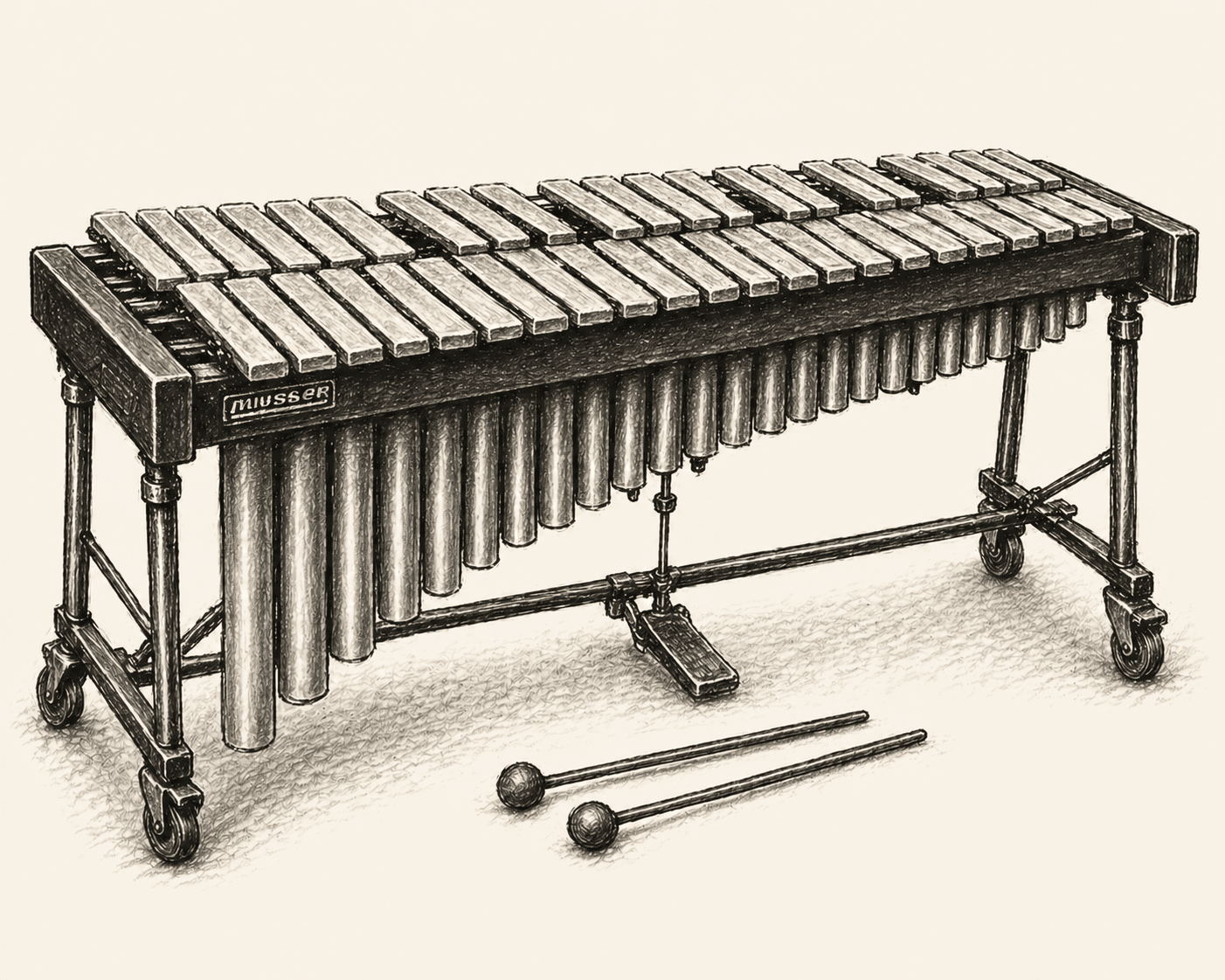
Three octaves of aluminium, suspended above resonators whose fans turn slowly under a small electric motor — and the pedal, that quiet partner, beneath.
The vibraphone is the youngest member of the orchestra’s tuned percussion, and in many respects the strangest. Its bars are not of rosewood but of aluminium; its resonators are stoppered not by air alone but by small rotary discs, turned by a motor at the player’s feet; and beneath the bars sits a long felted bar — a damper — which the foot pedal can lift, allowing every struck note to ring on for as long as the music asks.
It is, then, three instruments at once: a chime, a piano, and a breathing thing. Struck dry, with the pedal up, it speaks like a muted bell. Held with the pedal down, it sustains as no other tuned percussion can. And with the motor running, the slow opening and closing of the resonators sets a gentle vibrato over everything — the feature from which the instrument took its name.
Mechanism
The bars are graduated lengths of aluminium alloy, tuned by removing material from the underside. They lie in two chromatic ranks — naturals nearest the player, accidentals raised behind — strung on cord above their resonator tubes. Inside the top of each tube sits a small rotating disc, or fan; a belt links every fan along the length of the instrument to a low-voltage motor. As the discs turn, they open and close the mouth of each resonator, producing a periodic swelling of tone that the ear hears as vibrato.
Beneath the bars runs the damper bar, faced with felt. At rest it presses lightly upward; the player’s pedal lowers it, freeing the bars to ring. This single mechanism — borrowed in spirit from the piano — is what most distinguishes the vibraphone from the older glockenspiel and xylophone, and what makes the writing for it so unlike anything else in the percussion section.
Voice and Character
The vibraphone’s tone is at once metallic and warm — the bell of the glockenspiel softened by aluminium, sustained by pedal, and dressed by the slow turning of the fans. With yarn mallets and the motor at a slow pulse, it breathes. With harder mallets and the motor off, it takes on a clean, almost wooden attack. It is the most coloured of the tuned percussion, and the most easily over-coloured.
It came late to the orchestra by way of vaudeville and dance band, and it carries that history honestly. Berg gave it its first serious operatic role in Lulu; Messiaen made it a permanent member of his metallic gamelan; Bernstein brought the smoke of the nightclub straight into the pit. Use the instrument to colour, to suspend, to glaze a chord with light — but use it sparingly. A whole orchestra heard through the vibraphone’s wash is no orchestra at all.
“It is the only instrument in the orchestra that asks the composer how long a note should last — and is willing to wait for the answer.”
— paraphrased, from a percussionist’s teaching notes
The vibraphone is still a young instrument, and its repertoire is still being written. Treat it neither as a glockenspiel that sustains, nor as a marimba in metal. It is its own thing, and it knows what it is.
Three octaves of aluminium, suspended above resonators whose fans turn slowly under a small electric motor — and the pedal, that quiet partner, beneath.
The vibraphone rewards thought about three things in particular: the pedal, the motor, and the choice of mallet. Get those right and the rest is craft.
- i.Mark the pedal. Indicate ped. and ✱ as one would for a piano. A vibraphone part written without pedal markings will be guessed at — and almost always wrongly.
- ii.Decide about the motor. Specify motor on (with a tempo, slow or fast) or motor off. Many of the instrument’s most beautiful effects sit at the extremes — the still bar, or the slow swell.
- iii.Choose the mallets, or trust the player. Soft yarn for warmth and sustain; medium for the singing middle; hard cord or rubber for attack. If unsure, write soft and let the player ask.
- iv.Two hands, four mallets — but not always. Most modern players hold two mallets in each hand. Chords of three and four notes are routine; wide rolled chords are idiomatic. Do not assume them in every bar.
- v.Treble clef, sounding pitch. The vibraphone is non-transposing. Write where it sounds, in treble clef, and remember that the bars do not extend below F₃ or above F₆ in standard hands.
Above all, decide what you want from the instrument before you write. The vibraphone is too coloured to use casually; treated with care, it is among the most expressive sounds the orchestra can make.
The full compass
F₃ to F₆ — three octaves, sounding as written.
The standard vibraphone runs three octaves, from F₃ at the foot to F₆ at the top. A few extended instruments descend to C₃ or rise above F₆, but only the standard compass should be assumed. Three regions repay study.
Basso
The lowest octave — woody, dark, and surprisingly tender. With the pedal down and soft yarn, a single low chord will hum for several seconds. Hard mallets here turn the bars to muted bells.
Medio
The singing middle. Most of the instrument’s great solos live here — the register at which the motor’s vibrato is most audible, and at which the vibraphone most resembles its inventors’ idea of a “human” sound.
Acuto
Bright, glassy, struck more than sustained. The very top approaches the sound of the glockenspiel and is best used in punctuation rather than line — single notes, brief figures, or the topmost voice of a quiet chord.
Three octaves of aluminium, suspended above resonators whose fans turn slowly under a small electric motor — and the pedal, that quiet partner, beneath.
Of all the orchestra’s tuned percussion the vibraphone has the richest expressive vocabulary, and the one most shaped by the twentieth century. Its aluminium bars and pedal-controlled dampers permit a true legato; its motor-driven fans give a characteristic shimmer; and its idiom — first developed in jazz, and long since absorbed into the concert literature — assumes a player who is, by training, both colourist and accompanist.
Standard techniques
Medium yarn mallets are the orchestral default. Single strokes and rolls — single-stroke or alternating tremolo — make up the body of the writing, and the four-mallet idiom (Stevens or Burton) is now assumed in any serious solo or chamber writing. Double stops, chordal voicings, and independent four-mallet counterpoint are entirely natural to a contemporary player.
Two devices distinguish the vibraphone from its cousins. The first is the foot pedal, which raises and lowers a long damper bar above the keyboard: pedal up, the notes are stopped at the moment of release; pedal down, they ring on. Pedalling is the instrument’s central expressive lever — written, marked, and phrased exactly as for the piano. The second is the motor, which spins small fans inside the upper ends of the resonators and so introduces a periodic opening and closing that the ear hears as vibrato; strictly the effect is amplitude modulation rather than vibrato proper, but the name has stuck. The motor may be turned on or off, and its speed adjusted, between or within passages.
Mallet dampening — a technique imported from jazz, and largely the contribution of Gary Burton — uses the head of one mallet to stop a still-ringing bar while another sounds; the player thus articulates an unbroken melodic line beneath continued pedalling. Dead strokes, in which the mallet is pressed into the bar at the moment of striking, give a dry secco accent. Pitch bending is possible by pressing a mallet hard against a bar and drawing it slowly outward, lowering the perceived pitch by a small interval — a colour, more than a melodic device.
Extended techniques
Bowing the bars, with a contrabass or cello bow drawn across the edge, is among the vibraphone’s most famous extended effects: the long aluminium bars sustain magnificently, and the sound is at once eerie and luminous. Crumb, Reich, and many since have written it into the heart of their scoring. Turning the motor on or off mid-phrase — or asking for it stopped, with the fans angled open or closed — gives a further shading of timbre.
Prepared vibraphone — a sheet of paper laid across the bars, a strip of foil between bar and resonator — yields buzzes and rattles in the manner of John Cage’s prepared piano, and appears occasionally in modernist scoring. Harmonics, drawn softly with a fingertip lightly touching a node of a long bar, are obtainable but rare. As with all such effects, ask the player; the vibraphone is the keyboard percussion most accustomed to being asked.
The vibraphone is, more than its cousins, a singing instrument. Write for the pedal; write for the silence between notes; and the rest will largely take care of itself.
Three octaves of aluminium, suspended above resonators whose fans turn slowly under a small electric motor — and the pedal, that quiet partner, beneath.
A short, partial list — five places to begin if one wishes to know what the vibraphone has been asked to do, and what it has been willing to give.
- № 01
Berg — Lulu
Throughout
The first major operatic role for the instrument — Berg uses it as a chromatic shadow, halfway between bell and breath.
Listen on Spotify - № 02
Messiaen — Turangalîla-Symphonie
Joie du sang des étoiles, and throughout
Set beside celesta and glockenspiel, the vibraphone forms the heart of Messiaen’s metallic gamelan — voluptuous, ringing, slow to fade.
Listen on Spotify - № 03
Bernstein — West Side Story
Somewhere; Cool
A nightclub instrument lifted into the pit. The motor runs slow, the pedal is held, and the chord hangs suspended over the strings.
Listen on Spotify - № 04
Britten — Spring Symphony
The Driving Boy
Bright, struck, motor off — a pricked light against the boys’ chorus, more bell than breath.
Listen on Spotify - № 05
Milhaud — Concerto for Marimba and Vibraphone, Op. 278
Lent et lourd
A single soloist trades sticks between the two instruments. The slow movement is the vibraphone alone — pedalled, hovering, almost still.
Listen on Spotify
Further entries will be added as our study deepens.
Three octaves of aluminium, suspended above resonators whose fans turn slowly under a small electric motor — and the pedal, that quiet partner, beneath.
The vibraphone is, by orchestral standards, almost new. It was assembled in Indianapolis in the early nineteen-twenties, in the workshops of the Leedy Manufacturing Company, where the engineer Hermann Winterhoff was experimenting with motor-driven resonators beneath a set of steel marimba bars. By 1924 the instrument had a name — vibraphone — and a small place in vaudeville novelty acts, but neither yet a settled form.
The Deagan refinement
The decisive step was taken in 1927 by Henry Schluter at the rival firm of J. C. Deagan in Chicago, who replaced Leedy’s steel bars with aluminium, redesigned the resonator fans, and — most consequentially — added a piano-style damper pedal. The instrument that emerged is, in essentials, the vibraphone we know today; only the materials and motors have been refined since.
Jazz and the dance band
For a generation the vibraphone belonged to the dance band. Lionel Hampton took it up in the early thirties; Red Norvo, Milt Jackson, and Gary Burton followed. The instrument acquired its characteristic mannerisms there — slow motor, soft yarn, four mallets — long before any conservatoire began to teach it. Modern orchestral writing for the vibraphone still owes much of its vocabulary to those years.
Berg, Messiaen, and the orchestra
Berg’s Lulu, begun in 1929, gave the vibraphone its first serious operatic role; Messiaen, twenty years later, made it the anchor of the metallic gamelan in Turangalîla. From there the instrument entered the standard orchestra in earnest — quietly at first, then everywhere. By the second half of the twentieth century, scarcely a major work for orchestra and percussion was written without it.
The modern instrument
The modern vibraphone is essentially Schluter’s design with better bearings. Bars are tuned with greater precision, motors are quieter and continuously variable, and the standard three-octave compass from F₃ to F₆ is settled almost everywhere. A handful of extended-range instruments exist, but the composer who writes for the standard model writes for the instrument that nearly every section in the world will own.
Specifications
A summary, for the composer’s desk.
- Family
- Percussion, tuned (idiophone)
- Italian
- Vibrafono
- German
- Vibraphon
- French
- Vibraphone
- Range
- F₃ — F₆ (standard, 3 octaves)
- Transposition
- Non-transposing; treble clef, sounds as written
- Bars
- Aluminium alloy, graduated, in two ranks
- Resonators
- Tuned tubes with motor-driven rotary discs
- Damper
- Felted bar lifted by a foot pedal — sustain at will
- Mallets
- Yarn- or cord-wrapped, of varied hardness
- Origin
- United States, c. 1921 — Leedy Manufacturing, Indianapolis