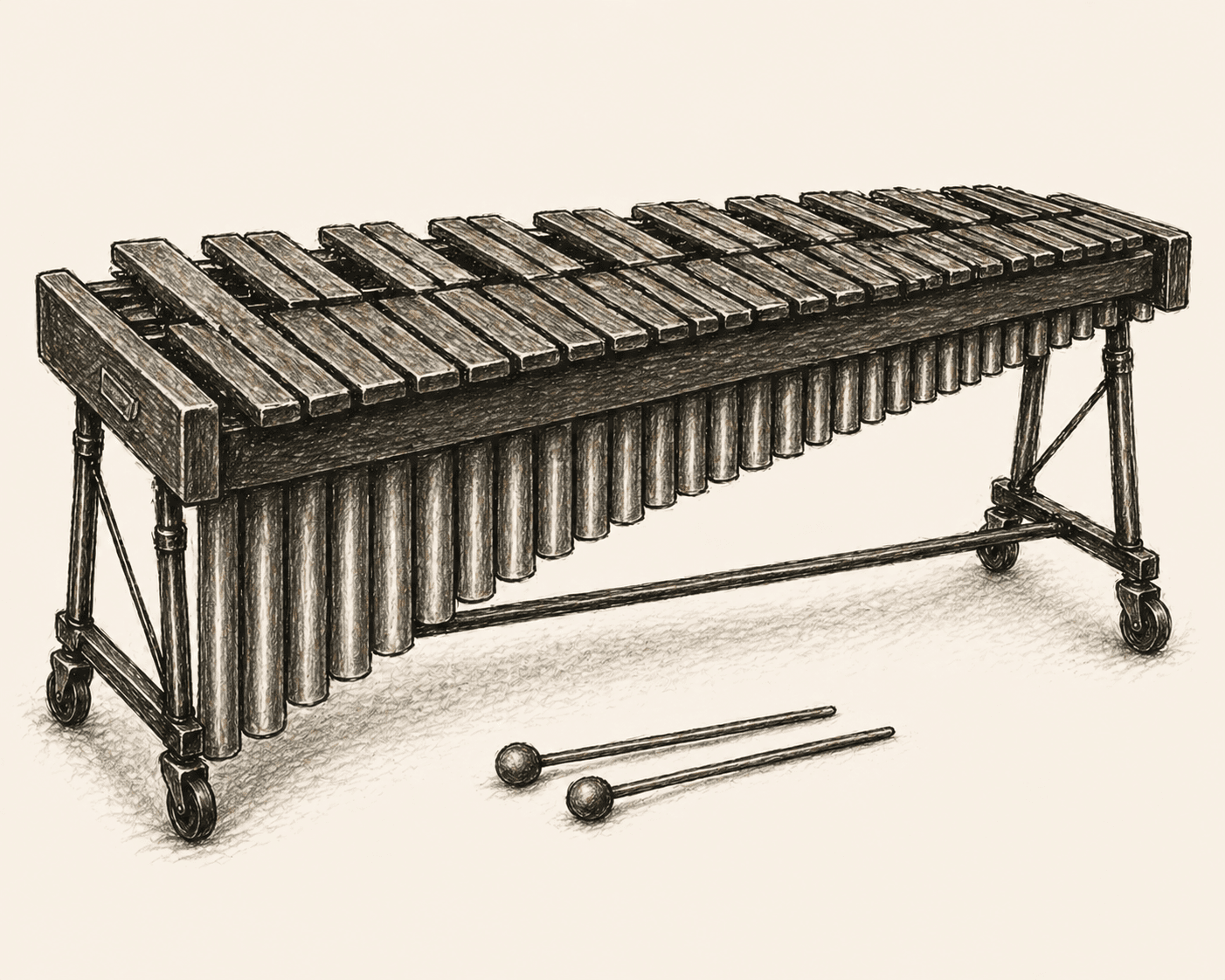
A graduated keyboard of rosewood bars, each suspended above its own tuned resonator — a small architecture of pitch.
Of all the orchestra’s tuned percussion, the marimba is the warmest — and, by some margin, the most recently arrived. Its bars are of seasoned rosewood, broad and thick, tuned not only at the pitch but also at the octave and twelfth above; beneath each bar hangs a metal tube cut to length, a resonator that lends the note its bloom. The result is a sound at once woody and singing, percussive and sustained.
It is an instrument that asks for two hands, and increasingly four mallets — the modern player carries two in each hand and so plays chords as readily as lines. Its lowest octave booms; its highest glints; the long middle is where it sings. To know the marimba is to understand that its pitch is brief but its overtone is generous, and that the player’s touch, more than the stick, makes the tone.
Mechanism
The bars — most often of Dalbergia stevensonii, the Honduran rosewood, though synthetic equivalents are now common — are arranged as on a piano, naturals before, accidentals raised behind. Each bar is bored at its nodal points and rests on cords; each is undercut on its underside to tune the fundamental, the second partial at the octave, and the third at the twelfth. Below, the resonator tubes — capped and cut to a quarter-wavelength — amplify the strike without colouring it.
The mallets are softer than those of the xylophone: yarn or cord wound over a rubber core, in hardnesses from the gentlest to the firm. A change of mallet changes the instrument as surely as a change of bow changes a violin. The composer who specifies soft or hard mallets is not being fussy — they are choosing the timbre.
Voice and Character
The marimba does not declaim. It speaks. Where the xylophone is bright and biting, the marimba is round and dark; where the glockenspiel pierces, the marimba bathes. It can disappear into the harp, double the cellos at the octave, or stand quite alone — and it sustains, by means of the tremolo roll, longer than any other tuned percussion. The roll is not an effect. It is the instrument’s legato.
It is also, it must be said, an instrument of recent welcome to the orchestra. Messiaen wrote for it; Boulez wrote for it; the minimalists adopted it wholesale; in the present day no large score is without one. Composers still tend to under-use it. They are beginning to learn.
“The marimba is the orchestra’s long memory — the one instrument that remembers what wood once sounded like.”
— paraphrase, after a marimbist of our acquaintance
Write for the marimba neither as a piano nor as a drum. It is its own category — and rewards the composer who treats it so.
A graduated keyboard of rosewood bars, each suspended above its own tuned resonator — a small architecture of pitch.
The marimba is a generous instrument that is easily smothered. A few habits, observed early, keep its voice in the orchestra rather than beneath it.
- i.Use two staves. Notate the marimba as one would a piano — treble above, bass below — and ledger lines will trouble nobody.
- ii.Specify the mallets. Soft, medium, hard — the choice transforms the timbre. Indicate it at every change, not only at the start.
- iii.Trust the roll. A rolled note is the marimba’s sustained tone; mark it tr~~~~ or with the conventional roll sign and the player will understand.
- iv.Mind the orchestration around it. The low register, beautiful in chamber music, is easily lost beneath a tutti — pair it with light textures, or none at all.
- v.Four mallets, not two. Modern players carry two in each hand. Chords of three and four notes are entirely idiomatic — write them without apology.
Beyond these, consult the player. The percussionist will know the instrument at hand, its compass and its mallets, and will tell you what the page should say.
The full compass
C₂ to C₇ — five octaves on the modern concert instrument.
The compass extends from C₂ — the great-octave C below the bass staff, added to the standard instrument only in the late twentieth century — to a high C₇, four octaves above middle C. Four regions repay study.
Basso
The five-octave instrument’s lower fifth — broad, woody, and slow to bloom. Glorious for soft pedal-tones and rolled chords; easily smothered by anything thicker than chamber strings.
Tenore
The instrument’s baritone — round, sustaining, the natural home of slow lyric writing. Here the marimba speaks most clearly with two mallets per hand.
Acuto
The singing register — bright but not piercing, agile, and unmistakable. Most solo writing lives here, and most orchestral doublings: with flutes, with celesta, with harp.
Sopracuto
The topmost octave — dry, glassy, almost xylophone-like. Brief flashes only; the bars are short and the resonance fleeting.
A graduated keyboard of rosewood bars, each suspended above its own tuned resonator — a small architecture of pitch.
Of all the keyboard percussion the marimba is the most resonant, and the one whose technique has, in the last half century, grown the furthest. Its long rosewood bars and tuned tube resonators give it a sustain unattainable on the xylophone, and its writing — solo, chamber, orchestral — has come increasingly to assume a four-mallet player at the keyboard. The vocabulary that follows is that player’s.
Standard techniques
The marimba is played with mallets of yarn, cord, or rubber wound in yarn — softer than those of the xylophone, and graded by weight to suit the register. The lower bars demand heavier heads; the upper, lighter. The four-mallet idiom is now central: a player holds two mallets in each hand, by the Stevens grip or the Burton, and commands a vocabulary of independent strokes, double laterals, single independent strokes, and chordal voicings. Solo repertoire — Smadbeck, Abe, Sejourné, Druckman — assumes it without comment.
Single strokes, in two-mallet writing, give clarity of line; the roll, single-stroke or alternating tremolo, is the marimba’s means of sustain, and a fine player will spin a melodic line across a long roll with the legato of a singer. Dolce passages — the warm, wooden tenor of the instrument — depend on soft mallets and a gentle attack; the lower bars, with their long resonators, will sustain a phrase as long as the music asks. Double stops are entirely natural; the four-mallet idiom extends them to chords of three and four notes, voiced and revoiced within the hands.
Extended techniques
Bowing the bars, with a contrabass or cello bow drawn across the edge, is more effective on the marimba than on the xylophone — the bars are longer, and the resonators speak — and yields a sustained, ghostly tone, used to fine effect by recent composers. Dead strokes, in which the mallet is pressed into the bar at the moment of striking, damp the resonance and leave only the attack: a percussive secco that contrasts beautifully with the marimba’s native sustain.
Mallet-shaft taps on the bars give a hard, dry wooden click; fingertip rolls — the bar struck repeatedly with the pads of the fingers — produce a softer, warmer tremolo than mallets can manage, used in a small body of contemporary writing. Prepared marimba (paper laid upon the bars, foil between bar and resonator) appears occasionally and gives a buzz or rattle on attack. Harmonics, drawn very softly with a fingertip lightly touching the node of a long bar, are real but rare and reserved for specialist writing.
The marimba responds to almost any colour the writer asks of it, provided the writer remembers what the instrument fundamentally is — a wooden voice, deep and warm, whose every note is born already in the act of dying away.
A graduated keyboard of rosewood bars, each suspended above its own tuned resonator — a small architecture of pitch.
A short, partial list — five places to begin if one wishes to know what the marimba can do, in the orchestra and out of it, in less than a century of concert life.
- № 01
Messiaen — Turangalîla-Symphonie
Throughout, in the keyboard percussion trio
Marimba, vibraphone, and glockenspiel braided together — a gamelan transplanted into the modern orchestra.
Listen on Spotify - № 02
Steve Reich — Drumming, Part II
For nine marimbas and voices
A long, patient unfolding of phase and pulse — the instrument as both rhythm and resonance.
Listen on Spotify - № 03
Creston — Concertino for Marimba, Op. 21
First movement, Vigorous
The first concerto written for the modern instrument, in 1940 — bright, athletic, unembarrassed.
Listen on Spotify - № 04
Reich — Six Marimbas
Whole work
Six players, twelve hands, a single shimmering object — the marimba choir at its most exposed.
Listen on Spotify - № 05
Schwantner — Velocities
Moto perpetuo for solo marimba
Five minutes of unbroken sixteenths — a study in stamina, evenness, and the four-mallet grip.
Listen on Spotify
Further entries will be added as our study deepens.
A graduated keyboard of rosewood bars, each suspended above its own tuned resonator — a small architecture of pitch.
The marimba is, by inheritance, an African instrument. Bar-keyboards with gourd resonators are documented across sub-Saharan Africa for many centuries, and were carried by enslaved peoples to the Americas in the sixteenth and seventeenth. In Guatemala and southern Mexico the instrument took root and flourished, becoming, over the nineteenth century, the national voice of both countries.
From folk to concert
The Hurtado brothers of Guatemala toured Europe and the United States in the early twentieth century, astonishing audiences with an instrument no one had previously heard. Their tours seeded the ground; American instrument-makers — most consequentially the J. C. Deagan company of Chicago — set about turning the folk instrument into a concert one. By the 1910s the marimba had metal resonators, tuned overtones, and a chromatic keyboard.
The first concertos
Paul Creston’s Concertino of 1940 and Darius Milhaud’s Concerto for Marimba and Vibraphone of 1947 gave the instrument its first canonical solo works. Clair Omar Musser, a marimbist of formidable ambition, organised marimba orchestras of a hundred players and toured them; the instrument acquired, almost overnight, a literature.
Messiaen, Boulez, and the orchestra
Olivier Messiaen welcomed the marimba into the symphony orchestra in Turangalîla of 1948, pairing it with vibraphone and glockenspiel in a trio that has since become standard. Pierre Boulez wrote for it in Le Marteau sans maître, scoring it among the alto flute and viola — the marimba as chamber instrument, not effect. By the late twentieth century Reich, Adams, Saariaho and others had made it indispensable.
The five-octave instrument
The modern five-octave marimba — descending to the low C₂ — is largely a development of the 1980s, championed by the Japanese marimbist Keiko Abe in collaboration with the Yamaha company. It is now the default instrument of the concert hall, though four-octave and four-and-a-third-octave instruments persist for travel and for the older repertoire.
Specifications
A summary, for the composer’s desk.
- Family
- Percussion, tuned idiophone
- Italian
- Marimba
- German
- Marimba (Marimbaphon)
- French
- Marimba
- Range
- C₂ — C₇ (modern five-octave)
- Transposition
- Non-transposing; written at sounding pitch on two staves
- Bars
- Honduran rosewood, or synthetic — graduated in length
- Resonators
- Tuned metal tubes, one beneath each bar
- Mallets
- Yarn- or cord-wrapped, of varying hardness; two to six in hand
- Origin
- Africa, ancient; modern concert form, United States, early 20th century