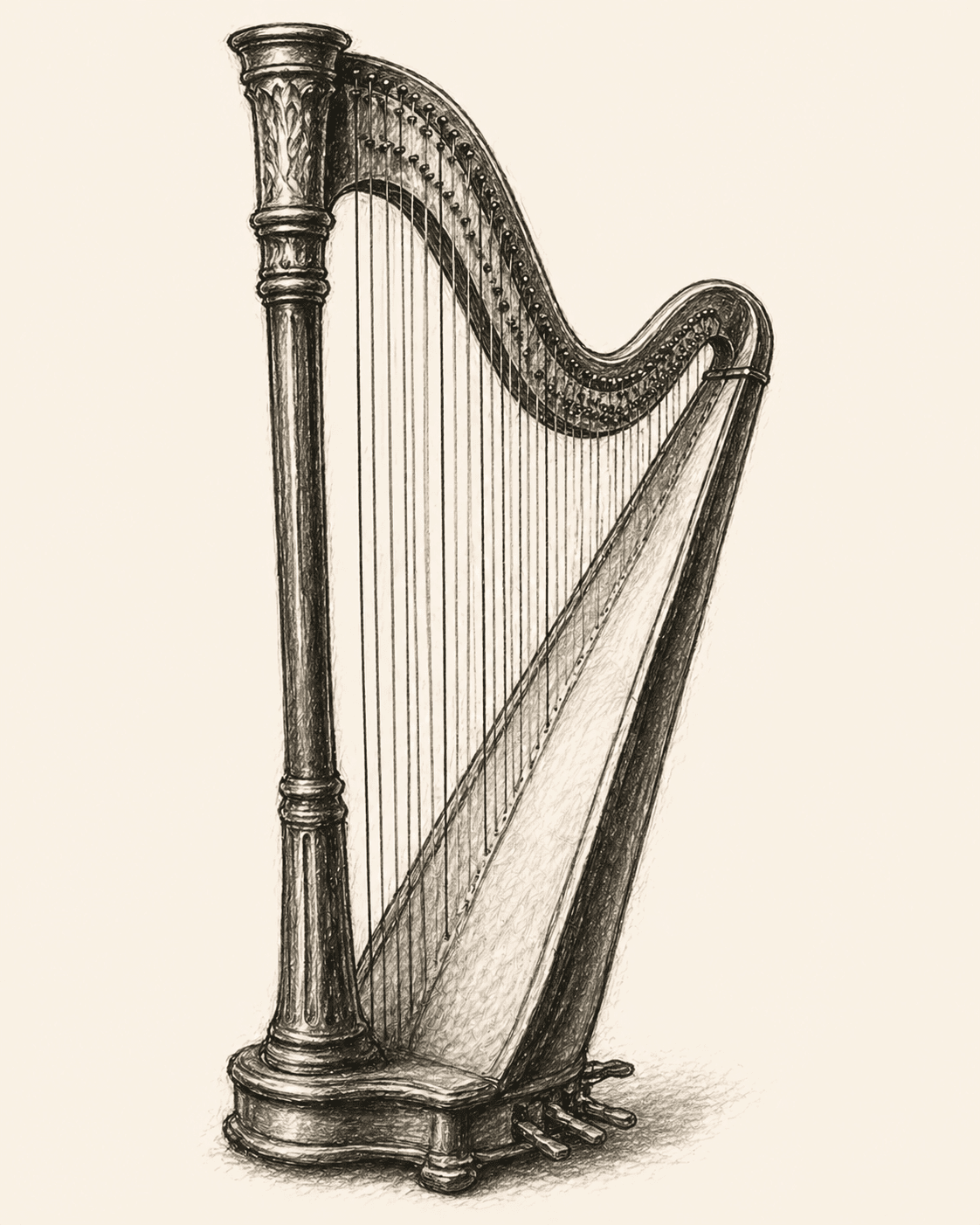
Forty-seven strings stretched between neck and soundboard, with seven pedals at the base — the whole instrument a single resonator, leaned back upon the player’s shoulder.
The harp is the orchestra’s elder, and yet — owing to a Parisian workshop and a patent of 1810 — it is also one of its most modern instruments. Forty-seven strings tuned to the white keys of C♭ major; seven pedals beneath the foot, each governing a string-name across all seven octaves; and a body of spruce and maple that sings, when struck, like the corner of a great wooden room.
The strings are coloured: red for every C, black or blue for every F, natural for the rest. The hand learns them as the eye learns a keyboard. The lowest two octaves are wire-wound, dark and bell-like; the middle, of gut, is the singing register; the highest, of nylon, is thin, glassy, fragile. To know the harp is to know which of these three materials your music is asking for.
Mechanism
Each of the seven pedals — D, C, B, E, F, G, A, in the foot’s order — passes through three positions: flat, natural, and sharp. A linkage of rods within the column carries the pedal’s motion up to a pair of toothed disks at the neck. The disks pinch the string at one of two points along its length, shortening it by a precise semitone or two. This is the double action, perfected by Sébastien Érard, and it is what makes the harp chromatic — within limits.
The limits are real. A pedal change governs every string of its name at once: every C, every F. Enharmonic respellings are therefore the harpist’s native tongue; rapid chromatic figures are not. The composer who would write idiomatically must think in pedal diagrams, or — what amounts to the same — must consult the player.
Voice and Character
The harp’s tone decays. Every note is a struck bell, sustained only by the slow ringing of the soundboard; every chord is a memory the instant after it is sounded. This decay is the harp’s great expressive resource. Arpeggios bloom and fade; bisbigliando trembles at the threshold of audibility; the harmonics, plucked at the half-string, speak an octave above with a tone like distant glass.
For all its delicacy, the instrument can carry. A single fortissimo chord, well voiced, will cut through a full string section; two harps in unison, as Berlioz first showed, can lift a waltz out of itself. And in the pianissimo — the territory of the late Romantics — the harp is unmatched: only it can sustain a quiet figure beneath a high solo violin without seeming, somehow, to insist.
“The harp is older than music itself, and yet it answers, with patience, to every new thing the orchestra asks of it.”
— paraphrased from Berlioz’s Treatise on Instrumentation
Write for the harp as you would for the rarest member of the orchestra — sparingly, attentively, and with a clear ear for what only it can do. The instrument will reward you in kind.
Forty-seven strings stretched between neck and soundboard, with seven pedals at the base — the whole instrument a single resonator, leaned back upon the player’s shoulder.
The harp is the most idiomatic of the orchestral instruments — that is to say, the most likely to embarrass a composer who writes for it as if it were a piano. A few habits, observed early, will spare much rewriting.
- i.Think in pedals, not in pitches. A scale of C♭ major lies under the hands; a scale of F♯ major requires every pedal to move. Plan the chromatic geography before you plan the line.
- ii.Respell enharmonically. The harp can sound a B and a C♭ on different strings — a great convenience for trills, glissandi, and rapid alternation. Use the spelling the player needs, not the one the theorist wants.
- iii.Glissandi belong to the pedals. A glissando across the open strings will give whatever scale the pedals are set to: pentatonic, whole-tone, dominant-seventh, octatonic. Choose the pedal diagram, then write the gesture.
- iv.Notate as for piano, but sparer. Two staves, treble and bass. Four notes per hand is the practical maximum; three sounds better; two is often best of all.
- v.Let the notes ring — or stop them. A harp note rings until damped. Mark laissez vibrer where you want the bloom; étouffé or sec where the music must be cleared. The silence is part of the instrument.
Beyond these habits, the principle is simple. Show the part to a harpist before the parts are printed. They will repay the courtesy in kind.
The full compass
C♭₁ to G♯₇ — six and a half octaves.
The compass extends from a low C♭₁ — sounding only when the C pedal is lowered to its first detent — to a high G♯₇, the topmost string. Four regions repay study, each distinguished by the material of its strings as much as by its sound.
Basso
Wire-wound strings, dark and slow to decay. The harp at its most bell-like; superb for pedal points, sparse arpeggios, and the long, ringing low octaves that anchor a tutti.
Tenore
Gut strings, the singing centre of the instrument. Most chordal writing lives here, and the warmest harmonics; this is the register the harp shares most graciously with the strings and the woodwinds.
Acuto
Still gut, but tighter and brighter. The territory of cadenzas, glissandi, and the high tracery beneath a soloist. Plucks speak quickly; the decay is shorter, the attack more silvery.
Sopracuto
Nylon strings — thin, glassy, and almost without sustain. Use sparingly, and never for melody; in the right voicing they shimmer, but they tire easily and break under pressure.
Forty-seven strings stretched between neck and soundboard, with seven pedals at the base — the whole instrument a single resonator, leaned back upon the player’s shoulder.
The harp’s expressive vocabulary lies along two axes — the fingers of the player and the seven pedals beneath. The fingers pluck; the pedals tune. Almost every characteristic effect of the instrument, from the gentlest arpeggio to the most violent glissando, is the joint product of those two simultaneous activities. To write well for the harp is, above all, to think pedalistically.
Standard techniques
The default sound is the diatonic plucking of strings with the pads of the fingers — the harpist uses four fingers per hand, the little finger reserved out of long custom. Within this framework lie chords, broken chords, octaves, and arpeggios across one or both hands. The instrument’s most famous gesture, the glissando, is a sweep of the finger or thumb across the strings, the pedals having first been set to determine the underlying scale; by skilful use of enharmonic spellings — F♯ written as G♭, for instance — the composer can colour a glissando with unusual modes, pentatonic and whole-tone among them.
Harmonics are produced by stopping the string at its midpoint with the side of the palm and plucking with the thumb or finger of the same hand; they sound an octave higher than the written note, with a soft, bell-like clarity that is among the loveliest sounds in the orchestra. Damping — sons étouffés or simply étouffé — silences a string with the palm immediately after plucking, giving a dry, pizzicato-like articulation. Rapid scale and arpeggio writing depends entirely on the pedal scheme: a passage in C major flows easily, while one in F♯ minor may require a moment’s anticipation to set the pedals. Enharmonic re-spelling, used cleverly, allows pedal changes to be anticipated or avoided altogether.
Extended techniques
Près de la table, plucking close to the soundboard, draws a nasal, guitar-like tone — an effect Debussy and Ravel both favoured. Pedal slides, in which the pedal is moved while the string still rings, produce a glissando on a single string of roughly a semitone, eerie and unexpected. Bisbigliando — literally whispering — is a soft tremolo on two strings tuned to the same pitch by enharmonic spelling, a shimmering wash first written into the orchestra by Berlioz. The xylophonic effect, achieved by plucking with a fingernail or laying paper across the strings, mimics the dry attack of mallets; tapping or knocking on the soundboard provides percussive colour.
Carlos Salzedo, in the early twentieth century, codified a whole catalogue of harp effects — the gushing chord, the oboic flux, imitations of tam-tam and Aeolian harp — that remain in the modern player’s vocabulary. The pedal buzz, produced by a string vibrating against a partly-set pedal disc, is a noisier cousin. Prepared harp, with paper, cloth, or metal woven into the strings, has a small but real literature; microtones can be obtained by setting a pedal between two of its three positions, though tuning is approximate and the technique must be planned with the player.
These extended colours have, in time, become part of the harp’s ordinary vocabulary. Used with care they remind the listener that the instrument is, beneath its mythology, a remarkably resourceful machine — and one whose secrets continue to be discovered.
Forty-seven strings stretched between neck and soundboard, with seven pedals at the base — the whole instrument a single resonator, leaned back upon the player’s shoulder.
A short, partial list — five places to begin if one wishes to know what the harp can do, and what it has been asked to do by composers who studied it carefully.
- № 01
Tchaikovsky — The Nutcracker
Waltz of the Flowers, cadenza
A moment of pure ornament — the harp alone, conjuring the ballroom out of nothing before the strings enter.
Listen on Spotify - № 02
Debussy — Danses sacrée et profane
Both dances, throughout
Written for the chromatic harp and inherited by the pedal harp; the instrument as soloist, the strings its quiet companion.
Listen on Spotify - № 03
Ravel — Introduction et Allegro
Solo passage and cadenza
Commissioned by Érard to advertise the double-action harp. It still does — every harpist learns it; few master it.
Listen on Spotify - № 04
Berlioz — Symphonie fantastique
Un bal, second movement
Two harps in the waltz, glittering across the strings. The first orchestral writing to take the modern harp at its full word.
Listen on Spotify - № 05
Mahler — Symphony No. 5
Adagietto
A single harp, slow arpeggios beneath the strings — the pulse of the movement, and almost its only motion.
Listen on Spotify
Further entries will be added as our study deepens.
Forty-seven strings stretched between neck and soundboard, with seven pedals at the base — the whole instrument a single resonator, leaned back upon the player’s shoulder.
The harp is older than written music. Bowed harps appear in Sumerian reliefs of the third millennium bc; angular harps follow in Egypt; the triangular frame harp arrives in medieval Europe and crosses, century by century, from Ireland into the salons of the continent. Every later instrument is a refinement of that frame.
The hooked harp
The Baroque harp was diatonic — tuned to a single key, and helpless outside it. Around 1700, a Tyrolean maker fitted the neck with manual hooks, each capable of shortening a string by a semitone. The hooks were turned by hand, one at a time. Bach knew this instrument. So did Handel, who wrote for it the concerto in his oratorio Alexander’s Feast.
The single action
In Bavaria, around 1750, the hooks were replaced by pedals: seven of them, each linked by rods within the column to disks at the neck. Press a pedal and every string of one name was sharpened by a semitone. This was the single action harp — the instrument of Mozart’s concerto for flute and harp, of Krumpholtz’s sonatas, and of the salon at Versailles.
Érard and the double action
In 1810, in Paris, Sébastien Érard patented the double action: the same pedal, now with two detents, each engaging its own pair of disks. The harp was, at last, fully chromatic — within the constraints of its seven pedals — and tuned in the curious key of C♭ major so that every accidental would be reachable in either direction. Érard’s design has been refined a thousand times since, but never replaced.
The modern instrument
The concert harp of today — Lyon & Healy in Chicago, Salvi in Piasco, Camac in Mouzeil — is recognisably Érard’s. Berlioz, hearing it new, scored it with a freedom previous composers could not have imagined; Wagner doubled it; Debussy and Ravel made it indispensable; Britten, Boulez, and Saariaho extended it into the present. Of all the orchestra’s strings, it is the one whose modern repertoire most clearly belongs to a single workshop’s patent.
Specifications
A summary, for the composer’s desk.
- Family
- Strings, plucked
- Italian
- Arpa
- German
- Harfe
- French
- Harpe
- Range
- C♭₁ — G♯₇
- Transposition
- Non-transposing; treble & bass clefs, on two staves
- Strings
- 47 — gut and nylon, with wire in the bass
- Pedals
- Seven, double-action; three positions each
- Height
- Approx. 1.85 m (6′ 1″)
- Origin
- Ancient; modern double-action perfected in Paris, 1810