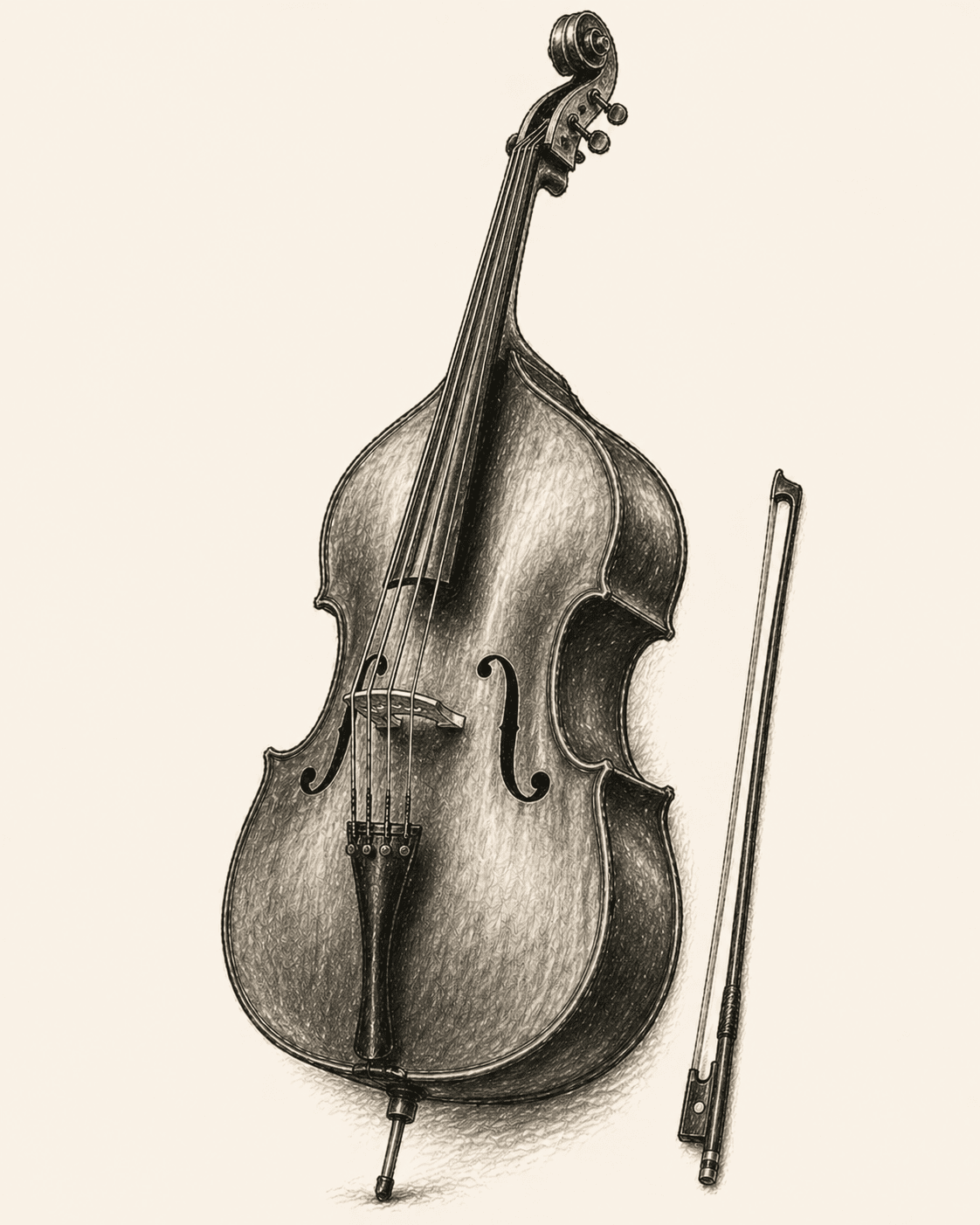
Sloped shoulders, flat back, four strings tuned in fourths — the instrument is a viol in everything but the company it keeps.
The double bass is the orchestra’s foundation, and a curious immigrant among its strings. Where the violin, viola, and cello are tuned in fifths and shaped after a single archetype, the bass is tuned in fourths and built — at least in lineage — from another family entirely. It is the last surviving member of the viol consort, walking among the violins by long arrangement rather than birth.
That heritage is audible. The bass speaks more slowly than the cello, sustains less easily, and carries a faint reedy graininess at the bottom of its register — qualities that make it the perfect bearer of the orchestra’s low line and a difficult, but rewarding, soloist. Its fundamental task is to give weight: every harmony, every cadence, every pizzicato downbeat in the score rests on it.
Mechanism
The instrument stands nearly six feet tall, with a body of roughly forty-five inches. Sloped shoulders — a remnant of the viol — make the upper positions reachable; the flat back is another inheritance, kept for resonance and weight. Four strings are standard, tuned E₁, A₁, D₂, G₂; many orchestras require a fifth string tuned to B₀, or a mechanical extension on the E string, to reach the lowest C of Bach and Mahler.
Two bows persist into the present. The French bow is held from above, like the cello’s; the German, descended from the viol bow of Dragonetti, is held from below in an underhand grip. Each has its partisans, and most professional sections include both. For the composer, the distinction is invisible.
Voice and Character
Berlioz, who heard the bass in the new orchestras of his century, found its tone “deep, powerful, and well-suited to give the characteristic features either to a serious or a savage style.” He was right on both counts. A line of basses, low and slow, can lend Beethoven the weight of a sermon; the same instrument, stopped high in thumb position, can carry the cantabile of a Bottesini concerto.
The bass is also the orchestra’s great pizzicato voice. A plucked bottom string speaks with the dry, percussive thump that no other instrument can imitate — Mahler knew it, Stravinsky knew it, every jazz bassist since has known it. Used in this way, the bass section is less a string choir than a kind of pitched percussion.
“Take away the basses, and the orchestra becomes a roof without walls.”
— said, in many forms, by many conductors
Write for the bass and you are writing for the floor of the room. Anything placed upon it will be felt before it is heard.
Sloped shoulders, flat back, four strings tuned in fourths — the instrument is a viol in everything but the company it keeps.
The double bass is generous to the composer who treats it as a bass first, and ungenerous to the one who forgets that it is also a string instrument with its own peculiar weight and slowness.
- i.Write at sounding pitch in your head, an octave higher on paper. The bass is a transposing instrument by tradition — notation lies an octave above the sound. Doublings with the cello will, accordingly, sit an octave below them.
- ii.Mind the lowest fourth. Below E₂ written, the section divides between four-string instruments, five-string instruments, and C extensions. Specify what you want, and provide an ossia where you can.
- iii.Allow time. The strings are long, the bow is heavy, and the lowest notes need a small but unmistakable moment to speak. Hurried bass lines lose their bottom.
- iv.Choose the clef the music asks for. Bass clef as a rule; tenor clef for sustained passages above the staff; treble clef in the rare reaches of solo writing — never to spare a few ledger lines.
- v.Trust the pizzicato. A bass pizzicato carries further than its dynamic suggests, and dies sooner than a cello’s. Notate the duration only if you mean it; the player will give you a beautiful natural decay if you don’t.
Write what the bass section can do well, and they will play it. Write what only a soloist can do, and you will hear it from one stand and nothing from the rest.
The full compass (written)
E₂ to C₅ written — sounding an octave below.
The compass extends from the open low E — written E₂, sounding E₁ — up to a written C₅ in skilled hands and beyond by harmonics. Five-string instruments and C-extensions descend further still. Four regions repay study.
Basso
The open territory of the lowest two strings. Ponderous, resonant, slow to speak — the ground the orchestra stands on. Rapid passagework here belongs to the soloist, not the section.
Tenore
The middle of the instrument — D and G strings in the lower positions. The bass at its most articulate, capable of rapid figuration and a clear singing tone, with the cellos a fifth or so above.
Acuto
The G string climbed past the open neck and into thumb position. Vocal, faintly nasal, capable of true cantabile. Mahler, Strauss, and Wagner all knew its weight; the section can do it well, with rehearsal.
Sopracuto
High thumb position and the territory of natural harmonics. The province of the soloist; in the section, treat it as decoration rather than line. The Bottesinis of the world will reach further still.
Sloped shoulders, flat back, four strings tuned in fourths — the instrument is a viol in everything but the company it keeps.
The double bass is the slowest-speaking and most physical of the bowed strings. Its long, thick strings ask for time and weight from the bow; its left hand stretches across half-tones where the cellist plays whole. The orchestral bassist works with two distinct bows — the French, held overhand like the cellist’s, and the German (or Dragonetti), held underhand with the palm facing upward — each producing its own grain and attack. The vocabulary that follows is the family’s, transposed downward and slowed accordingly.
Standard techniques
Détaché on the bass is a stroke of weight rather than speed; legato requires a generous bow distribution; rapid passagework wants careful phrasing and, often, simplification. Martelé and staccato are weighty and emphatic rather than nimble. The off-string bowings — spiccato, sautillé, ricochet, jeté — are all possible, but ask considerably more of the player than they do of the violinist; spiccato in particular is at its best in moderate tempi, and grows leaden when pressed too quickly. Louré (portato) and the long bowed tremolo are both idiomatic; fingered tremolo is heavier than on the upper instruments and slower of attack.
Pizzicato is one of the bass’s glories — the open low E and A ring magnificently, and the section pizzicato is among the orchestra’s most reliable colours. Left-hand pizzicato is harder than on the smaller strings, the stretches greater, and is best used sparingly. Bartók pizzicato, the snapped pluck, is violent and unmistakable on the bass and should be reserved for moments that warrant it. Slap bass, inherited from the jazz tradition, has begun to find its way into the orchestral score, and gives a percussive cluck that is wholly distinctive.
Natural harmonics on the bass are extraordinary — the long strings give them a clarity and resonance that smaller instruments cannot match, and a register an octave above the open string that is, in effect, a second instrument. Artificial harmonics are possible but require careful writing. Trills, double-stops, and rolled chords are all idiomatic; glissando and portamento have a particular gravity here, the slide audibly traversing every position. Sul ponticello, sul tasto, col legno battuto and the rarer col legno tratto, vibrato and senza vibrato, con sordino and senza sordino all behave as in the rest of the family, but at the bass’s own pace.
Extended techniques
Scordatura has a notable bass tradition, the lowest string sometimes tuned down to C or even B♭ in solo writing; the modern five-string bass and the C-extension on the E string achieve the same end mechanically. Bowing behind the bridge gives a darkly ringing wash; extreme sul ponticello presses to a low, breathy white noise; bow placement near the nut produces an unfamiliar, glassy edge. Quarter-tones and finer microtones are within reach in skilled hands; multiple-stop tremolo, prepared techniques (rare, best worked out with the player), and percussive effects on the body of the instrument all enlarge the palette.
Of all the strings, the bass rewards economy most. A single low note, allowed to ring, will say more than a busy figure poorly suited to the instrument’s nature.
Sloped shoulders, flat back, four strings tuned in fourths — the instrument is a viol in everything but the company it keeps.
A short, partial list — five places to begin if one wishes to know what the double bass can do, and what it has been asked to do by composers who heard it carefully.
- № 01
Mahler — Symphony No. 1
Third movement, opening
A solo bass intones Frère Jacques in minor — the most exposed entrance ever asked of the section.
Listen on Spotify - № 02
Saint-Saëns — Le Carnaval des animaux
L’éléphant
A waltz in the lowest register, ponderous and tender at once. The bass as character actor.
Listen on Spotify - № 03
Beethoven — Symphony No. 9
Finale, recitative
Cellos and basses speak before the voices do — instrumental song in everything but name.
Listen on Spotify - № 04
Verdi — Otello
Act IV, Desdemona’s death
Four solo basses, divisi, descending to a low B — a sound few in the audience can name, and none forget.
Listen on Spotify - № 05
Bottesini — Concerto No. 2 in B minor
Andante
The bass as cantabile soloist, in the high thumb position — Paganini of the contrabbasso.
Listen on Spotify
Further entries will be added as our study deepens.
Sloped shoulders, flat back, four strings tuned in fourths — the instrument is a viol in everything but the company it keeps.
The double bass is the orchestra’s lone survivor of the viol family. Its sloped shoulders, flat back, and tuning in fourths are Renaissance inheritances; its presence among violins is the work of a slow seventeenth-century compromise, by which the deepest voice of one consort was transplanted into another and never sent home.
The violone
The instrument’s direct ancestor is the violone — the great bass viol of the sixteenth and seventeenth centuries, played underhand with a viol bow and tuned variously in fourths and thirds. As the violin family rose and the consort declined, the violone alone refused to disappear; the orchestra needed something to play below the cello, and there it was.
The Baroque and Classical bass
Through the eighteenth century the bass was an unstandardised creature, with three, four, or five strings, and tunings that varied by city. Vienna kept a five-string instrument tuned in thirds; Italy, France, and England settled gradually upon four. Haydn and Mozart wrote for it as a doubling instrument, a sixteen-foot shadow of the cello — a function it has never wholly relinquished.
Dragonetti, Bottesini, and the soloist
Two players changed the instrument’s standing. Domenico Dragonetti, the Venetian who astonished Beethoven, established that the bass could be played with the agility of a cello. Giovanni Bottesini, in the next generation, wrote concertos for it that demanded — and got — a singing thumb position no one had previously believed in. By 1850 the bass was, at last, an instrument that could stand alone.
The modern instrument
Standardisation arrived gradually. The four-string instrument tuned in fourths is now the orchestral norm, with the German bow predominant in Central Europe and the French bow elsewhere. Five-string instruments, and the C extension fitted to the E string, allow the section to reach the lowest written notes of the late-Romantic and modern repertoire — the C of Bach’s passions, the B of Verdi and Mahler. The bass a player picks up today would be familiar enough to Bottesini, who would recognise the bow, the strings, and the labour of the lowest octave.
Specifications
A summary, for the composer’s desk.
- Family
- Strings, bowed
- Italian
- Contrabbasso
- German
- Kontrabass
- French
- Contrebasse
- Range
- E₁ — C₅ (sounding); written an octave higher
- Transposition
- Sounds an octave below written; bass, tenor & treble clefs
- Tuning
- E₁ A₁ D₂ G₂ — in fourths
- Height
- Approx. 1.8 m (6′); body c. 115 cm
- Strings
- Four, sometimes five (low B₀ or C₁ extension)
- Bow
- French (overhand) or German (underhand)
- Origin
- Italy, early 17th century