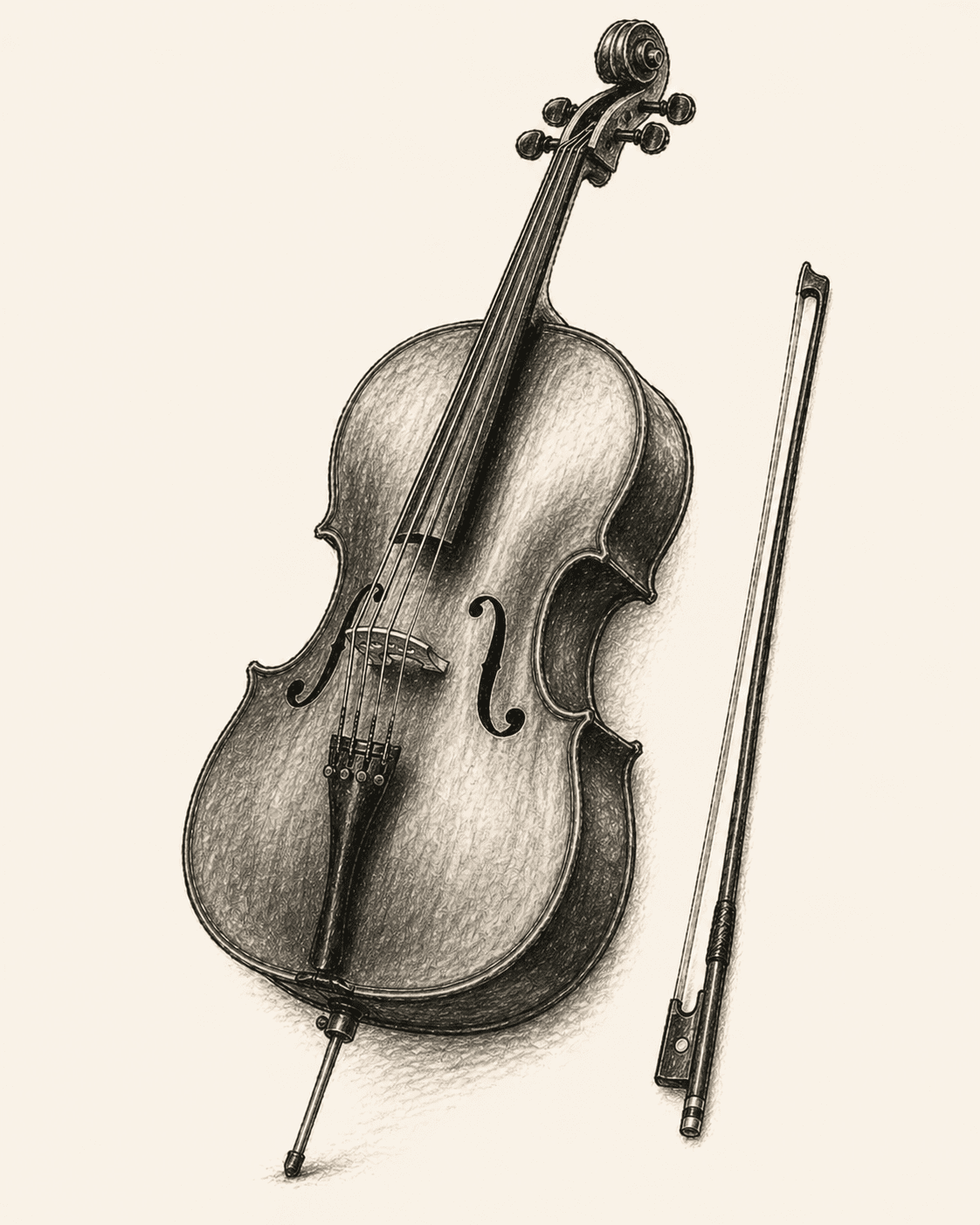
The instrument rests on a steel endpin between the player’s knees — its long body of spruce and maple shaped to project a baritone voice.
The violoncello is the instrument that, of all the orchestra, sings nearest to the human voice. Its compass spans from the chest of a bass to the head of a tenor; its bow draws warmth from four strings tuned in fifths; and its body — long enough to require an endpin and a player’s seated embrace — gives back a tone that has been called, more often than any other, noble.
It is, in the strings, the great middle voice. Above it the violins flicker; below, the basses ground. The cello holds the centre — and is therefore asked, in the orchestra, to do almost everything: to sing the melody, to anchor the harmony, to drive a rhythm, to murmur a countersubject, to console. It is, after Bach, perhaps the most thoroughly explored solo instrument we possess.
Mechanism
The cello is built like a violin grown to four times its weight: a spruce belly, maple back and ribs, an ebony fingerboard, four strings tuned C₂ — G₂ — D₃ — A₃. Inside, a small spruce sound postcouples the two plates and carries vibration; a slender bass-bar runs beneath the lowest string. The bow — usually pernambuco, some 73 cm long and rather heavier than a violin’s — is held overhand, fingers flexible, the wrist quiet.
The endpin, an apparently humble steel rod, is the great quiet innovation of the late nineteenth century. Before it, the cello was gripped between the calves; after it, the player sits straight, the instrument tilted to meet the bow. Tone, projection, and stamina all improved at once.
Voice and Character
Pablo Casals, who knew the instrument as well as anyone in the last century, said only that he played the cello “to bring out what is in it.” The character he found there — and helped audiences hear — was confiding, gravely warm, and, in the upper register, oddly luminous. The cello does not project like a trumpet. It draws the listener forward.
It is also, in section, the orchestra’s most reliable rhetorician. A choir of cellos — six, eight, ten of them — bowing a slow line in unison is among the most stirring sounds the strings can make. Tchaikovsky knew this, and Wagner, and Mahler. The cellos rarely shout. When they speak together, they are usually heard.
“The cello is like a beautiful woman who has not grown older, but younger with time, more slender, more supple, more graceful.”
— Pablo Casals
Write for the cello as you would write for a singer. Give it air, give it line, and trust it to carry the meaning of what it is given.
The instrument rests on a steel endpin between the player’s knees — its long body of spruce and maple shaped to project a baritone voice.
The cello is generous to the composer who knows its registers and unkind, in performance, to the one who does not. A few habits will save the writer many awkward bars.
- i.Treat it as a singer. A cello melody wants breath, shape, and a destination. Phrases that would suit a baritone will almost always suit the cello.
- ii.Know the open strings. C, G, D, A — the harmony of these four pitches will resonate sympathetically. Lines that pass through them ring; lines that avoid them sound a degree drier.
- iii.Choose the right clef. Bass clef as a rule; tenor clef from about middle C upward; treble clef only when the line lives genuinely high. Switching too early tires the eye.
- iv.Mind the thumb. Above E₄ the player’s thumb leaves the neck and moves onto the fingerboard. The territory is supple but slower to negotiate — write idiomatically, not athletically.
- v.Use the section as a chorus. Eight cellos in unison are a great voice; eight cellos in divisi are an entire string quartet of their own. Both are underused.
Beyond these, write with the player in mind. A cellist will tell you what is possible — and, more usefully, what is beautiful.
The full compass
C₂ to C₆ — four octaves, with skilled players climbing higher.
The compass extends from the open C₂ — the floor of the string section before the basses — up through four octaves and, in virtuoso hands, a little beyond. Four regions repay study.
Basso
The C and G strings — dark, resonant, a little gruff at the bottom. The natural ground of the section, and the orchestra’s preferred bass beneath divided strings.
Tenore
The D string and the lower reaches of the A — the singing centre of the instrument. Most great cello melodies live here. Vocal, warm, supremely expressive.
Acuto
The upper A string. Brighter, more focused, with the keening quality of a tenor at the top of his range. Tenor clef is the natural home; treble feels premature.
Sopracuto
Thumb position — luminous, vocal, sometimes thin. A region for soloists and for moments earned. Used carelessly, it whistles; used well, it floats.
The instrument rests on a steel endpin between the player’s knees — its long body of spruce and maple shaped to project a baritone voice.
The cello carries the bowed-string vocabulary into a deeper, more speaking register, and adds to it a few possibilities of its own. The instrument is large enough to be felt as well as heard; the bow is heavier; the strings are longer and slower to set in motion. Its idiom is therefore declamatory by nature — a tenor or baritone voice equipped with the violin’s grammar and a wider, slightly slower articulation.
Standard techniques
Détaché on the cello is broad and full; legatosings naturally on every string. Martelé and staccato speak with a particular incisiveness in the lower register, where the bow’s weight does most of the work. The off-string bowings — spiccato, sautillé, ricochet, jeté — are all available, though they sit a little less easily than on the violin and are most idiomatic in the upper half of the bow. Louré (portato) suits the instrument particularly well, as does the long tremolo, bowed or fingered.
Trills and double-stops are everywhere idiomatic; chords of three and four notes can be rolled or, in shorter durations, played as broken arpeggiations across the strings. Pizzicato, both right- and left-hand, is full and resonant — the cello’s pizzicato is among the most beloved sounds in the orchestra. Bartók pizzicato, the snapped pluck, finds a natural home here. The cellist’s thumb position, in which the side of the thumb stops the strings as a movable nut, opens the upper registers and unlocks chord and harmonic figurations impossible on the violin.
Harmonics, both natural and artificial, are abundant — the long strings give the natural harmonics a bell-like clarity that no smaller instrument matches. Glissando, portamento, sul ponticello, sul tasto, col legno battuto and the rarer col legno tratto, vibrato and the cooler senza vibrato, con sordino and senza sordino: the family vocabulary, in the cello’s speaking voice.
Extended techniques
The cello has been the great laboratory of the post-war string avant-garde. The famous textural contrast in Penderecki’s Threnody — the shimmer of extreme sul ponticelloagainst the breath-like veil of sul tasto — was first heard, in many ears, on cellos and double basses. Bowing behind the bridge produces a wash of unpitched harmonics; bow placement near the nut gives an unfamiliar, glassy ring; scordatura has a long cello tradition (Bach’s Fifth Suite asks the A string lowered to G).
Quarter-tones and finer microtones, multiple-stop tremolo, prepared techniques (rare, and to be worked out with the player), unusual bow speeds and pressures: all are within reach. The instrument is large enough, and slow enough, to make even modest gestures register. Use them deliberately — and the cello, perhaps the most humane voice in the orchestra, will speak them as if they were its own.
The instrument rests on a steel endpin between the player’s knees — its long body of spruce and maple shaped to project a baritone voice.
A short, partial list — five places to begin if one wishes to know what the cello can do, and what it has been asked to do by composers who loved it.
- № 01
Bach — Suite No. 1 in G, BWV 1007
Prelude
A single voice that becomes, by some quiet magic of the bow, a polyphony. Every cellist begins here.
Listen on Spotify - № 02
Dvořák — Concerto in B minor, op. 104
First movement, soloist’s entry
A homecoming written from exile — the cello speaks at last, after long orchestral preparation, and seems to arrive from another country.
Listen on Spotify - № 03
Elgar — Concerto in E minor, op. 85
Opening recitative
Four bars, alone, marked nobilmente — the voice of a man surveying ruins. The piece never recovers its composure, and is the better for it.
Listen on Spotify - № 04
Strauss — Don Quixote
Throughout
The solo cello is the knight himself. Ironic, gallant, increasingly delusional — and at the close, on his deathbed, suddenly sober.
Listen on Spotify - № 05
Rossini — Guillaume Tell, Overture
Opening
Five solo cellos, alone in the dawn, before any other instrument has stirred. A small chamber inside the orchestra.
Listen on Spotify
Further entries will be added as our study deepens.
The instrument rests on a steel endpin between the player’s knees — its long body of spruce and maple shaped to project a baritone voice.
The violoncello emerged in northern Italy in the early sixteenth century, the bass member of the new violin family — distinct from the older viola da gamba, which it would, over the next two hundred years, slowly displace. Andrea Amati of Cremona is among the first makers whose cellos survive; the dimensions he settled upon were, after much variation, more or less what we play today.
The Baroque
Through the seventeenth century the cello was, above all, a continuo instrument — anchoring the bass line beneath harpsichord and singer. Then, between 1717 and 1723, J. S. Bach wrote the six suites for solo cello, and the instrument was given a literature it has never exhausted. By the time of Boccherini — himself a fine cellist — the cello had begun to step forward as a soloist in its own right.
Stradivari and the form
Antonio Stradivari, working in Cremona around the turn of the eighteenth century, fixed the cello’s proportions with what now seems an almost finality. His so-called forma B — slightly smaller and more compact than the giants of the previous generation — set the size that nearly every modern instrument follows. The great Cremonese cellos of 1700–1730 remain the unrivalled reference points of the tradition.
The Romantic voice
The nineteenth century gave the cello its modern role: a singer. The endpin arrived; the bow was perfected by Tourte; the instrument was strung at higher tension. Schumann, Brahms, Saint-Saëns and Dvořák each wrote concertos that pushed it firmly into the foreground; and in the symphonies of the period — Tchaikovsky’s, Mahler’s — the section was asked to carry slow movements alone, in a way that a century earlier would have seemed impossible.
Casals and the modern era
At the close of the nineteenth century the young Pablo Casals rediscovered, in a second-hand shop in Barcelona, a copy of Bach’s solo suites — works which until then were treated as exercises. He spent twelve years studying them in private before performing one in public. The recording he eventually made redrew the imagination of every cellist who came after. The instrument the modern player picks up is, in design, three centuries old; in expressive ambition, it is largely Casals’s.
Specifications
A summary, for the composer’s desk.
- Family
- Strings, bowed
- Italian
- Violoncello
- German
- Violoncello (Cello)
- French
- Violoncelle
- Range
- C₂ — C₆ and above
- Transposition
- Non-transposing; bass, tenor & treble clefs
- Tuning
- C₂ — G₂ — D₃ — A₃, in fifths
- Body length
- Approx. 75 cm (29½″)
- Bow
- Pernambuco, approx. 73 cm; horsehair
- Origin
- Northern Italy, early 16th century