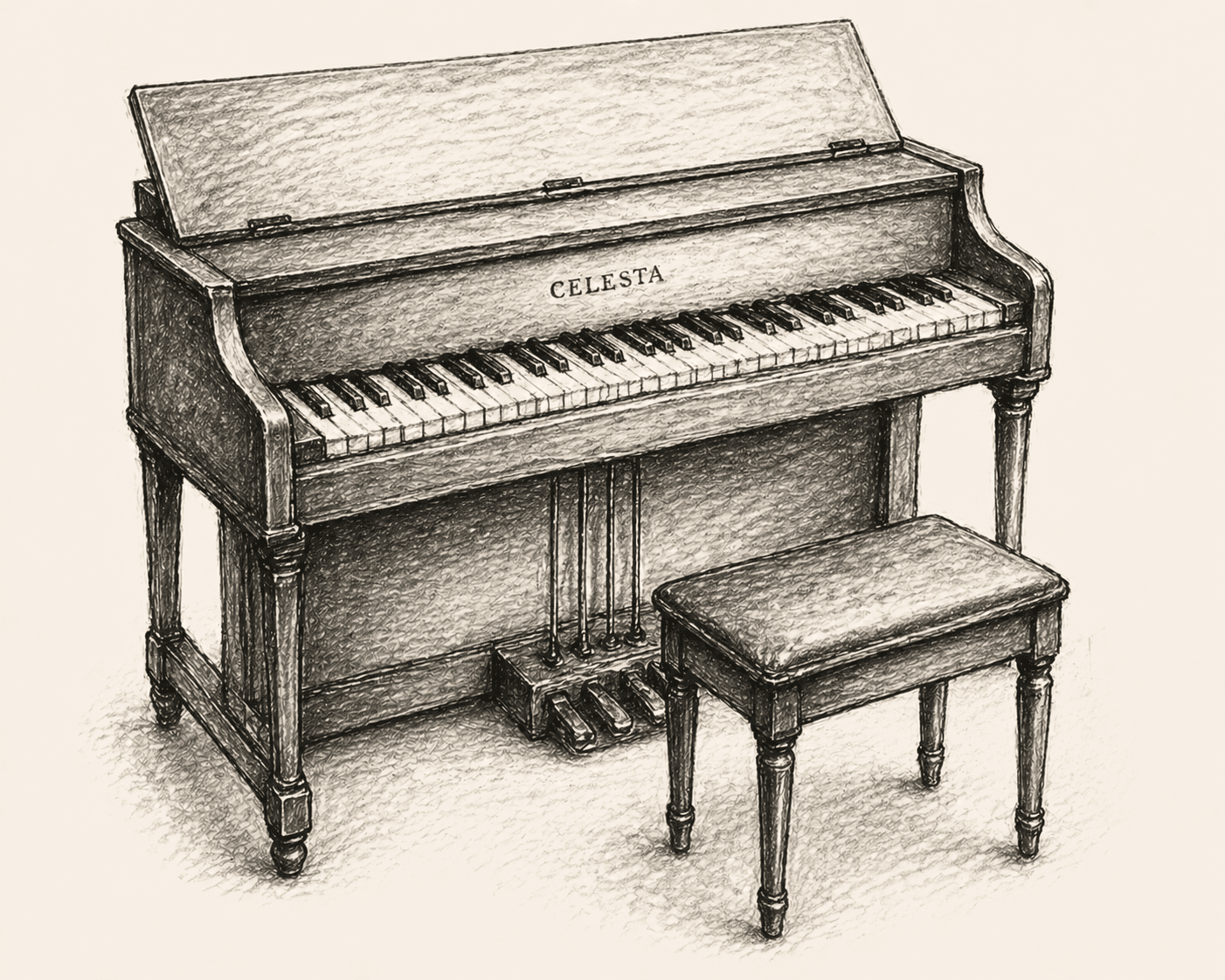
In appearance, a small upright piano — within, a rank of steel plates suspended above resonating boxes of cedar.
The celesta is the youngest of the orchestra’s keyboards, and the quietest. It looks, at first glance, like a small upright piano; it is played from a piano-style keyboard; and yet within its modest cabinet is a rank of steel plates, struck by felted hammers and laid above wooden resonators, whose sound — silvery, sustained, faintly bell-like — belongs to no other instrument in the orchestra.
It does not project. A single celesta against a forte tutti will be lost; a single celesta against a hushed string chord will seem to descend from the rafters. Its great composers have always known this, and have written for it as one writes for a candle in a dark room — carefully, and with the understanding that what surrounds the light is as important as the light itself.
Mechanism
Within the cabinet, each key is linked by a simple action to a small felt-headed hammer, which strikes a tuned plate of steel. Beneath the plate sits a wooden resonator — a closed box, tuned to the plate’s partial — which lengthens the tone and softens its attack. A single sustain pedal, on the model of the piano, lifts the dampers from the plates and allows them to ring.
The instrument is built today by only a small handful of makers — the original house of Mustel in Paris until its closure, and Schiedmayer of Stuttgart, which has built the modern standard since the early twentieth century. Most concert celestas have a five-octave compass and a keyboard scaled exactly to a piano’s, so that a pianist may sit at one without surprise.
Voice and Character
Tchaikovsky, who first heard the celesta in Paris in 1891, wrote at once to his publisher of “a new instrument, something between a small piano and a Glockenspiel, with a divinely beautiful tone.” He swore him to secrecy, lest Rimsky-Korsakov or Glazunov hear of it first. The instrument, in his Sugar Plum Fairy, has not since been outclassed in its own idiom.
The character is fixed: pure, cool, slightly otherworldly. It cannot crescendo; its dynamic range is narrow. But within that narrow range it can suggest enchantment, sleep, or distance more efficiently than almost any other instrument in the orchestra. Bartók made of it a creature of the night; Holst, of the cold edge of the solar system; Mahler, of a star seen from a battlefield.
“Something between a small piano and a Glockenspiel, with a divinely beautiful tone.”
— Tchaikovsky, letter to Jurgenson, 1891
It is an instrument of moments rather than movements. Used sparingly — a phrase, a chord, a glittering descent — the celesta will lift the whole texture around it. Used continuously, it tires the ear. Honour its quietness. Let it surprise.
In appearance, a small upright piano — within, a rank of steel plates suspended above resonating boxes of cedar.
The celesta is a small instrument with a large mythology. A few habits of mind, kept close, will keep the writing honest.
- i.Notate at the sounding pitch, octave-displaced. The celesta is written on two staves like the piano, and sounds an octave above what is written. Mark the part clearly; players expect both staves and the convention.
- ii.Reserve it for quiet textures. Against a tutti the celesta is inaudible. Place it against muted strings, harp, soft winds — or alone — and it will speak.
- iii.Favour the upper octaves. The lowest octave is muffled and dim; the top three glitter. The instrument’s memorable solos almost all sit between C₅ and C₇ written.
- iv.Write idiomatically for the keyboard. A celestist is a pianist. Octaves, broken chords, scalic flourishes — these read at sight. Awkward stretches and chromatic clusters do not.
- v.Mind the decay, and the pedal. The tone rings on, slowly, after the key is released. A pedalled chord blooms; a dry one is over before it began. Mark pedalling as you would for the piano.
Most orchestras own one celesta; many borrow. Plan for the instrument to live a little outside the percussion section — its player is often a keyboardist on hire, and its placement on stage is rarely settled until the morning of the rehearsal.
The full compass
C₃ to C₇ as written — sounding an octave higher.
The compass spans five octaves on the keyboard, written C₃ to C₇ and sounding an octave higher. Four regions of character lie within it.
Grave
The lowest octave. Muffled, woody, faintly indistinct — the resonators are large and the steel speaks slowly. Useful as a shadow beneath the upper hand; rarely interesting alone.
Medio
The instrument’s warm middle. Tone is balanced, sweet, and noticeably more present than the octave below. Good for inner voices and for chords that wish to be heard but not seen.
Acuto
The Sugar Plum register. Pure, silvery, ringing — the part of the instrument every great solo has lived in. Project is best here, and the decay long enough to make legato singing convincing.
Sopracuto
The top two octaves. Brilliant, glassy, and brief — the steel decays quickly up here. Reserve it for glittering effects, scalic descents, and the occasional star.
In appearance, a small upright piano — within, a rank of steel plates suspended above resonating boxes of cedar.
The celesta is the most reticent of the orchestra’s tuned percussion. It is, in form, a small upright keyboard; its hammers strike not strings but graduated steel bars suspended over wooden resonators; and its sound — a soft, silvery glimmer — is more or less the same at every dynamic the player can give it. It is, by nature, an instrument of timbre rather than of articulation, and its expressive vocabulary lies almost entirely in how it is scored, not in how it is played.
Standard techniques
The celesta is played from a piano-style keyboard, and a keyboardist will sit down to it without difficulty. The mechanism — felted hammers striking steel bars — gives a soft, bell-like attack, but very little in the way of dynamic shading: the instrument has nothing approaching the dynamic range of the piano, and most of its writing lives between piano and mezzo-forte. Write louder than that and the orchestra will simply cover it.
The instrument has no una corda in the piano sense; the single foot pedal is a sustain pedal, raising the dampers from the bars and allowing them to ring. It is the celesta’s chief expressive lever, and is used precisely as on the piano — to colour, to blur, to sustain a chord or a single note across a rest. Beyond pedalling and a careful touch, the celesta does not much reward technical refinement: it gives what it gives, and the composer’s task is to know that limitation and to write within it.
Extended techniques
The celesta has, in candour, very few extended techniques. The bars are enclosed within the case and beneath the action; reaching them with a mallet, a bow, or the fingers requires the case to be open, and the instruments commonly hired for orchestral use are not built to accommodate it. Plucking the bars, striking them directly, or bowing them is theoretically possible on certain modern instruments, and a small body of contemporary writing has explored such effects, but the orchestral writer should not assume them.
The celesta’s real expressive range is, in the end, compositional rather than instrumental. Its placement within the orchestra — most often doubled with harp, or set against muted strings, or used in a high register where its slim sound carries cleanly — does more than any technique to shape what the listener hears. Tchaikovsky’s Sugar Plum Fairy, Mahler’s delicate halo of bells, Bartók’s glassy nocturne — all are triumphs not of execution but of orchestration.
Write for the celesta as one writes for a small bell. Decide where it shall sound, with what it shall blend, and against what it shall be set; the rest, the player will give you without being asked.
In appearance, a small upright piano — within, a rank of steel plates suspended above resonating boxes of cedar.
Five places to begin, if one wishes to hear what the celesta has been asked to do — and what, in the right hands, it has answered.
- № 01
Tchaikovsky — The Nutcracker
Dance of the Sugar Plum Fairy
The instrument’s first great solo, and still the one that defines it — a music-box that has somehow learnt to whisper.
Listen on Spotify - № 02
Bartók — Music for Strings, Percussion and Celesta
Third movement, Adagio
Night-music. The celesta enters as if through a half-open door, and the strings hold their breath.
Listen on Spotify - № 03
Mahler — Symphony No. 6
Finale
High, solitary chimings amid the catastrophe — the celesta as a small, indifferent star.
Listen on Spotify - № 04
Holst — The Planets
Neptune, the Mystic
Celesta and harp glitter beneath an offstage women’s chorus — the cold light of the outer dark.
Listen on Spotify - № 05
Ravel — Ma mère l’oye
Laideronnette, impératrice des pagodes
Pentatonic, lacquered, as though heard through silk — the celesta playing at being a gamelan.
Listen on Spotify
Further entries will be added as our study deepens.
In appearance, a small upright piano — within, a rank of steel plates suspended above resonating boxes of cedar.
The celesta was patented in Paris in 1886 by Auguste Mustel, son of Victor Mustel, the harmonium-maker. Auguste’s innovation was to suspend each tuned steel plate above a wooden resonator and to strike it with a felted hammer driven from a piano-style keyboard. The result was the first practical keyboard idiophone — soft enough to be played with chords, sweet enough to be used melodically.
Tchaikovsky and the secret instrument
In 1891, on his way home from America, Tchaikovsky stopped in Paris, heard the new instrument, and was enchanted. He wrote to his publisher Jurgenson asking that one be ordered for St Petersburg, and that the order be kept secret — he was, he confessed, afraid that Rimsky-Korsakov or Glazunov might hear of it first and use it before him. The Sugar Plum Fairy, in The Nutcracker of 1892, was the result.
Bartók and the night
For the first decades of the twentieth century the celesta remained a decorative instrument — Mahler, Strauss, Holst, Ravel, all wrote for it, but none made it the equal of the strings or the winds. It fell to Bartók, in 1936, to do so. Music for Strings, Percussion and Celesta placed the instrument on the title page; the slow movement, that great essay in night-music, gave it a voice from which it has never quite recovered.
Mustel and Schiedmayer
The Mustel firm built celestas in Paris until the family closed it in the 1970s. The Stuttgart house of Schiedmayer, which had begun making the instrument in 1890 with Mustel’s licence, has since become the principal builder in the world. The two traditions differed in detail — bore of the resonator, weight of the hammer, alloy of the plate — but the instrument they handed down is recognisably the same one Mustel patented.
The modern instrument
The standard concert celesta is today a five-octave instrument weighing some 175 kilograms, with a piano-scaled keyboard and a single sustain pedal. It is found in every major orchestra’s inventory, though rarely on every desk. New writing has expanded its repertoire — film and electronic scores rely on it heavily — but its sound, in the orchestra, remains as Tchaikovsky first heard it: divinely beautiful, and slightly elsewhere.
Specifications
A summary, for the composer’s desk.
- Family
- Percussion, struck idiophone with keyboard
- Italian
- Celesta
- German
- Celesta
- French
- Célesta
- Range
- Written C₃ — C₇; sounding C₄ — C₈
- Transposition
- Sounds one octave higher than written; treble & bass clefs
- Compass
- Five octaves, on a piano-style keyboard
- Sounding parts
- Steel plates struck by felted hammers, set above wooden resonators
- Pedal
- A single sustain pedal, after the manner of the piano
- Origin
- Paris, 1886 — Auguste Mustel