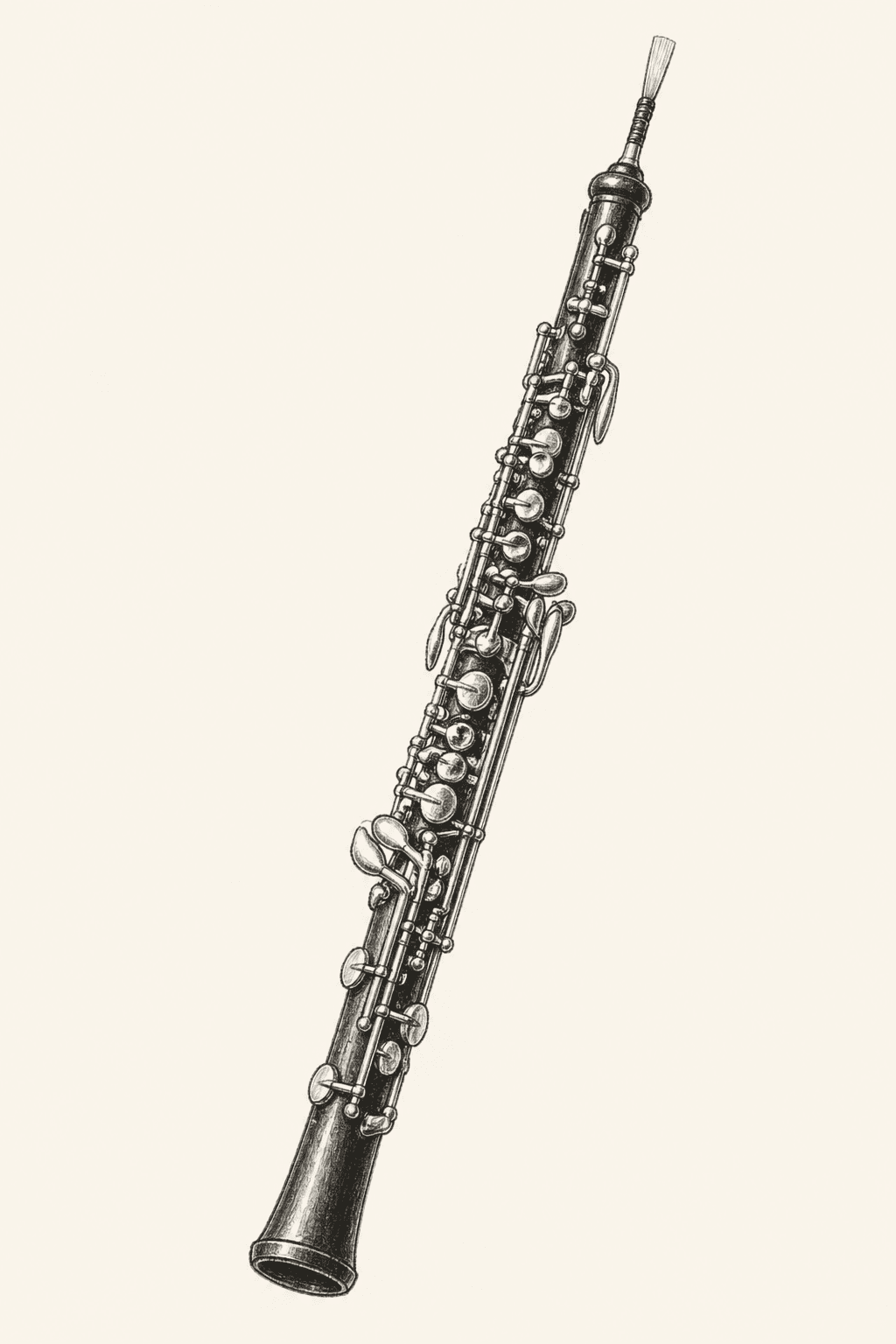
A straight conical bore of some two feet — the reed mounted on a slender metal staple, the bell flaring scarcely at all.
The oboe is the orchestra’s pure soprano of double reeds — a narrow conical pipe whose voice cuts through any texture by virtue of its very thinness. It does not rely on power; it relies on a particular, unmistakable colour. The audience hears it before it hears anything else.
That this is the note to which the orchestra tunes is no accident. The oboe holds its pitch with stubborn clarity, and its sound — slightly nasal, slightly reedy, slightly aching — penetrates the ensemble in a way that a flute or a clarinet does not. From A at four hundred and forty cycles, the rest of the room finds its bearings.
Mechanism
The instrument is built of three joints — top, lower, and bell — most often of grenadilla, sometimes of cocobolo or rosewood. The bore is conical and remarkably narrow: a little under four millimetres at the top, opening to scarcely sixteen at the bell. The reed, of two pieces of cane lashed to a metal staple, is fitted directly into the top joint.
The keywork is the conservatoire system as refined by the Triébert family in the nineteenth century and elaborated, with various national accents, ever since. Modern instruments differ in detail more than in substance — a thumb-plate here, a third octave key there — and for the composer the differences are negligible. Write what you hear, and the player will choose the fingering.
Voice and Character
Berlioz, who took the oboe seriously where others had merely taken it for granted, wrote that its voice expressed “candor, artless grace, soft joy, or the grief of a fragile being.” He was not flattering it. The oboe, used poorly, becomes querulous; used well, it is among the most affecting voices in the orchestra. There is no instrument better suited to the long, simple line.
Its register is small — barely two and a half octaves of useful range — but each region within that compass is distinct. The low is thick and a little gnarled; the middle is the singing place; the upper is bright and pinched, the place where the instrument most resembles a treble voice in distress. Composers from Bach to Britten have known this and rationed the highest notes accordingly.
“The oboe is an ill wind that nobody blows good.”
— old orchestral joke, repeated by every conductor
It is a sentimental instrument that resists sentimentality; an instrument of complaint that, used sparingly, becomes consolation. Few composers have wasted its solos. Do not be the first.
A straight conical bore of some two feet — the reed mounted on a slender metal staple, the bell flaring scarcely at all.
The oboe asks, above all, for melodies. It is the orchestra’s singer of single lines, and a few habits of mind will help the composer write for it as it deserves.
- i.Write a tune. The oboe rewards the long phrase and resents the busy one. Filigree belongs to the flute; conviction belongs here.
- ii.Watch the breath. The narrow bore consumes very little air. The player must often exhale stale breath before inhaling fresh — phrases far longer than the lungs can sustain.
- iii.Beware the bottom note. Low B♭ is loud, unsubtle, and slow to speak. Approach it from above or write a rest before it; never pianissimo.
- iv.Treat the high register as a privilege. From G₆ upwards the instrument grows pinched and effortful. Save these notes for moments the music has earned them.
- v.Mind the tuning A. The first oboe is, by tradition, the orchestra’s pitch reference. A first chair’s reed is a thing of considerable consequence.
And: spend an afternoon watching a good oboist make a reed. The instrument is, in the end, a wooden tube with a piece of cane on top — and the cane is most of the music.
The full compass
B♭₃ to A₆ — a little under three octaves.
The compass extends from a low B♭₃ — fixed by the conservatoire system — to roughly A₆ in skilled hands. The useful range is narrower still: most of what the orchestra asks of the oboe lies within two singing octaves.
Basso
Thick, reedy, a little intractable. The lowest fourth speaks loudly and resists pianissimo; useful for grotesque or rustic colour but rarely for the singing line.
Tenore
The singing middle. Warm, vocal, supremely flexible at any dynamic — the register of nearly every great oboe solo from Bach to the present.
Acuto
Brighter, clearer, faintly silvered. Carries effortlessly above an orchestral tutti; here the oboe most resembles a treble voice in its prime.
Sopracuto
Pinched, effortful, the territory of specialists. Above G₆ the notes thin to a whistle; reserve them for moments the music has earned.
A straight conical bore of some two feet — the reed mounted on a slender metal staple, the bell flaring scarcely at all.
The oboe’s expressive vocabulary turns, before anything else, on the reed. The narrowest bore in the orchestra and a small piece of hand-scraped cane between the player and the air — together they produce an instrument capable of remarkable subtlety in the singing line, and remarkable difficulty in nearly everything else. Most of what an oboist is asked to do is, in some way, a negotiation with the cane.
Standard techniques
Articulation on the oboe is, by long custom, almost entirely a matter of single tonguing — and a very fast single tongue at that. The orchestral oboist trains for years upon the assumption that no passage will be too quick for the syllable tu; the rapid figurations of the Rossini overtures, the staccati of Stravinsky, the perpetual motion of Ravel’s Tombeau all rest on this fluency. Double and triple tonguing were, until the late twentieth century, considered impossible; modern players have shown otherwise, but the technique remains the property of specialists, and its use should never be assumed.
Vibrato is the oboe’s defining colour and, like the reed, the player’s own. It is produced in the diaphragm rather than the throat, and is by orchestral convention almost continuous in sustained writing — though the breadth and speed are matters of taste, school, and instrument. Slurring across the registers, particularly across the break between C₅ and D₅, is the oboist’s long apprenticeship; composers should write the line they wish to hear and trust the player to find the fingering that sustains it. Breath, on the oboe, is its own peculiar science: the narrow bore consumes very little air, and the player frequently spends a phrase exhaling stale breath rather than running short. Build pauses for fresh air, not for relief.
Extended techniques
Circular breathing belongs to the oboe more naturally than to any other woodwind, and Heinz Holliger has spent half a century demonstrating the fact. Long phrases of theoretically unlimited duration — once a cabinet of curiosities — have entered the contemporary repertoire by his example, and a working oboist of the twenty-first century is increasingly expected to manage them. Multiphonics, produced by partial fingerings and a carefully divided embouchure, are abundant on the oboe and have been catalogued in considerable detail since Bartolozzi’s manuals of the nineteen-sixties; they range from rough, two-pitch buzzes to surprisingly stable chords of three or four notes.
Microtones — quarter-tones and finer — are within reach through altered fingerings and embouchure adjustment, the latter also responsible for the small expressive glissandi that good players can shape across a tone or so. True sweeping glissandi, of the sort one hears on the clarinet, are not idiomatic. Harmonics, overblown from low fingerings, produce thinner and more glassy versions of the natural notes; modern composers have used them sparingly and to telling effect.
Less common, and more recent, are flutter-tongue — possible but coloured by the reed in a manner some players find awkward — and the oboe’s various forms of growl, in which the instrument is voiced simultaneously with a hum or a sung pitch. Key clicks exist but rarely carry; the oboe, unlike the flute, is not naturally a percussive instrument. Of all its modern techniques, the oldest — vibrato, the long-breathed line, the carefully shaped tone — remain the most expressive, and the most readily recognisable as the oboe.
A straight conical bore of some two feet — the reed mounted on a slender metal staple, the bell flaring scarcely at all.
A short, partial list — five places to begin if one wishes to know what the oboe can do, and what it has been asked to do by composers who understood it.
- № 01
Tchaikovsky — Symphony No. 4
Andantino in modo di canzona
The oboe alone, over pizzicato strings — a melody of such plain candor it seems remembered rather than composed.
Listen on Spotify - № 02
Brahms — Violin Concerto, Op. 77
Adagio
A long-breathed solo of such tenderness that Sarasate is said to have refused to play the concerto, declining to stand silent while the oboe took the best tune.
Listen on Spotify - № 03
Strauss — Oboe Concerto in D
Allegro moderato
Written at eighty-one, after the war — an unbroken garland of a phrase that asks of the player a near-impossible breath.
Listen on Spotify - № 04
Ravel — Le Tombeau de Couperin
Prélude
A perpetual motion in semiquavers, given almost entirely to the oboe — gracious, unhurried, faintly archaic.
Listen on Spotify - № 05
Rossini — La scala di seta
Overture
The little staircase: a chattering, scampering oboe figure that has terrified second auditioners ever since.
Listen on Spotify
Further entries will be added as our study deepens.
A straight conical bore of some two feet — the reed mounted on a slender metal staple, the bell flaring scarcely at all.
The oboe is a French invention of the seventeenth century. Around 1657, in the court of Louis XIV, the wind makers Jean Hotteterre and Michel Philidor took the older shawm — loud, raucous, fit chiefly for the open air — and rebuilt it for the room. They narrowed the bore, softened the reed, divided the body into joints, and added keys. The result was an instrument that could play, for the first time, beside strings without obliterating them.
The Baroque
The new hautbois spread quickly. By the end of the seventeenth century it was a settled member of the orchestra; by the first decades of the eighteenth it was indispensable. Bach wrote for it incessantly — in the cantatas, the Passions, the orchestral suites — and Handel gave it solos of an aria-like dignity. The Baroque instrument had two or three keys, a wider reed, and a tone closer to the shawm than to anything we know today: pungent, vocal, faintly outdoor.
Classical refinement
Through the second half of the eighteenth century the oboe was progressively narrowed, lengthened, and fitted with additional keys. Mozart wrote a concerto for it in 1777 that defined what the classical instrument could be asked to do; Haydn used it as a soloist in symphony after symphony. By 1800 the oboe could pass for a soprano in a Mozart aria — but its colour was still distinct, still a little plaintive, and the great composers wrote with that quality in mind.
Triébert and the conservatoire
The decisive step into the modern instrument was taken in mid-nineteenth century Paris by the Triébert family. Guillaume and his sons Charles and Frédéric, working in conversation with the Paris Conservatoire, rebuilt the keywork on a logical basis — the so-called système 6 bis — and refined the bore for evenness across registers. By the 1880s the French oboe had become, in essentials, the instrument played everywhere. The German tradition kept its own slightly wider model into the early twentieth century, but the conservatoire pattern eventually won the field.
The modern instrument
The oboe a player picks up today is recognisably the Triébert design — further refined by Lorée in Paris and by makers in Germany, Britain, and the United States. Strauss wrote his concerto for it in 1945; Britten his metamorphoses; Carter, Berio, and Henze the modern repertoire. It is, by the standards of orchestral instruments, an unusually settled craft — and the reed remains, as ever, the player’s own private burden.
Specifications
A summary, for the composer’s desk.
- Family
- Woodwind, double reed
- Italian
- Oboe
- German
- Oboe (formerly Hoboe)
- French
- Hautbois
- Range
- B♭₃ — A₆
- Transposition
- Non-transposing; treble clef
- Length
- Approx. 65 cm (25½″)
- Bore
- Conical, of grenadilla or cocobolo
- Reed
- Double, of Arundo donax, hand-scraped
- Origin
- France, mid-17th century