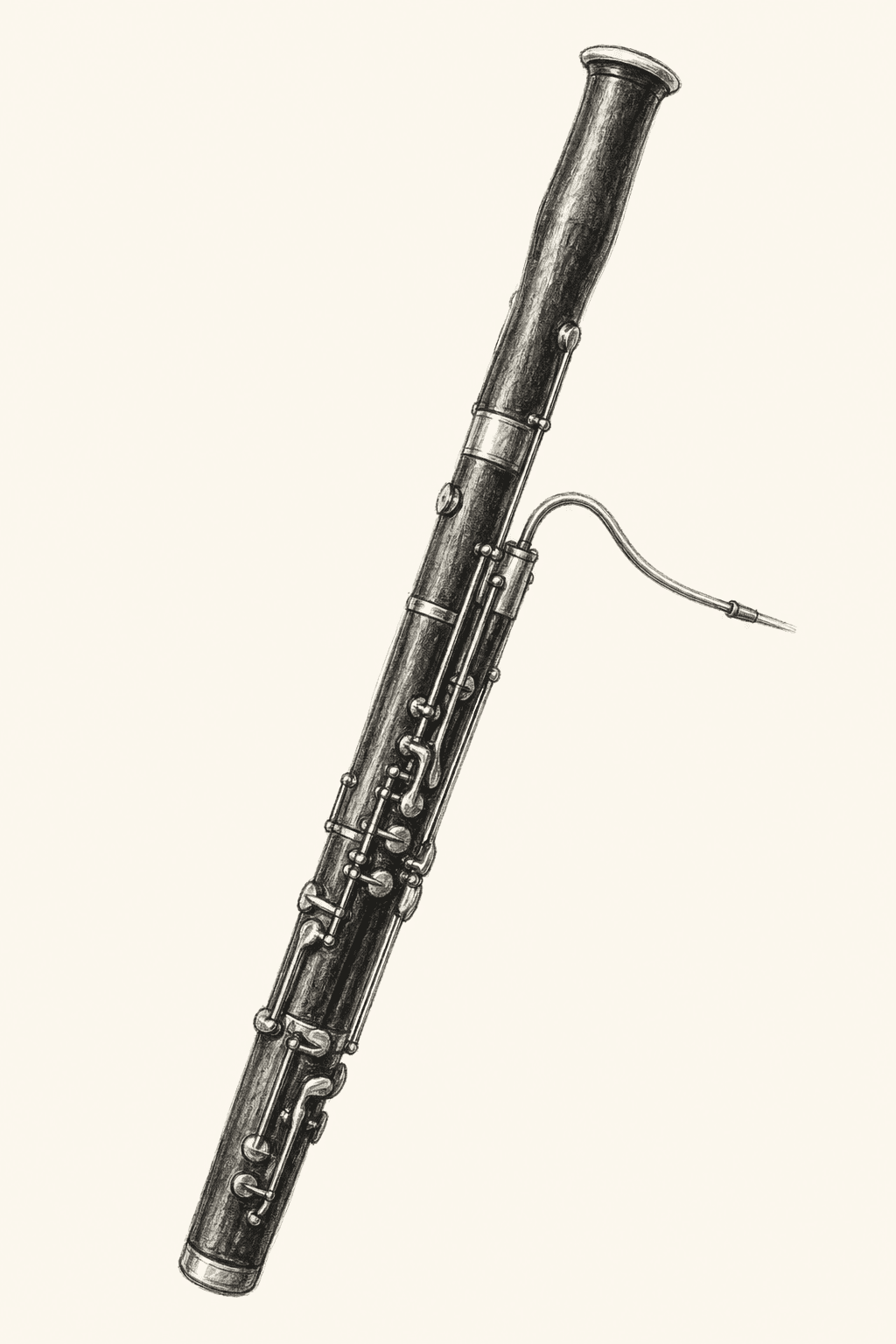
The instrument is, in effect, a folded conical tube of some eight feet — its weight borne on a sling at the player’s neck.
Of all the woodwinds, the bassoon is the most quietly idiosyncratic. Its conical bore is folded twice upon itself; its keywork sprawls across that folded length like ivy across an old wall; and its sound — produced by a small double reed barely larger than a thumbnail — is in turn grave, plaintive, ironic, even comical, depending entirely on the temperament of the writer who summons it.
It is an instrument that rewards patience. Its lowest octave speaks slowly and must not be hurried; its highest is delicate, almost vocal, and asks of the player a careful embouchure. Between the two lies the singing tenor — the register of Stravinsky’s opening Rite, of Tchaikovsky’s Pathétique, of Mozart’s tender concerto. To know the bassoon is to know these three rooms and the doors between them.
Mechanism
The bassoon is built of four principal joints — boot, wing, long, and bell — most often of seasoned mountain maple, stained a deep red-brown. Air enters through a slender curved metal tube, the bocal, upon which the reed is mounted. From there it travels down the wing joint, makes its U-turn at the boot, and ascends through the long joint to the bell — a route of nearly eight feet folded into an instrument of four.
Two systems of keywork persist into the present day: the German, or Heckel, system — preferred almost universally outside France — and the French, or Buffet, system, lighter of tone and rarer in the modern orchestra. The differences are real, but for the composer they are mostly invisible. Write well for one and you write well for the other.
Voice and Character
Berlioz, who knew the orchestra as well as any composer ever has, thought the bassoon’s tone “not very strong, with little brilliance, and rather of a peculiar character.” He meant this as praise. The bassoon does not declaim. It confides. It can stand alongside the cellos and disappear into them, or it can stand entirely alone — as in the famous solo that opens The Rite of Spring, ascending out of silence like a thing waking up.
The instrument has, by long accident, also become the orchestra’s native comedian. Dukas wrote for it the most famous staccato in all of music — the bassoons of The Sorcerer’s Apprentice — and the rapid tongued figures of the low and middle registers will always carry, to the trained ear, a faint trace of mischief. Honor that history. Do not try to suppress it.
“The bassoon is the clown of the orchestra — but a clown who has read Montaigne, and is not above weeping.”
— attributed, perhaps unfairly, to a French conductor
The bassoon will outlast every fashion that has yet been imposed on it. Write for it without irony, or with all of it; either way, the instrument will know what to do.
The instrument is, in effect, a folded conical tube of some eight feet — its weight borne on a sling at the player’s neck.
The bassoon is forgiving of the patient composer and unsparing of the hurried one. A handful of habits, kept in mind, will save many later revisions.
- i.Give the player time. The reed responds in milliseconds, but the bore does not; the lowest octave wants air, and air takes breath.
- ii.Pair them in the low register. Two bassoons in thirds, low in the staff, will always sound older and graver than the sum of the two lines.
- iii.Trust the tenor, used sparingly. The tenor register marked dolce will draw an audience forward in their seats. Use the privilege carefully.
- iv.Choose the right clef. Bass clef as a rule; tenor clef when it spares the reader a thicket of ledger lines; and never treble.
- v.Mind the breath, and the silence after it. A bassoon line without a place to breathe is no line at all. Build the rests into the phrase, not around it.
Beyond these few rules, write with the player in mind. A bassoonist will tell you what is possible — and, more usefully, what is beautiful.
The full compass
B♭₁ to E♭₅ — three and a half octaves.
The compass extends from the low B♭₁ — a note added in the late eighteenth century, and the bass of every choir of woodwinds — to a high E♭₅ in skilled hands, and beyond on rare occasion. Three regions repay study.
Basso
Dark, cavernous, slow to speak. Magnificent for pedal tones; treacherous in rapid passagework. Often best heard, in the orchestra, doubled at the octave by the contrabassoon or low strings.
Tenore
The singing voice of the instrument. Here the bassoon most resembles a baritone, and here most great solos live. Direct, vocal, faintly grainy — supremely expressive at any dynamic.
Acuto
Pinched, vocal, faintly oboe-like. Use sparingly and always with knowledge of the player; the highest fifth requires devotion to write well.
Sopracuto
The extreme upper reach. Thin and often pinched, the territory of specialists; reserve it for moments the music has earned.
The instrument is, in effect, a folded conical tube of some eight feet — its weight borne on a sling at the player’s neck.
For so quietly idiosyncratic an instrument, the bassoon’s expressive vocabulary is unusually broad. The reed responds with a delicacy approaching the human voice; the long folded bore lends every articulation a faint resonance; and a careful player can summon, from the same nine keys, a staccato of comic precision and a legato of almost vocal warmth. What follows are the means by which that vocabulary is shaped.
Standard techniques
The bassoon is, by long habit, a single-tongued instrument. Dukas’s scampering brooms in L’apprenti sorcier — the famous staccato that every bassoonist measures himself against — were written for a single tongue, and the agility of the modern player in this articulation is remarkable. Double and triple tonguing are possible in skilled hands and have entered the repertoire of soloists and contemporary players, but a composer cannot assume them; ask, and write the alternatives if uncertain.
Legato slurring is the instrument’s native mode of song — the Mozart concerto’s Andante is, in essence, an extended exercise in it — and the bassoon will sustain a long phrase, dolce, with a directness no other low woodwind can quite match. Vibrato is used moderately and according to taste; the player shapes it with the embouchure rather than the diaphragm. Dynamic range is wide, but the lowest octave demands a great deal of air, and the highest register must be coaxed at any dynamic short of forte. Build the breath into the phrase, not around it.
Extended techniques
Flutter-tongue (Flatterzunge) is effective across most of the compass and has been used by Strauss, Mahler, and many since; it works best in the tenor and acuto registers, where the reed flutters readily. Multiphonics — two or more pitches sounded together by particular fingerings and embouchure pressure — are a substantial part of the modern bassoon’s contemporary voice, and Berio’s Sequenza XII remains the locus classicus of their study. Each multiphonic has its own colour and its own difficulty; consult a fingering chart, and the player.
Microtones — quartertones and finer divisions — are available throughout the range by alternate fingerings and embouchure adjustment, though intonation grows uncertain at the extremes. Glissando is severely limited by the keywork: a true glissando is impossible, but smeared chromatic passages and embouchure bends give a partial effect. Slap tongue, key clicks, and breathy tones are all in the contemporary toolbox, though less idiomatic than on the clarinets. As ever, the safest course is to consult the player before committing the page to print.
The bassoon will respond to almost anything asked of it gracefully; it will respond to nothing asked of it carelessly. The composer who treats it as a singer first and an effects machine second will find it the most generous of collaborators.
The instrument is, in effect, a folded conical tube of some eight feet — its weight borne on a sling at the player’s neck.
A short, partial list — five places to begin if one wishes to know what the bassoon can do, and what it has been asked to do by composers who loved it.
- № 01
Stravinsky — Le Sacre du printemps
Opening solo
A high C in the acuto, ascending out of silence — perhaps the most famous notes the bassoon will ever play.
Listen on Spotify - № 02
Mozart — Concerto in B♭, K. 191
Andante ma adagio
The instrument as singer. Mozart wrote it at eighteen and never improved upon it.
Listen on Spotify - № 03
Tchaikovsky — Symphony No. 6, Pathétique
First movement, opening
A low solo, marked pppppp, that seems to begin before the music does.
Listen on Spotify - № 04
Dukas — L’apprenti sorcier
Theme
The most famous staccato in the repertoire — three bassoons, lightly malevolent.
Listen on Spotify - № 05
Stravinsky — The Firebird
Berceuse
A study in the tenor register, low and lulling, against muted strings.
Listen on Spotify
Further entries will be added as our study deepens.
The instrument is, in effect, a folded conical tube of some eight feet — its weight borne on a sling at the player’s neck.
The bassoon traces its descent to the dulcian — a single piece of folded wood that, in the late sixteenth century, gave the Renaissance wind band a voice in the bass. Italian makers of the early seventeenth century split the dulcian’s folded bore into separate joints, fitted them with keys, and so produced the instrument that could, for the first time, reasonably be carried — and reasonably be played in tune.
The Baroque
By the early eighteenth century the bassoon had three or four keys and was a settled member of the orchestra. Vivaldi composed thirty-seven concertos for it. Bach used it sparingly, but tellingly, in the Passions; Handel gave it elegant continuo lines. The instrument of this period was lighter, narrower in bore, and a little reedier than what we know today — closer in spirit to its Renaissance ancestor than to the modern Heckel.
Mozart and the singing voice
Mozart’s concerto in B♭ major, K. 191, written when he was eighteen, is the moment at which the bassoon was first asked to sing like a human voice — and consented. The Andante is, by quiet consensus, among the most beautiful slow movements in the wind repertoire. Every bassoonist plays it. Every bassoonist remembers playing it.
Heckel and Buffet
The nineteenth century brought two divergent answers to the question of how the bassoon should be built. In Germany, Carl Almenräder and the Heckel family of Biebrich rebuilt the instrument from the bore outward — wider, darker, more even from one register to the next. In France, the firm of Buffet refined the older system, preserving its lighter, more reedy tone. By the close of the century the Heckel system had spread almost everywhere outside France; the French held out the longest, and to a small extent still do.
The modern instrument
The modern bassoon is, in essence, the design that Wilhelm Heckel and his son Wilhelm Hermann had codified by the early twentieth century. Subsequent decades have refined the keywork and the materials, but the instrument a player picks up today is recognisably the one Stravinsky wrote for in Le Sacre, the one Mahler wrote for in his symphonies, the one Strauss orchestrated with such love. It is, by the standards of orchestral instruments, a quietly settled craft.
Specifications
A summary, for the composer’s desk.
- Family
- Woodwind, double reed
- Italian
- Fagotto
- German
- Fagott
- French
- Basson
- Range
- B♭₁ — E♭₅
- Transposition
- Non-transposing; bass & tenor clefs
- Length unfolded
- Approx. 2.55 m (8′ 4″)
- Reed
- Double, of Arundo donax
- Origin
- Italy, late 16th century